 Bellingham Exterior
 Roof decisions are hard to get right from the ground. Shingles that look fine from the driveway can be failing underneath, and a roof that seems rough up close might have another five good years in it. In Bellingham, where driving rain off Bellingham Bay, salt-laden air, and long stretches of shaded, moss-friendly weather all work against a roof at once, the guesswork gets even harder. This guide walks through the real signals that tell you whether it's time to repair, patch, or replace, so you can make the call with facts instead of anxiety.
Why Roofs Age Faster Here Than the National Average Suggests
Most asphalt shingle warranties are written around a national average climate — moderate rain, moderate sun, moderate everything. Whatcom County doesn't offer moderate. We get roughly 35 rainy days more per year than the U.S. average, persistent marine humidity, and enough tree cover in many neighborhoods to keep roofs shaded and damp long after a storm passes. Add proximity to salt water along the bay, and you've got a combination that accelerates granule loss, moss colonization, and fastener corrosion faster than the shingle manufacturer's lab testing ever accounted for.
That doesn't mean every roof here fails early. A well-ventilated, well-installed roof can still hit or exceed its rated lifespan. But it does mean a 25-year shingle in Bellingham should be inspected on a tighter schedule than the same shingle in Denver, and that "the warranty says 25 years" isn't a substitute for actually looking at the roof.
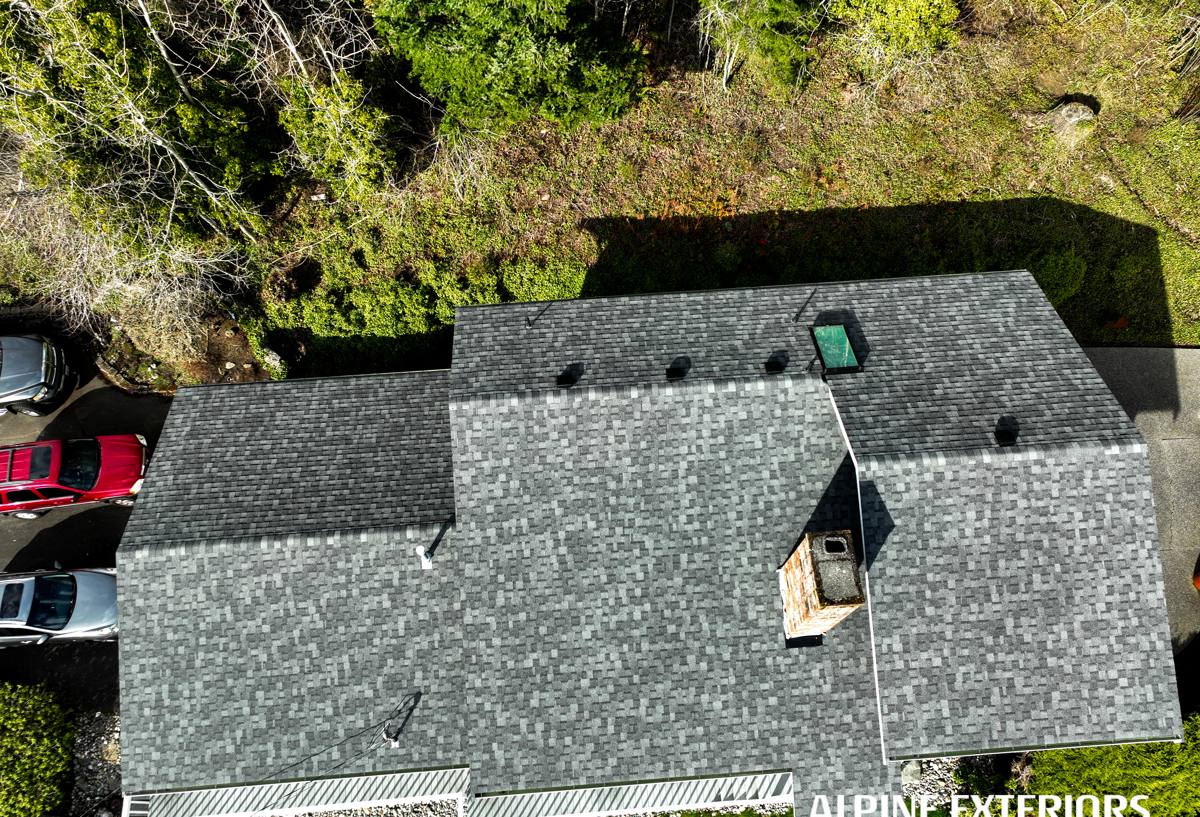
Age: The First Filter, Not the Final Answer
Roofing material has a rough age bracket where replacement becomes the more sensible conversation than repair. Age alone doesn't condemn a roof, but it tells you how much benefit-of-the-doubt to extend when you find a problem.
| Roofing Material | Typical Lifespan (National) | Realistic Range in Whatcom County Conditions |
|---|---|---|
| 3-tab asphalt shingle | 15-20 years | 12-18 years |
| Architectural (dimensional) asphalt shingle | 25-30 years | 20-28 years |
| Wood shake or shingle | 25-30 years | 15-25 years, heavily dependent on moss control and airflow |
| Metal (standing seam or panel) | 40-60 years | 40-60 years, minimal climate penalty |
| Composite/synthetic slate or shake | 40-50 years | 35-50 years |
If your roof is within a few years of the low end of its range and you're starting to see wear, that's the point to get serious about a professional inspection rather than another round of spot repairs.
The Visible Signs Worth Walking Your Property For
From the Ground
- Shingles that look curled at the edges, cupped in the middle, or visibly darker in patches (granule loss showing the asphalt mat underneath)
- Bald or shiny spots where granules have washed away, especially at roof edges and valleys where water concentrates
- Moss or algae streaking, particularly on north-facing slopes or under tree cover — common throughout Bellingham's shaded lots
- Sagging rooflines, especially along ridges or between rafters, which can indicate structural moisture damage
- Missing shingles or exposed underlayment after a windstorm
Inside the Attic
- Daylight visible through the roof deck
- Water stains or dark trails on rafters and sheathing
- Damp or matted insulation, which often points to a slow leak rather than a single storm event
- Musty smell or visible mold on the underside of the deck
An attic check takes ten minutes with a flashlight and tells you more about roof health than staring at shingles from the yard ever will. If you're not comfortable getting up there yourself, it's worth asking a contractor to include it in an inspection.
Moss: Bellingham's Signature Roofing Problem
Moss deserves its own section because it's the single most common reason we get called out to look at roofs that are otherwise not that old. Whatcom County's combination of shade, humidity, and mild temperatures is close to ideal moss habitat, and moss doesn't just sit on top of a roof looking rustic — it actively works against the shingle.
Moss holds moisture against the shingle surface long after the rest of the roof has dried, which accelerates granule loss and, over years, can lift shingle edges as rhizoids work into seams. On wood shake roofs it's worse: trapped moisture under moss is one of the fastest ways to rot shake in place. A moss-covered roof isn't automatically a roof that needs replacing, but it is a roof that needs a maintenance plan — periodic gentle cleaning, zinc or copper strips at the ridge, and honest tracking of how fast it comes back after each cleaning. If moss keeps returning within a season or two despite treatment, that's often a sign the roof has lost enough of its protective surface that replacement is the more cost-effective path than repeated cleanings.
Leaks: Not All Leaks Mean "Replace the Whole Roof"
A leak is alarming, but it's not automatically a death sentence for the roof. The real question is whether the leak is a localized, fixable failure (a cracked boot around a vent pipe, a flashing gap at a chimney, a few damaged shingles after a windstorm) or a symptom of the whole roofing system reaching the end of its service life.
Signs that point toward "this is systemic, not isolated":
- Leaks appearing in multiple, unrelated locations rather than one consistent spot
- A leak that keeps reappearing in the same place after repeated patch repairs
- Leaks combined with visible granule loss and an aging roof (see the age table above)
- Water intrusion at valleys or low-slope sections where flashing and underlayment quality matter more than shingle quality
A single leak on a 10-year-old roof is almost always worth repairing. A recurring leak on a 22-year-old architectural shingle roof is usually the roof telling you it's done, and further patching is money spent delaying an inevitable decision.
Repair vs. Replace: How to Actually Decide
The honest framework most roofers use, whether they say it out loud or not, comes down to three questions:
- How much of the roof is affected? Damage concentrated in one section (one slope, one valley, storm damage in a defined area) usually favors repair. Wear spread evenly across the whole roof favors replacement.
- What's the remaining life of the material? Repairing a roof that has 8-10 years of useful life left makes sense. Repairing a roof that's already past the realistic lifespan for our climate (see the table above) usually just delays a replacement you'll pay for anyway, plus the cost of the repair.
- What will the repair cost relative to replacement? As a rough rule of thumb, if a repair or series of repairs is approaching 30-40% of what full replacement would cost, replacement is usually the better long-term value — you're not paying twice.
There's no shame in repairing a roof multiple times over its life. The problem is repairing a roof past the point where the underlying material can actually hold up its end of the deal.
What a Legitimate Roof Inspection Should Cover
Not every inspection is equal. A quick look from the ground with a pair of binoculars is not the same as a real inspection. Before you accept a "yes, you need a new roof" or "no, you're fine" verdict, make sure the inspection included:
- Physical access to the roof surface (not just a ground or drone-only look)
- Attic inspection for moisture, staining, and ventilation issues
- Assessment of flashing at every penetration — chimneys, vents, skylights, valleys
- A moss and algae assessment, including how much has worked under shingle edges
- Photos documenting specific problem areas, not just a verbal summary
- A written estimate that separates repair options from replacement options, with reasoning for each
Choosing a Roofing Contractor in Bellingham
Roofing is one of the trades most prone to storm-chasing outfits — crews that show up after a windstorm, knock on doors, and disappear before warranty issues surface. A few basics protect you regardless of who you hire:
- Confirm active Washington state contractor licensing and current liability insurance — ask for the license number and verify it independently rather than taking a business card at face value
- Get a written scope of work, not just a price — what's being removed, what underlayment and flashing are being used, how ventilation is handled
- Ask how they handle decking replacement if rot is found once the old roof comes off, and how that's priced
- Get local references you can actually call, ideally from jobs done more than a year ago so you can ask how the roof has held up through a wet season
- Be wary of full payment demanded upfront before any work begins
How Roofing and Siding Decisions Connect
Roofs don't fail in isolation. Water that gets past a compromised roofline often shows up next in the siding and trim below it — soaked sheathing, staining under eaves, or accelerated rot at the point where roof and wall meet. When we're called out to look at a roof, we're also looking at what's happening at the transitions: kick-out flashing at roof-to-wall intersections, the condition of fascia and soffit, and whether the siding system below is holding up its end of the moisture-management job. This is part of why we standardized on James Hardie fiber cement siding for the homes we work on — it's a non-combustible product engineered for wet Pacific Northwest conditions, with factory-applied ColorPlus finish that holds up under UV and salt air without the swelling or repainting cycle that wood-based sidings need. A roof replacement is a reasonable moment to have that conversation, even if siding isn't the reason you called.
Getting a Straight Answer
If you're staring at a roof that's showing some wear and you're not sure whether it's a repair-this-season problem or a replace-it-now problem, an in-person look is worth more than any article, including this one. We're happy to come out, get on the roof, check the attic, and give you a straight answer with the reasoning behind it — including telling you when a roof doesn't need replacing yet. If you'd like a free, no-pressure estimate, the form below gets you on the schedule.