 Bellingham Exterior
 Bellingham's Climate Is Harder on Siding Than Most Homeowners Realize
Whatcom County doesn't get hurricanes or extreme heat, and that lulls people into thinking siding here has it easy. It doesn't. Bellingham sits between salt water and mountains, which means siding takes a steady, low-grade beating year-round: salt-laden air drifting off Bellingham Bay and the Sound, long stretches of driving rain pushed sideways by wind off the water, and a moss and algae season that can run eight or nine months in shaded, north-facing exposures. None of that is dramatic. All of it is cumulative, and cumulative is what wears out a wall system over fifteen or twenty years.
That's the lens we use when we talk to homeowners about siding material. We're not selling a look — we're selling something that has to survive a specific climate without babysitting. After years of installing multiple product lines, we made the call to install James Hardie fiber cement exclusively. This page explains the reasoning, not just the marketing.
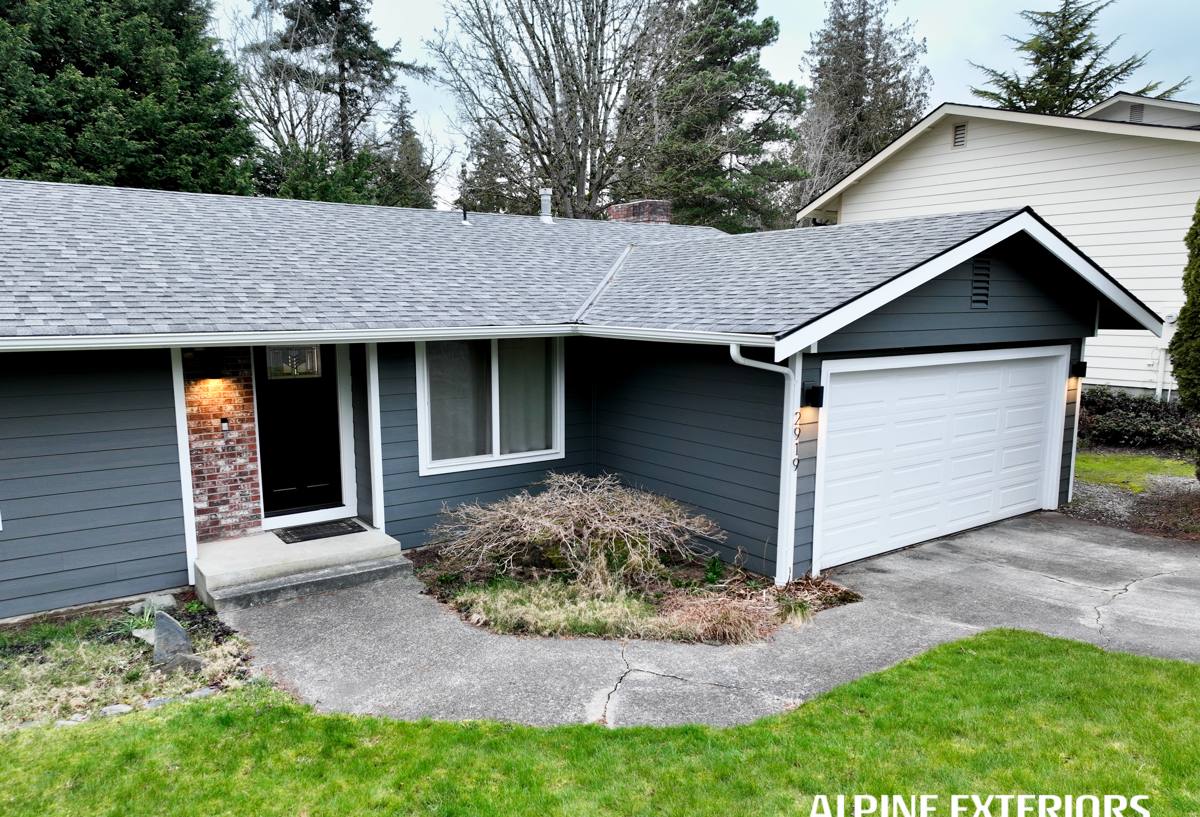
What James Hardie Fiber Cement Actually Is
James Hardie siding is fiber cement — a mix of Portland cement, sand, and cellulose fiber, cured under pressurized steam (an autoclave process) into rigid boards. It's not a plastic product like vinyl, and it's not a wood composite like LP SmartSide. That distinction matters because it determines how the material behaves when it gets wet, when it sits in salt air, and when it's exposed to direct flame or radiant heat from a nearby structure fire or brush fire.
Why the Composition Matters Here
Fiber cement doesn't feed mold or rot the way wood-based products can if moisture gets behind them. It doesn't warp, crack, or go brittle in cold snaps the way vinyl can. And because it's essentially a cement product, it holds its shape and doesn't expand and contract with humidity swings the way organic materials do — which matters in a county that goes from soaked winters to dry summer stretches.
Engineered for Specific Climates: The HZ System
James Hardie doesn't make one generic product for the whole country. Their HZ5 line is engineered specifically for climates like ours — the Pacific Northwest's wet-cold-cycle exposure — with formulations tuned to resist moisture intrusion and freeze-thaw stress better than a one-size-fits-all product. That's a meaningful difference from products that are formulated the same whether they're installed in Arizona or Whatcom County.
We only order HZ5-rated Hardie product for jobs in Bellingham and the surrounding areas. It's a small line item on paper and a real difference over a couple of decades of Pacific Northwest weather.
ColorPlus Technology: Why the Finish Matters as Much as the Board
A lot of siding failure isn't the substrate failing — it's the paint failing first, and then the substrate paying for it. James Hardie's ColorPlus finish is a factory-applied, baked-on finish system applied in a controlled environment, not a jobsite paint job at the mercy of weather and temperature. It's backed by its own finish warranty, separate from the product warranty, and it's formulated to resist fading from UV and to shed moisture rather than let it track down through nicks in a field-applied coat.
Why This Beats Site-Painting
Paint applied on a ladder in variable Bellingham weather never cures as evenly as paint applied in a factory line at controlled temperature and humidity. That unevenness is where early chalking, fading, and peeling start — usually first on the south and west elevations that take the most sun and wind-driven rain. ColorPlus removes that variable entirely.
The Product Lines We Install
"James Hardie siding" isn't one product — it's a system, and we spec different pieces for different parts of the house.
- HardiePlank lap siding — the primary wall product, available in multiple exposure widths and textures (smooth, cedarmill)
- HardiePanel vertical siding — used for board-and-batten looks and accent sections
- HardieShingle siding — for staggered or straight-edge shingle-style accents, common on Bellingham craftsman and cottage-style homes
- HardieTrim boards — matched trim system so the trim ages and weathers at the same rate as the field siding
- HardieSoffit panels — vented and non-vented options for eaves, which matters for attic moisture control in our climate
Using the full matched system — not just the lap siding with off-brand trim — is part of what keeps a wall assembly performing as a system instead of a collection of parts aging at different rates.
The Warranty, and Why It's Structured the Way It Is
James Hardie backs its siding with a limited transferable warranty — meaning if the home sells within the coverage period, the new owner inherits the remaining protection. That transferability is a real selling point in a market like Bellingham's, where buyers and their inspectors increasingly ask directly about siding material and warranty status. ColorPlus finishes carry their own separate finish warranty covering fade and chip performance.
We tell every homeowner the same thing: a warranty is only as good as the installation behind it. Hardie's warranty terms assume installation to their published specifications — clearances, fastener patterns, flashing details. That's the next section, and it's the one most siding failures actually trace back to, regardless of brand.
Why Installation Quality Determines Everything
We'd rather be blunt about this: most siding problems we get called out to inspect on other contractors' work aren't material defects. They're installation shortcuts. Fiber cement is unforgiving of certain mistakes in a way that's worse in a wet climate like ours.
Ground and Roof Clearance
Hardie specifies minimum clearances from grade, decks, and roof lines — typically several inches — to keep the bottom edge of the siding from sitting in splash-back moisture or snow load against the house. In Bellingham's rain volume, skipping this clearance is one of the fastest ways to trap moisture at the bottom course.
Fastening Pattern
Fiber cement needs to be fastened into studs at the correct spacing with the correct fastener type and depth — not overdriven, not underdriven. Overdriven fasteners crack the board's fiber matrix at the fastening point and create a moisture entry path that isn't visible until the damage is already done.
Joint Flashing and Caulking
Butt joints between boards need to be flashed or properly caulked with a product compatible with the ColorPlus finish — not just any exterior caulk. Skipped or wrong-product caulking at joints is the single most common failure point we find on Hardie siding installed by crews rushing the job.
Rainscreen and Drainage Plane
Behind the siding, a proper water-resistive barrier and drainage gap give any moisture that does get past the cladding a way to drain and dry out rather than sit against the sheathing. This detail matters everywhere, but it matters more in a county that gets the rain totals Whatcom does.
Cost Factors Homeowners Should Actually Weigh
| Factor | Why It Affects Price | Long-Term Effect |
|---|---|---|
| Product line (plank vs. shingle vs. panel) | Shingle and vertical panel styles take more labor per square foot | Minimal difference in service life if installed correctly |
| ColorPlus vs. primed-for-paint | Factory finish costs more upfront than primed board | Substantially delays repainting cycles, often 15+ years |
| Tear-off vs. overlay of existing siding | Full tear-off costs more in labor and disposal | Lets us fix hidden moisture damage and install a proper drainage plane |
| Trim and soffit matching | Full matched system costs more than mixing in off-brand trim | Keeps the whole assembly aging and weathering evenly |
| Installer experience with fiber cement | Doesn't show up as a separate line item | Determines whether the warranty actually holds up over time |
What Ongoing Maintenance Actually Looks Like
Fiber cement is genuinely low-maintenance compared to wood, but "low-maintenance" isn't "no-maintenance," especially with Bellingham's moss and algae season.
- Rinse siding annually with a garden hose and soft brush — avoid pressure washers, which can force water behind joints and under the finish
- Check and clear moss or algae growth on shaded, north-facing walls before it establishes a foothold in the finish texture
- Inspect caulk lines at joints, window and door trim, and penetrations every year or two, and re-caulk with a compatible product if it's cracking or pulling away
- Keep gutters clear and downspouts directed away from the wall so splash-back doesn't concentrate at the bottom courses
- Trim back vegetation and irrigation spray that keeps a section of wall damp longer than the rest of the house
Why We Made This Our Standard
We didn't arrive at "James Hardie only" from a sales pitch — we arrived at it from watching which siding held up in Whatcom County conditions over a full ownership cycle and which required more homeowner intervention than it should have. Fiber cement, engineered for our climate zone, finished at the factory rather than in the field, backed by a transferable warranty, and installed to spec, gives homeowners the fewest surprises over the longest stretch of time. That's the whole case. It's not the flashiest pitch, but it's the honest one.
If you're planning a siding project in Bellingham or anywhere in Whatcom County, we're happy to walk your home, look at your specific exposure and conditions, and put together a free, no-pressure estimate using the form below.