 Bellingham Exterior
 Allura Is a Real Fiber Cement Product — Let's Start There
We want to be upfront about something: Allura fiber cement is not a junk product. It's manufactured from the same core recipe as every reputable fiber cement siding on the market — Portland cement, cellulose fiber, and sand, cured into a plank that resists fire, rot, and pests far better than wood or vinyl. It carries a noncombustible fire rating, it holds paint and factory finish reasonably well, and plenty of homes around the country wear it without incident. If a homeowner in Bellingham already has Allura on their house and wants a repair or a partial re-side matched to it, that's a different conversation than what this page is about.
This page is about why, when we're the ones speccing the job from scratch, we don't put Allura on the wall. It's not because the product is defective. It's because after years of installing and standing behind fiber cement siding in Whatcom County's specific climate, we settled on one manufacturer whose engineering, finish system, and long-term support track record we trust enough to put our own warranty behind — and Allura isn't it.
What Siding Actually Has to Survive Here
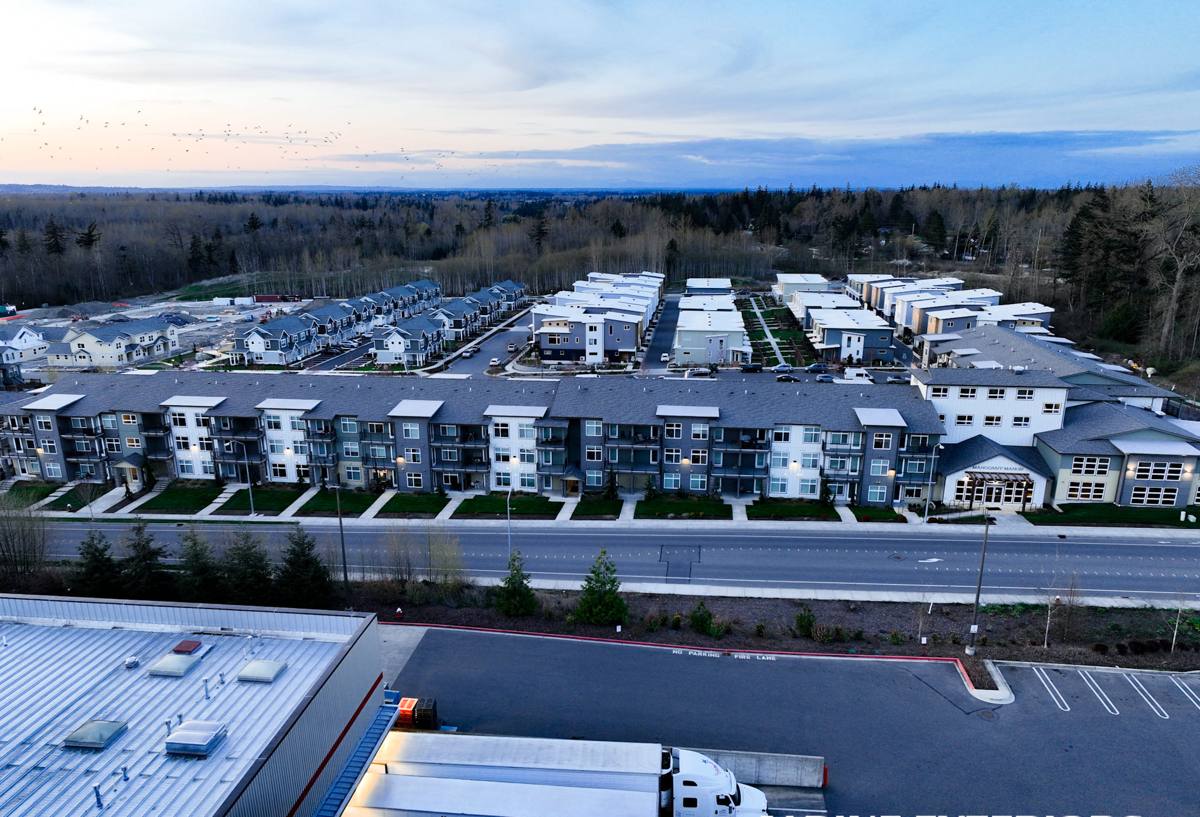
Bellingham sits on Bellingham Bay, which means salt-laden air moves through the marine layer and settles on every exterior surface in town, not just the waterfront homes. Add Whatcom County's long wet season — driving rain off the Strait, months of overcast humidity, and a moss season that can run from October well into spring on north-facing walls and shaded lots — and you get a climate that's genuinely harder on siding than most of the country realizes. Fiber cement handles this environment better than wood or OSB-based products because it doesn't swell, rot, or feed moss the way organic materials do. But "fiber cement" as a category covers a wide range of manufacturing quality, factory finishing, and product engineering, and those differences show up over a 10-, 20-, and 30-year timeline — not in the first two years.
Where Allura and Hardie Actually Diverge
On a spec sheet, Allura and James Hardie look close. Both are noncombustible fiber cement. Both offer lap siding, panels, and trim. Both offer a factory-applied finish option instead of field painting. The differences that matter show up once you get past the marketing page and into how each company engineers for specific climates, how deep their finish warranty and color-match support goes, and how present they are in the Pacific Northwest market specifically.
| Factor | Allura Fiber Cement | James Hardie |
|---|---|---|
| Climate-specific engineering | General product line, not zone-differentiated for regional moisture profiles | HardieZone system — HZ5 product formulated specifically for wetter, colder climates like ours |
| Factory finish | ColorMax prefinish, limited regional track record we can personally verify | ColorPlus finish, widely installed in Whatcom County with years of visible in-field performance |
| Trim and accessory matching | Narrower matched trim and accessory lineup | Full engineered trim, soffit, and batten system designed to move and seal as one assembly |
| Regional distribution and support | Thinner distributor and installer network in Western Washington | Established regional supply chain and contractor training presence in the PNW |
| Fire rating | Noncombustible / Class 1(A) | Noncombustible / Class 1(A) |
Notice what's not in that table: durability claims we can't verify, or suggestions that Allura fails where Hardie succeeds. Both materials are sound. The gap is in regional engineering, finish depth, and support infrastructure — the stuff that determines how a siding job looks and performs in year fifteen, not year one.
Why "Zone-Engineered" Isn't Just a Marketing Term
James Hardie sells different formulations for different climate zones — a hot, dry HZ10 product is not the same recipe as an HZ5 product built for high-moisture, freeze-prone regions like ours. That distinction exists because fiber cement's dimensional stability and moisture absorption characteristics genuinely change with formulation. Allura does not offer the same zone-specific tiering. That doesn't mean their standard product can't hold up here — it means we can't point to a version of it that was formulated with Whatcom County's rain and moss season specifically in mind, the way we can with Hardie's HZ5 line.
The Finish System Is Where Fiber Cement Actually Fails or Succeeds
Almost nobody's fiber cement siding fails from the substrate cracking or rotting. When fiber cement siding looks bad after ten years, it's almost always the finish — fading, chalking, or a paint film that couldn't handle repeated wet-dry cycling and started peeling at the laps. That's why we care more about the factory finish system than almost anything else on the spec sheet.
Hardie's ColorPlus finish is baked on in a controlled factory environment, cured harder than a field-applied coat, and backed by a finish-specific warranty separate from the substrate warranty. We've been installing it around Bellingham long enough to have seen it hold color and adhesion through repeated Pacific Northwest wet seasons. Allura's ColorMax finish is engineered on the same general principle — factory-applied, baked-on color — but we don't have the same volume of long-term, local, in-field examples to point a homeowner to. When we're the one signing off on a 30-year siding decision for someone's house, "the process sounds similar" isn't the bar we hold ourselves to.
Trim, Soffit, and the "Whole Assembly" Problem
Siding doesn't fail as a single flat plank — it fails at transitions: where lap siding meets trim, where trim meets a window, where a soffit meets a fascia board. Those joints are where moisture gets a foothold, and they're the first place driving rain finds a way in during a Whatcom County storm. Hardie engineers its lap siding, panels, trim boards, soffit, and battens as one coordinated system, with installation specs written to keep those joints tight and moving together. Allura's trim and accessory lineup is narrower, which in practice means more instances where an installer has to improvise a transition detail instead of using a manufacturer-engineered part built for that exact joint. Fewer improvised details means fewer places for water to find a way in ten years down the road.
Warranty and Support: What Happens in Year Twelve
Every fiber cement manufacturer publishes a warranty. The real question isn't what the document says on day one — it's what happens when a homeowner calls in year twelve because a panel got cracked by a fallen branch, or a color-match repair is needed after storm damage. That's where manufacturer presence and regional support matter. James Hardie has a large, established distribution and warranty-service footprint in the Pacific Northwest, along with a contractor certification program that trains installers specifically on their system. Allura's presence in Western Washington is thinner. A smaller regional footprint doesn't void a warranty, but it can mean longer waits for matched replacement stock, less local technical support, and fewer installers in our market with deep, repeated experience on that specific product.
Why We Standardized on James Hardie
We made a decision, as a company, to install one fiber cement system rather than quoting whatever brand a homeowner throws out. That's a deliberate trade-off: it narrows our options, but it means every crew member is trained on one manufacturer's fastening spacing, clearance requirements, and flashing details, rather than switching install methods project to project. James Hardie's HZ5 product line, ColorPlus finish, and the depth of their trim and accessory system matched what we needed for salt air, driving rain, and a moss season that punishes any weak point in an exterior assembly. Hardie also backs installations with a strong transferable warranty when installed to spec — something that matters to a buyer if this house sells in fifteen years.
We're not telling you Allura will fail on your house. We're telling you that when it's our name on the installation and our warranty on the line, we chose the manufacturer with the deepest regional track record, the most complete matched-assembly system, and the finish warranty we've personally watched hold up through Whatcom County winters.
What to Ask Any Contractor Before You Choose a Fiber Cement Brand
- Is the product formulated or tiered for your specific climate zone, or is it a single nationwide formulation?
- Is the color a factory-cured finish with its own separate warranty, or field-applied paint?
- Does the manufacturer offer matched trim, soffit, and batten pieces, or will the installer be improvising transitions?
- How established is that manufacturer's distributor and warranty-service network in your specific region?
- How many installations of that specific product has the contractor personally done in your climate, not just fiber cement in general?
- What does the transferable warranty actually cover if you sell the house before the labor warranty expires?
If a contractor can't answer most of those questions with specifics, that's worth noticing regardless of which brand they're proposing.
Get an Honest Look at Your Siding Options
We're happy to walk through your home, talk through what your exposure looks like — how much salt air, shade, and moss pressure your specific walls actually see — and give you a straight answer on what we'd install and why. Reach out for a free, no-pressure estimate and we'll show you the real trade-offs, not just the sales pitch.