 Bellingham Exterior
 Why "How Much Does Siding Cost?" Doesn't Have One Answer
Every homeowner asking about siding replacement wants a number. The honest answer is that there isn't a single number — there's a range, and where your project lands in that range depends on a handful of specific, identifiable factors. Two houses of similar size in the same Bellingham neighborhood can come in thousands of dollars apart once you account for what material is going up, what's underneath the old siding, and how complicated the house's shape is to work around.
This page walks through the real cost drivers in the order they typically matter, so you can understand your own estimate instead of just comparing bottom-line numbers between contractors.
Material Choice Is the Single Biggest Lever
More than anything else, the product you choose sets the baseline for your project cost — both the material price per square foot and how much it costs to install correctly.
Vinyl
Vinyl siding is the cheapest material to buy and among the fastest to install, which is why it shows up so often on spec-built homes. It has real limitations in a marine climate, though: it flexes and can crack in cold snaps, it fades unevenly with UV exposure over the years, and it isn't a rigid substrate, so it telegraphs waviness in the wall underneath rather than hiding it.
Engineered Wood (LP SmartSide and Similar)
Engineered wood products install quickly and cost less than fiber cement, but they're wood-based at the core — treated and resin-bonded, but still wood. In a county that sees driving rain off the Strait and long stretches of damp, low-light winter, any wood-based product depends heavily on caulking, flashing, and finish maintenance staying perfect for its full service life. We don't install these products, and we explain why on our dedicated page comparing engineered wood to fiber cement.
Fiber Cement (James Hardie)
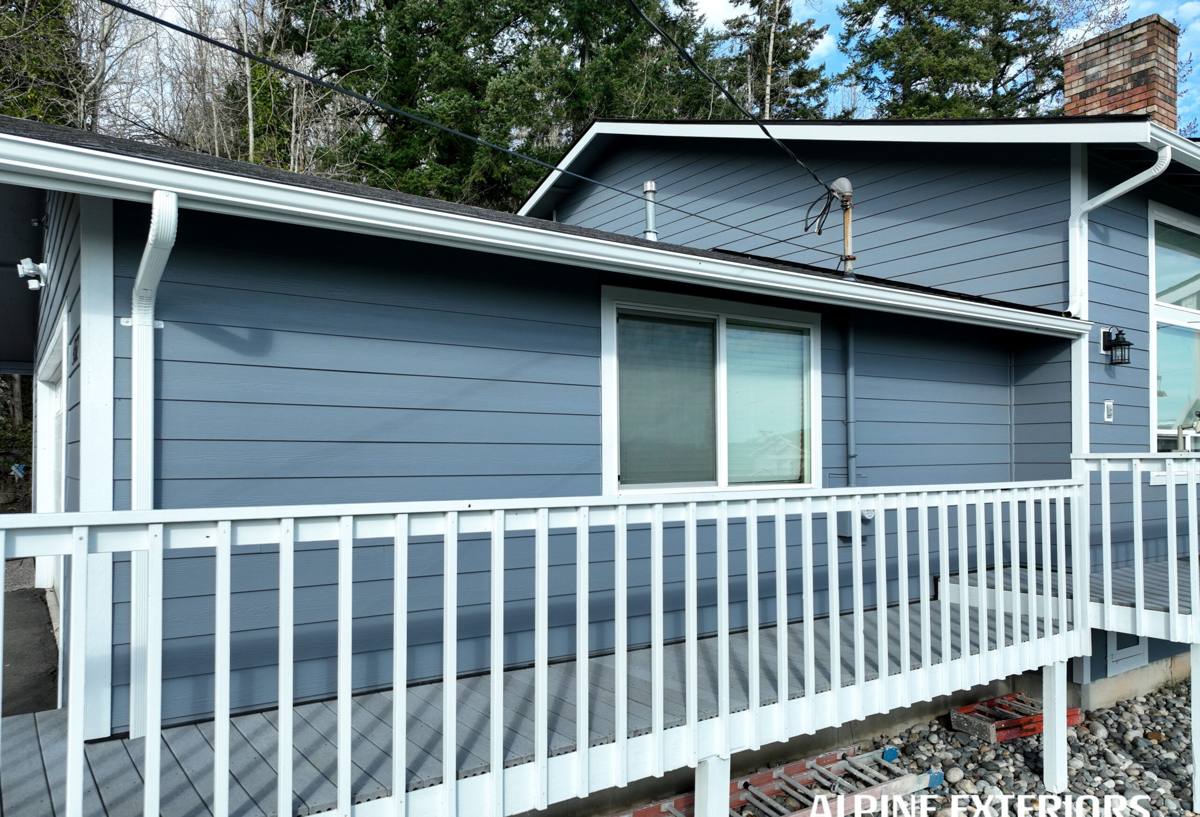
Fiber cement costs more than vinyl and more than engineered wood, both in material and in labor — it's heavier, requires carbide-tipped blades or shears, and takes a crew that knows how to nail and flash it correctly. It's also the product we install exclusively. It's non-combustible, dimensionally stable in wet-dry cycling, and holds a factory-applied ColorPlus finish that doesn't depend on a perfect field paint job to perform. For a house that's going to sit through another 30 or 40 Whatcom County winters, the higher upfront cost buys a materially different maintenance and longevity profile.
Home Size, Shape, and Trim Complexity
Square footage sets the floor for a quote, but shape does more to move the number than most homeowners expect. A simple rectangular ranch is straightforward to side. A home with multiple gables, dormers, bump-outs, a wraparound porch, or a lot of window and door trim takes considerably more cutting, fitting, and flashing per square foot of coverage — all of which is labor, not material.
- Steep or multi-story sections that require staging or lift rental add cost beyond simple ladder work
- Extensive trim, corner boards, and frieze detail add labor hours even on a modest footprint
- Homes with a lot of window and door openings need more flashing and cutting per square
- Detached structures (garages, shops) are usually priced separately from the main house
What's Underneath: Tear-Off, Sheathing, and Water Damage
The siding you see is the last layer of a wall system that includes sheathing, a water-resistive barrier, and flashing at every penetration. A siding replacement is the one time that whole system is exposed, and what a crew finds once the old material comes off has a real effect on final cost.
Full tear-off costs more than installing over existing siding (which we generally don't recommend, since it buries a problem instead of solving it). Rotted sheathing, compromised framing around old window flashing, or a water-resistive barrier that failed years ago all need to be addressed before new siding goes on — and that work isn't visible until demolition happens. A contractor who gives you one firm number before any tear-off has occurred is either padding the number to cover the unknown or planning to hit you with change orders later. The more honest approach is a base estimate plus a clearly explained contingency for what typically gets found on a house of your age and construction.
How Bellingham's Climate Changes the Math
Whatcom County siding doesn't face the same conditions as siding two hours inland, and that shows up in the cost conversation in a few specific ways.
Salt Air
Homes closer to Bellingham Bay and the Strait deal with airborne salt that accelerates corrosion on fasteners, flashing, and any unprotected metal trim. That pushes the spec toward corrosion-resistant fastening and flashing details, which costs a bit more than the minimum but avoids premature failure at the connections — usually the first place a cheap installation fails, long before the siding material itself does.
Driving Rain
Wind-driven rain off the water pushes water sideways into wall assemblies, not just straight down. That makes correct flashing, house wrap lapping, and drainage plane detailing more important here than in a drier climate, and it's part of why installation quality matters as much as material choice — a lesser product installed to a rigorous standard can outlast a premium product installed carelessly.
Moss and Sustained Dampness
Bellingham's long moss season means anything that traps moisture against a wall — poor clearance at grade, bad kickout flashing, siding installed too tight to the ground or a deck — stays damp for months at a stretch rather than drying out between storms the way it might in a sunnier climate. That sustained dampness is exactly the condition wood-based products struggle with and fiber cement handles well, and it's a factor we design around on every job, not just an afterthought.
Labor, Crew Experience, and Installation Standard
Fiber cement is installation-sensitive. Nailing pattern, gapping, caulking at butt joints, and flashing at every penetration all have to be done to the manufacturer's published specification for the warranty to mean anything and for the wall to actually perform in our climate. Crews with real fiber cement experience work at a different pace and price point than a general remodeling crew adding siding as one more service — that experience is part of what you're paying for, and it's worth asking about directly rather than assuming all quotes reflect the same labor standard.
Paint and Finish System
A field-painted product depends on paint adhesion, prep, and reapplication on a maintenance schedule the homeowner has to keep up with — miss a repaint cycle in a wet climate and the substrate underneath starts absorbing moisture. James Hardie's ColorPlus finish is baked on at the factory under controlled conditions, which is a meaningfully different proposition: the color and protective layer are part of the product, not a separate maintenance obligation layered on top of it. That's reflected in the material cost, but it changes what "finished" actually means for the life of the siding.
What Typically Moves a Quote
| Factor | Effect on Cost |
|---|---|
| Material (vinyl vs. engineered wood vs. fiber cement) | Largest single driver of material and labor cost |
| Home shape and trim detail | Increases labor hours per square foot covered |
| Full tear-off vs. install-over | Tear-off costs more upfront but exposes hidden problems early |
| Sheathing or framing repair | Adds cost only where damage is found during demolition |
| Height and access (multi-story, steep grade) | Adds staging, lift, or scaffolding cost |
| Corrosion-resistant fastening and flashing | Modest add for homes closer to the water |
| Trim and finish package (batten, shakes, custom colors) | Increases material and cutting labor |
Getting an Estimate You Can Actually Compare
The best way to compare quotes isn't to line up the bottom-line numbers — it's to make sure every contractor is pricing the same scope.
- Confirm whether the quote includes full tear-off or installation over existing siding
- Ask what happens, cost-wise, if rotted sheathing is found once tear-off starts
- Check that flashing and water-resistive barrier work is itemized, not lumped into "installation"
- Ask specifically about fastener and flashing material given proximity to the water
- Confirm whether the quoted product carries a factory finish or requires field painting
- Ask how many fiber cement installations the actual crew (not just the company) has completed
A quote that's silent on these points is harder to trust than one that's slightly higher but answers all of them clearly.
If you're weighing a siding replacement and want a straight answer on what your specific house will actually cost, we're happy to walk the property, look at what's underneath the existing siding where we can, and put together a detailed, no-pressure estimate — no hard sell, just a clear breakdown of the scope and the number behind it.