 Bellingham Exterior
 Decking in Barkley Has to Answer to the Weather
Barkley sits close enough to Bellingham Bay and the surrounding wetlands that homes here deal with a specific combination of punishment: salt-tinged air drifting in off the water, driving rain that comes sideways more often than straight down, and a moss season that can stretch from October well into April. A deck in Barkley isn't just outdoor furniture — it's a structure that spends most of the year wet, shaded, or both. That changes what "correct" decking looks like here compared to a drier inland climate.
Composite decking has become the default recommendation for homeowners in this part of Whatcom County precisely because it handles that combination better than solid wood, without pretending the climate isn't a factor. It still needs to be installed correctly for this environment — drainage, fastening, and board selection all matter more here than they would in a place that doesn't see six or seven months of near-constant moisture.
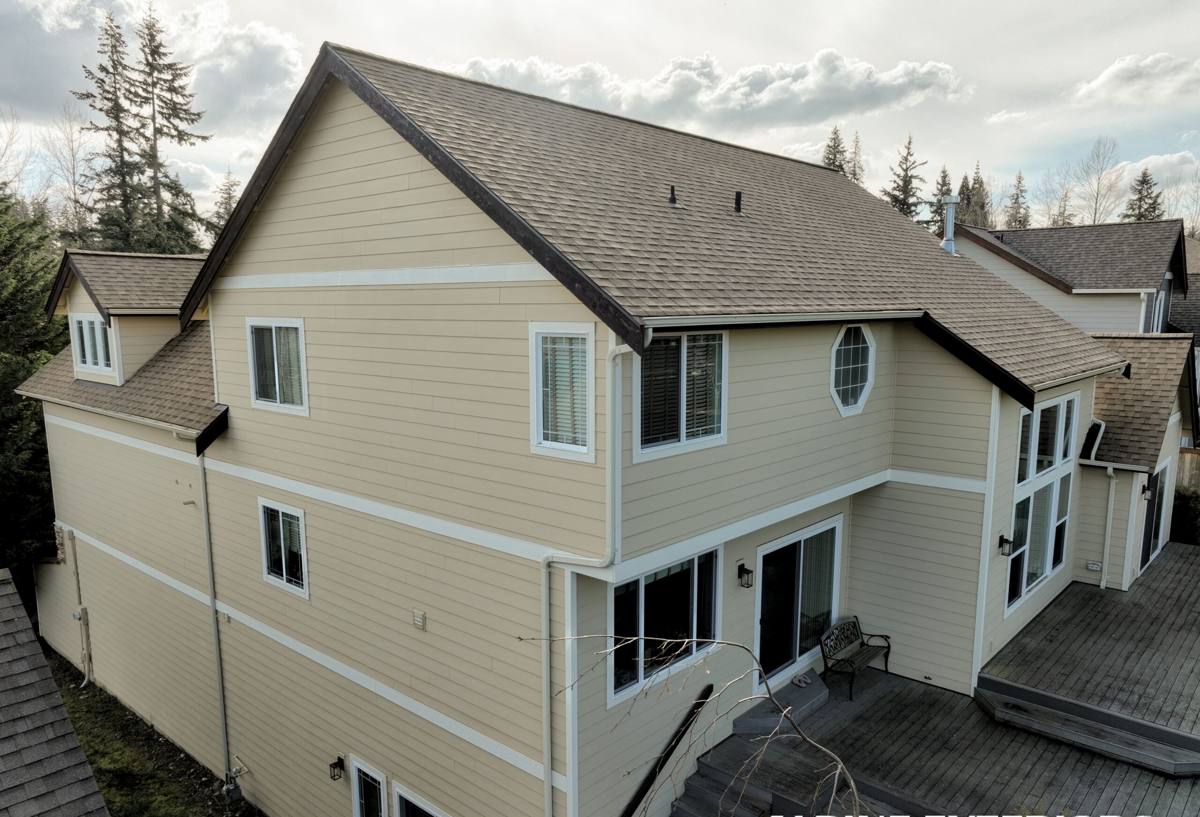
What Bellingham's Climate Actually Does to a Deck
Salt Air and Metal Fasteners
Proximity to Bellingham Bay means a low but steady exposure to salt-laden air, especially on breezy days. Over years, that air accelerates corrosion on any exposed metal — screw heads, joist hangers, ledger flashing. On composite decks, the boards themselves don't corrode, but the fasteners and structural hardware holding them up absolutely can if the wrong grade is used. This is one of the most common shortcuts we see on decks that were installed cheaply: standard zinc-coated hardware instead of stainless or coated fasteners rated for coastal exposure.
Driving Rain and Water Intrusion
Rain that comes in at an angle finds its way into gaps that vertical rain never would — behind ledger boards, along house-to-deck connections, and under poorly flashed rim joists. Composite boards themselves shrug off moisture, but the framing underneath, the ledger attachment to the house, and any concealed fastening system are only as good as the flashing and gapping details behind them.
Moss, Algae, and Shade
Whatcom County's long wet season, combined with mature tree cover in many Barkley yards, creates ideal conditions for moss and algae growth on any outdoor surface that stays damp and shaded. Wood decking is especially vulnerable because moss roots into the grain and holds moisture against the board. Composite decking resists this better because it has no organic grain for growth to anchor into, but it isn't immune — moss and algae can still form a surface film on any decking material that doesn't get airflow or periodic cleaning.
Why Composite Makes Sense for This Neighborhood
We don't tell every homeowner in Bellingham that composite is the only right answer — wood has its place, and some homeowners genuinely prefer the look and are willing to keep up with it. But for Barkley specifically, where shade, moisture, and salt air stack together, composite removes several of the maintenance burdens that make wood decks in this climate a recurring project rather than a one-time build.
| Factor | Wood Decking | Composite Decking |
|---|---|---|
| Annual maintenance | Cleaning, sealing/staining, spot repairs | Periodic wash-down; no sealing required |
| Moss/algae resistance | Low — grain traps moisture and organic growth | Higher — dense surface, but not maintenance-free |
| Behavior in driving rain | Absorbs water; prone to cupping, splitting, rot at fasteners | Doesn't absorb; performance depends on framing and drainage details |
| Expected board lifespan (PNW coastal exposure) | 10-15 years with consistent upkeep | 25+ years, manufacturer-dependent |
| Upfront material cost | Lower | Higher |
| Long-term cost (labor + materials over 20 years) | Often higher due to recurring refinishing | Generally lower once installed correctly |
The trade-off is upfront cost. Composite material runs more per square foot than dimensional lumber, and that's a legitimate consideration for any project. We'd rather tell you that plainly than oversell the material.
What a Correct Composite Deck Installation Actually Involves
Composite boards get most of the attention because they're what you see and stand on, but the work that determines whether a deck lasts is almost entirely underneath them. In a climate like ours, cutting corners on the framing is where decks actually fail.
Framing and Substructure
- Joist spacing matched to the specific composite product's span rating — composite requires tighter joist spacing than lumber decking in most cases, and manufacturers publish exact specs that get ignored more often than you'd think
- Pressure-treated or naturally rot-resistant framing lumber, since the substructure is still wood even when the surface isn't
- Joist tape or a comparable protective barrier on top of every joist to keep standing water off the framing lumber
Ledger and Flashing
Where the deck attaches to the house is the single most common failure point on any deck in this climate, wood or composite. Proper step flashing and a water-resistant barrier between the ledger and the house sheathing keep driving rain from working its way into the wall assembly over time. This detail is invisible once the deck is finished, which is exactly why it's the detail worth asking about before hiring anyone.
Fasteners and Hardware
Stainless steel or coated fasteners rated for coastal/marine-adjacent exposure, hidden fastener clip systems sized correctly for the board profile, and corrosion-resistant joist hangers throughout. This is a small percentage of total project cost and the part most likely to get value-engineered out on a low-bid job.
Airflow and Drainage Underneath
A deck built low to the ground or over a patio needs a clear plan for where water goes — proper slope, gaps for airflow, and in some cases a drainage system underneath if the space below is meant to stay dry. Standing water or trapped moisture under a deck is exactly the condition that grows moss and accelerates hardware corrosion, so this isn't optional in a Barkley yard with any tree cover.
Choosing the Right Composite Product
Not all composite decking is the same, and the differences matter more in a wet, shaded climate than they might in a drier one.
Capped vs. Uncapped Composite
Capped composite has a polymer shell around a wood-plastic core, which resists moisture absorption and staining significantly better than older uncapped composite products. In a climate with this much rainfall and shade, we generally steer homeowners toward capped products — the extra durability against moisture and mold is worth more here than it would be in a dry climate.
Board Profile and Surface Texture
Grooved-edge boards paired with hidden fastener systems give a cleaner look and no exposed screw heads for water or debris to sit against. Textured or wood-grain surface finishes help with slip resistance when boards are wet, which is a real consideration given how many months of the year Bellingham decks stay damp.
Color Considerations
Lighter colored composite boards show pollen, dirt, and early moss growth more visibly than darker or variegated colors, which some homeowners prefer for low-maintenance appearance between cleanings. This is a matter of preference and upkeep tolerance rather than one color being objectively better.
Warranty Structure
Composite warranties vary by manufacturer and typically cover structural integrity and staining/fading separately, often with different terms for each. It's worth reading what's actually covered rather than assuming "25-year warranty" means the same thing across every brand — some exclude coastal or marine environments from certain fade or mold clauses, which is directly relevant for a property in Barkley.
Our Process for a Barkley Deck Project
- On-site assessment — we look at existing framing (if replacing a deck), house attachment point, sun/shade exposure, tree cover, and drainage before recommending anything
- Product selection — matched to your budget, sun exposure, and how much upkeep you actually want to do, not a one-size answer
- Permitting — deck projects in Bellingham typically require a permit through the City; we handle that process rather than leaving it on you
- Demolition and framing — old material removed, framing inspected or rebuilt to current span and fastening standards
- Flashing and ledger work — the part that doesn't show but determines whether the house stays dry behind the deck
- Composite installation — correct spacing for thermal expansion, hidden fasteners where specified, clean board transitions
- Final walkthrough — we go over basic care with you before we consider the job done
Many properties in Barkley fall under planned-development design guidelines or HOA standards from the neighborhood's original master planning. If that applies to your home, we can work within whatever material or appearance requirements are in place — it's worth mentioning at the estimate stage so it's accounted for from the start rather than discovered partway through.
Keeping a Composite Deck Looking Right in This Climate
Composite decking is lower-maintenance than wood, not maintenance-free. In a climate with this much moss pressure, a little seasonal attention keeps a deck looking like it did on installation day.
- Sweep leaves and debris regularly, especially in fall — trapped organic material under leaves is what feeds moss and algae growth
- Wash the deck surface with a soft-bristle brush and mild soap and water once or twice a year; avoid pressure washers on composite unless used on a low setting from a safe distance, since aggressive pressure washing can damage the board's surface
- Keep gutters and downspouts near the deck clear so runoff isn't dumping directly onto or under the decking
- Trim back overhanging branches where practical to reduce shade and speed up drying time after rain
- Check fastener heads and any visible hardware annually for early signs of corrosion, especially on decks closer to the water
- Address standing water or slow drainage under the deck promptly rather than letting it sit through the wet season
Why Local Experience with Barkley Specifically Matters
A lot of composite decking problems we get called out to inspect aren't material failures — they're installation shortcuts that a crew unfamiliar with this specific climate wouldn't necessarily know to avoid. Joist spacing that's technically fine in a dry climate but too wide for consistent freeze-thaw and moisture cycling here. Standard hardware instead of coastal-rated fasteners. Flashing details that work in theory but don't account for how often rain comes in sideways off the bay.
Working regularly in Bellingham and Whatcom County means we're not learning the region's quirks on your project. We know what the City's permitting process expects, we know how Barkley's tree cover and shade patterns affect drainage decisions, and we've seen what happens to decks that were built to a generic spec instead of this one.
Get a Straightforward Estimate
If you're planning a new composite deck in Barkley or replacing one that hasn't held up, we're happy to come take a look, walk you through what your specific site needs, and give you an honest, no-pressure estimate. There's no obligation — just a straight answer on what the job actually involves.