 Bellingham Exterior
 Why Birch Bay Siding Wears Differently Than Inland Bellingham Siding
Birch Bay sits right on the water, and that changes the math on siding. A house a few miles inland in Bellingham deals with the normal Pacific Northwest mix of rain and humidity. A house in Birch Bay deals with all of that plus near-constant airborne salt, more direct wind-driven rain off the water, and a moss season that runs longer because shaded, damp siding never gets a real chance to dry out between storms. None of this means siding is a lost cause here — it means the material and the installation both have to be matched to the exposure, or you end up replacing siding again in half the time it should last.
Salt air is the part homeowners underestimate most. It doesn't just sit on the surface — over years it works into seams, fastener heads, and any spot where the original installation left a gap. Combine that with the driving rain that comes off the Strait of Georgia during winter storms, and you get moisture finding its way behind siding that would have stayed dry a few miles inland. Add Whatcom County's long gray stretch from fall through spring, and you've got the three-part problem Birch Bay siding actually has to survive: salt, wind-driven water, and moss.
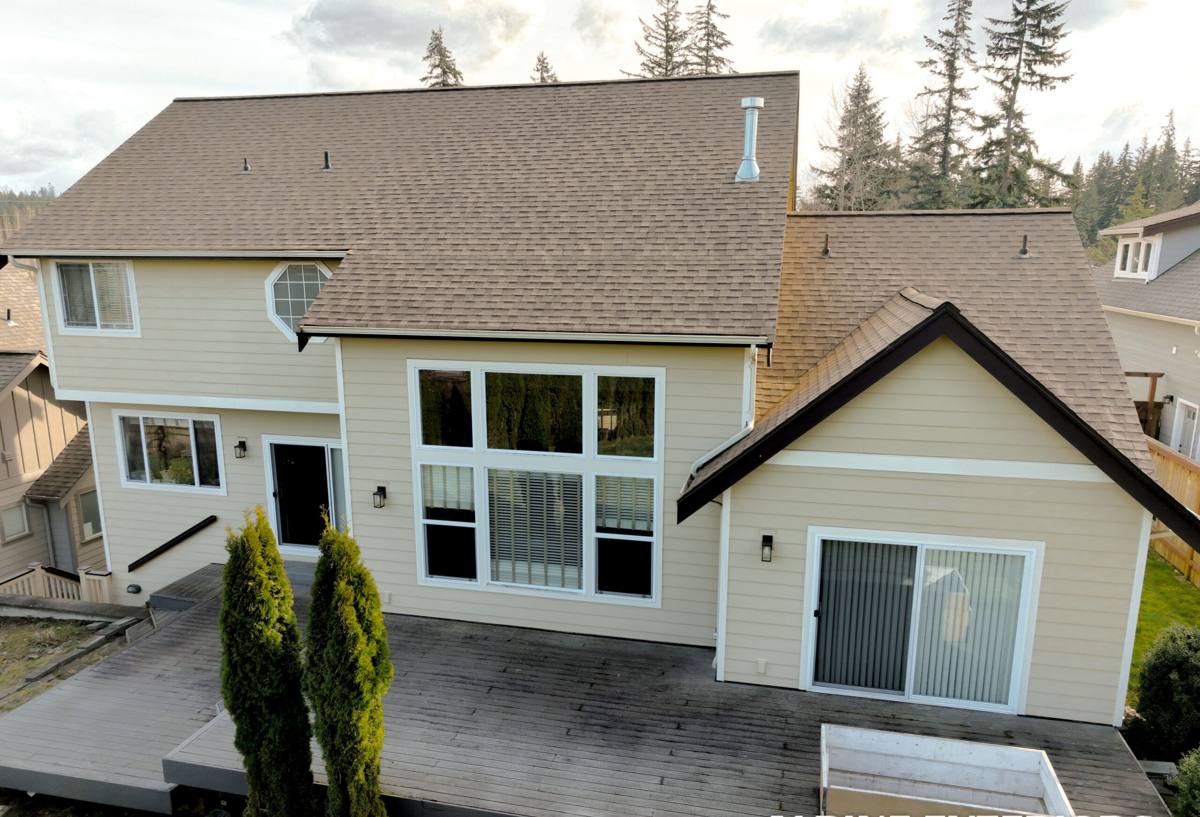
Signs Your Birch Bay Home's Siding Has Reached the End of the Road
Siding failure on the coast rarely announces itself with one dramatic problem. It's usually a handful of smaller signs that, together, mean the assembly behind the siding is no longer doing its job.
- Soft or spongy spots when you press on the siding, especially near the bottom courses and around windows
- Persistent moss or algae staining that comes back within weeks of being cleaned off
- Paint that's chalking, peeling, or blistering faster than a normal repaint cycle would explain
- Visible warping, cupping, or gaps opening up between boards or panels
- A musty smell in an exterior wall, or interior drywall that stays damp near an outside corner
- Corroded or rust-streaked fasteners showing through the surface
- Siding that was already an aging, moisture-sensitive material — cedar, primed spruce, or older composite — installed before it was clear how hard this location is on wood-based products
Any one of these on its own might just need a repair. Several together, especially on the water-facing side of the house, usually mean the siding and the water-resistive barrier behind it have both been compromised, and patching won't fix the underlying moisture path.
What a Correct Siding Replacement Actually Involves
A siding replacement is only as good as what's underneath it. Rushing this part is how a brand-new siding job ends up with the same rot problem five years later.
Tear-off and inspection
Old siding comes off in full, not patched around. That's the only way to actually see the sheathing, framing, and window flashing underneath — which, on a coastal home, is where the real damage usually is. Any soft or water-damaged sheathing gets replaced, not covered over.
Water-resistive barrier and flashing
This is the layer that actually keeps water out of the wall assembly — the siding itself is the second line of defense, not the first. Every window, door, and penetration gets flashed and integrated with the barrier so wind-driven rain off the bay has nowhere to get behind the wall.
Correct fastening and clearances
Fiber cement siding has a manufacturer-specified fastening pattern, and it matters more in high-wind, high-moisture locations than in sheltered ones. Ground clearance, gaps at trim, and caulking at the right joints (and not others) all follow the manufacturer's install manual — not habit.
Factory-finished exterior
Whatever finish goes over that sheathing needs to be engineered for UV, moisture cycling, and salt exposure — not just painted after the fact and hoped for the best.
Why We Only Install James Hardie Fiber Cement
We made a deliberate call to install exclusively James Hardie fiber cement siding, and we don't install vinyl, LP SmartSide, Cemplank, Allura, primed spruce, or cedar. That's not a marketing position — it's what years of seeing how different materials actually hold up in coastal Whatcom County conditions led us to.
Wood-based products, including engineered wood siding, rely on their coating staying fully intact to keep moisture out. In a location with this much salt air and this long a wet season, any nick, gap, or worn spot in that coating is where rot starts — and it's very hard to inspect every square foot of a house closely enough to catch it early. Vinyl is durable in the sense that it won't rot, but it deforms and fades faster under UV and temperature swings, and it doesn't hold a factory finish the way fiber cement does. Cedar is a beautiful, legitimate material, but it demands a maintenance commitment — regular refinishing, vigilant caulk and moisture checks — that most homeowners don't sign up for once the novelty wears off, and Birch Bay's climate accelerates that maintenance clock.
James Hardie fiber cement is non-combustible, doesn't rot or absorb moisture the way wood does, and comes with a factory-applied ColorPlus finish that's baked on rather than field-painted — which means far more consistent coverage and a warranty that actually covers the finish, not just the substrate. Hardie also builds region-specific product formulations (their HZ system) rather than one generic board for the whole country, which matters when the region in question sits directly on saltwater.
Matching the Right Hardie Product to a Waterfront Exposure
Not every Hardie product is used the same way on a coastal home. Part of doing this job right in Birch Bay is choosing the right line and profile for each part of the house based on how much weather it actually takes.
| Hardie Product | Best Use on a Birch Bay Home | Why |
|---|---|---|
| HardiePlank lap siding | Primary field siding, all elevations | Most common profile; factory ColorPlus finish stands up to salt air and sun better than field-applied paint |
| HardieShingle | Accent gables, dormers | Adds texture and curb appeal without sacrificing the moisture performance of fiber cement |
| HardiePanel | Modern facades, porch ceilings, accent walls | Clean vertical lines for contemporary coastal design |
| HardieTrim | Corners, fascia, window and door trim | Matches the siding's moisture resistance at the joints most exposed to wind-driven rain |
On the water-facing side of a Birch Bay home in particular, we pay close attention to fastener choice, joint sealing, and clearance details — the same product installed loosely performs very differently than the same product installed to spec.
Our Siding Replacement Process
- On-site assessment — We walk the whole exterior, check for soft sheathing, failed flashing, and moisture entry points, and give you an honest read on what's actually needed.
- Scope and product selection — We recommend the Hardie products and profiles suited to each elevation's exposure, and walk you through color and finish options.
- Full tear-off — Old siding and any compromised building paper or sheathing come off completely.
- Repair and re-wrap — Damaged sheathing is replaced, and a new water-resistive barrier goes on with correctly integrated window and door flashing.
- Installation to manufacturer spec — Fastening pattern, clearances, and joint treatment follow James Hardie's published installation guidelines, not shortcuts.
- Final inspection and cleanup — We walk the finished job with you before we consider it done, and the site is cleaned up, debris included.
What Drives the Cost of a Birch Bay Siding Replacement
Every home is different, but these are the factors that most often move the price up or down on a coastal siding replacement:
| Factor | Why It Matters in Birch Bay |
|---|---|
| Extent of hidden sheathing damage | Homes closer to the water more often need sheathing repair discovered during tear-off, which isn't fully known until the old siding is off |
| Home size and number of stories | More square footage and access/scaffolding needs on taller elevations both add labor time |
| Trim and architectural detail | Gables, dormers, and multiple roof lines mean more cutting, flashing, and trim work |
| Product mix | Combining lap siding with shingle accents or panel sections costs more than a single profile throughout |
| Site access | Waterfront lots with limited driveway or staging space can slow material handling and add time |
We give straight, itemized estimates so you know what you're paying for and why — no vague lump sums.
Why Local Experience in Birch Bay Actually Matters
A crew that mostly works inland can install siding correctly on paper and still miss the details that matter on the water — how much clearance to leave at grade on a lot that floods with wind-driven spray, which elevations need extra attention to flashing because they take the brunt of storms off the bay, or how Whatcom County's permitting and inspection process applies to exterior work in this area. Working Birch Bay regularly means we've already seen how different details hold up here over time, and we build that into every estimate and install rather than treating it as a standard job in a non-standard location.
If your Birch Bay home is showing signs of siding wear, or you'd simply like an honest read on what shape your siding is really in, we're happy to take a look. Request a free, no-pressure estimate below and we'll walk the exterior with you and tell you exactly what we see.