 Bellingham Exterior
 Cordata's Climate Asks More of Siding Than People Expect
Cordata sits in north Bellingham, close enough to the water and the wind patterns off Bellingham Bay that homes here take on a steady diet of moisture most of the year. It's not the dramatic storms that wear siding down — it's the everyday combination of driving rain, damp air carrying trace salt, and long stretches of shade and cloud cover that keep exterior walls from ever fully drying out. In Whatcom County, that combination adds up fast over a decade or two.
Homes in Cordata range from newer builds to older construction, and we see the same pattern regardless of age: siding that wasn't detailed correctly for this climate starts showing problems years before it should. Paint fails at seams, moss colonizes north-facing walls, and moisture works its way behind panels that were never given a real drainage path. None of that is inevitable — it's a function of material choice and installation quality, and both are things a homeowner can control when it's time to replace siding.
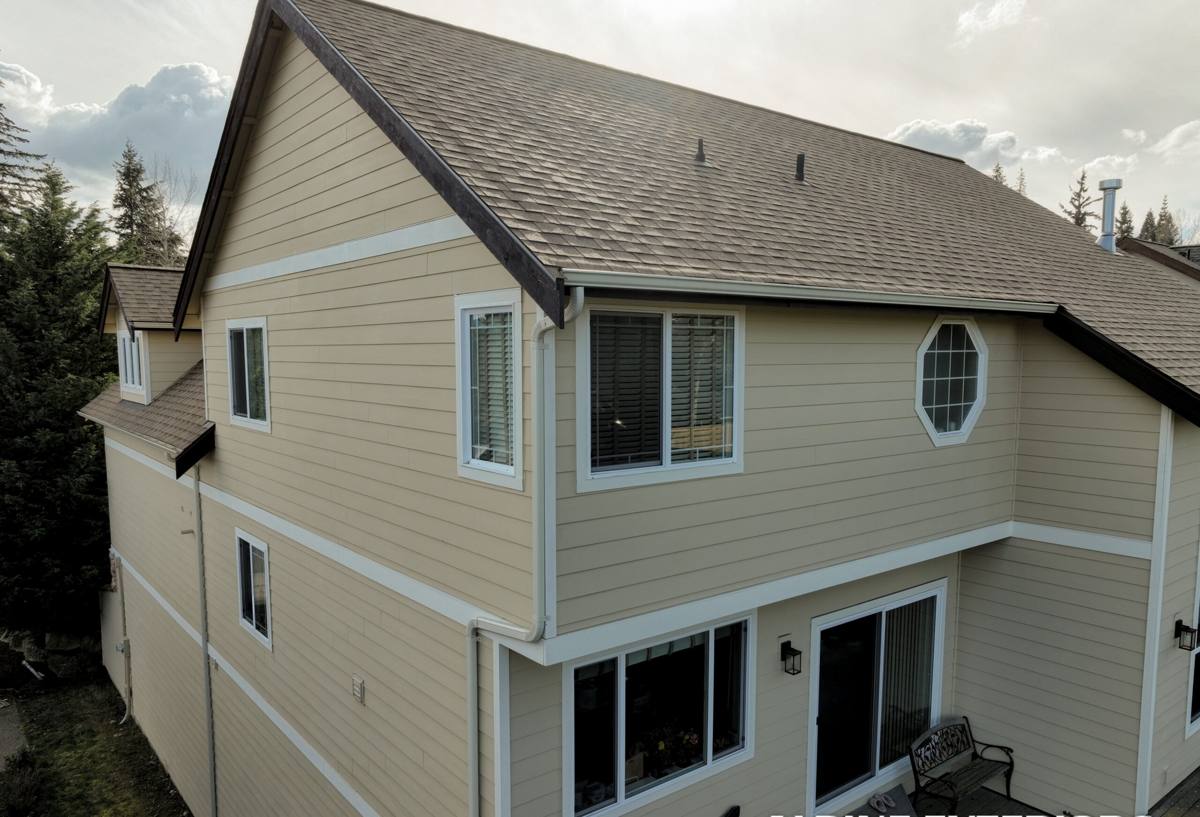
What Bellingham's Wet Season Actually Does to a Wall
Driving Rain and Wind-Driven Moisture
Rain that falls straight down is easy to shed. Rain that's pushed sideways by wind — which is common in this part of Whatcom County — finds every gap, seam, and fastener hole in a wall system. Over years, that wind-driven moisture is what causes rot at trim boards, staining at butt joints, and swelling in siding materials that absorb water rather than resist it.
Salt Air and Coastal Proximity
Cordata isn't waterfront, but Bellingham's proximity to the bay means the air carries more salt and moisture than an inland town would see. Salt-laden moisture accelerates corrosion on fasteners and hardware, and it breaks down finishes that weren't engineered to handle it. This is a big part of why fastener choice and coating quality matter as much as the siding panel itself.
Moss Season
Between the shade from mature trees common in established neighborhoods and the length of the Pacific Northwest wet season, many Cordata homes deal with moss and algae growth for a good chunk of the year. Moss holds moisture directly against the siding surface, and on materials that aren't dimensionally stable or properly finished, that constant dampness is what starts the clock on rot, delamination, or paint failure.
What a Correctly Installed Siding System Includes
A siding job is only as good as what's underneath it. The panel itself gets the attention, but the details that actually keep a Cordata home dry are mostly invisible once the project is finished:
- A continuous weather-resistant barrier installed over the sheathing, lapped correctly at every seam so water is directed out and down, never trapped against the wall.
- Proper flashing at windows, doors, and every horizontal trim transition — the single most common failure point we see on older installations in this area.
- Correct fastener type, spacing, and penetration — undersized or improperly coated fasteners are a direct path for moisture and corrosion, especially this close to the bay.
- Clearance and gapping at the foundation, roofline, and any siding-to-trim transition, so the material isn't sitting in standing water or trapped moisture.
- Correct caulking and sealant use — used only where the manufacturer specifies it, since over-caulking can trap moisture just as easily as under-caulking lets it in.
Skip any one of these and the siding material almost doesn't matter — water will eventually find a way in. Get them right, and even a demanding climate like this one stops being a threat.
Why We Install Only James Hardie Fiber Cement
We made a deliberate decision to install one siding system: James Hardie fiber cement. We don't install vinyl, LP SmartSide, cedar, primed spruce, or competing fiber cement brands like Cemplank or Allura. That's not a marketing position — it's a standard we hold because of what this climate does to lesser materials over time.
Fiber cement doesn't absorb water the way wood-based products do, and it doesn't warp, crack, or become brittle under the freeze-thaw and constant-damp cycles common to Whatcom County winters. James Hardie's HZ5 product line is specifically engineered for the Pacific Northwest's moisture exposure. The ColorPlus factory finish is baked on under controlled conditions, which holds up far better against Bellingham's UV and moisture combination than field-applied paint. It's also non-combustible, which matters more each year as wildfire smoke and regional fire risk become a bigger part of Pacific Northwest summers.
The product also carries a strong, transferable warranty — but a warranty is only as good as the installation behind it. That's why our process focuses as much on the barrier, flashing, and fastening details as on the panels themselves.
Our Siding Installation Process for Cordata Homes
- On-site assessment. We look at the existing siding, sheathing condition, moisture history, moss patterns, and any trouble spots specific to the home's orientation and tree cover.
- Removal and sheathing inspection. Old siding comes off and we check the wall beneath it for hidden rot or moisture damage before anything new goes up — this step catches problems a surface inspection can't.
- Weather barrier installation. A continuous, correctly lapped barrier goes over the sheathing as the home's real first line of defense.
- Flashing at every penetration. Windows, doors, vents, and trim transitions get flashed before the siding covers them.
- James Hardie panel installation. Installed to manufacturer spec for fastener type, spacing, gapping, and clearance — the details that determine whether the warranty is actually valid.
- Trim, caulking, and final detail work. Finished with manufacturer-approved sealants only where specified.
- Final walkthrough. We go over the completed work with the homeowner before calling the job done.
Signs a Cordata Home Needs New Siding
Homeowners often wait longer than they should because siding problems develop slowly. Some signs worth acting on:
- Paint that's peeling, bubbling, or chalking well before it should
- Soft spots or visible swelling in the siding material, especially near the bottom of walls
- Persistent moss or algae growth that comes back within weeks of cleaning
- Visible gaps, cracks, or warping at seams and corners
- Rising energy bills that point to a wall system no longer sealing the way it should
- Interior signs like musty odors or staining near exterior walls
What Siding Replacement Typically Costs
Every home is different, but the factors that move the price are consistent. This gives a general sense of what drives cost up or down — not a quote.
| Factor | Lower Cost | Higher Cost |
|---|---|---|
| Home size and wall area | Smaller, single-story footprint | Larger or multi-story homes |
| Sheathing condition | Sound sheathing, no rot found | Rot repair or sheathing replacement needed |
| Siding profile | Standard lap panels | Shingle-style or mixed profiles, more trim detail |
| Access and site conditions | Easy ground-level access | Steep grades, tight setbacks, tall walls |
| Existing siding removal | Single layer to remove | Multiple layers or difficult tear-off |
The honest answer to "what will this cost" almost always requires a walkthrough of the specific home — that's the only way to account for sheathing condition, wall complexity, and access.
Why Hiring a Crew That Already Works in Cordata Matters
Siding installation isn't a one-size-fits-all trade. A crew that regularly works in Cordata and the surrounding Bellingham area already understands the moisture patterns, the moss cycle, and the wind-driven rain exposure that's typical here — that experience shows up in the small decisions made on-site: where to add extra flashing, how much clearance to leave at grade, which walls need extra attention because of shade and tree cover. A crew unfamiliar with Whatcom County's climate can install a product correctly on paper and still miss the details that matter here.
Before hiring any siding contractor, it's worth asking a few direct questions:
- Are you licensed and insured to work in Washington State, and can you provide proof?
- Do you install to the manufacturer's specific installation guide, not just "industry standard"?
- Who inspects the sheathing before new siding goes up, and what happens if rot is found?
- Is the warranty from the manufacturer, the installer, or both — and what voids it?
- Can you explain your flashing and weather-barrier approach in plain terms?
A contractor who can answer those clearly, without hesitation, is one who understands what actually protects a home in this climate.
Ready to Talk About Your Cordata Home's Siding?
If your siding is showing its age, or you just want an honest opinion on where it stands, we're happy to take a look. We'll walk the exterior, point out what we see, and give you a straightforward assessment — no pressure, no obligation. Use the form below to request a free estimate.