 Bellingham Exterior
 Why Birch Bay Is a Tough Place on Siding
Birch Bay sits right on the water, and that changes what a house needs from its exterior. Homes here deal with a combination that inland Whatcom County neighborhoods don't see nearly as often: constant salt-laden air off the bay, wind-driven rain that gets pushed sideways into walls instead of just falling straight down, and a shaded, damp shoulder season long enough to grow a healthy crop of moss and algae on anything that stays wet. None of these alone is unusual for Western Washington. Together, on a shoreline lot, they add up to siding wear that a homeowner two miles inland may never deal with.
Salt air is corrosive to metal, and it's persistent — it doesn't take a storm to deposit it, just wind off the water on an ordinary day. Wind-driven rain finds any weak point in a wall system: a gap at a butt joint, a poorly flashed window, a nail that backed out. And moss doesn't care how new your siding is; it cares about moisture and shade, both of which Birch Bay has in steady supply for months at a time. Siding here isn't just cosmetic. It's the first line of defense against a climate that's actively working against the building.
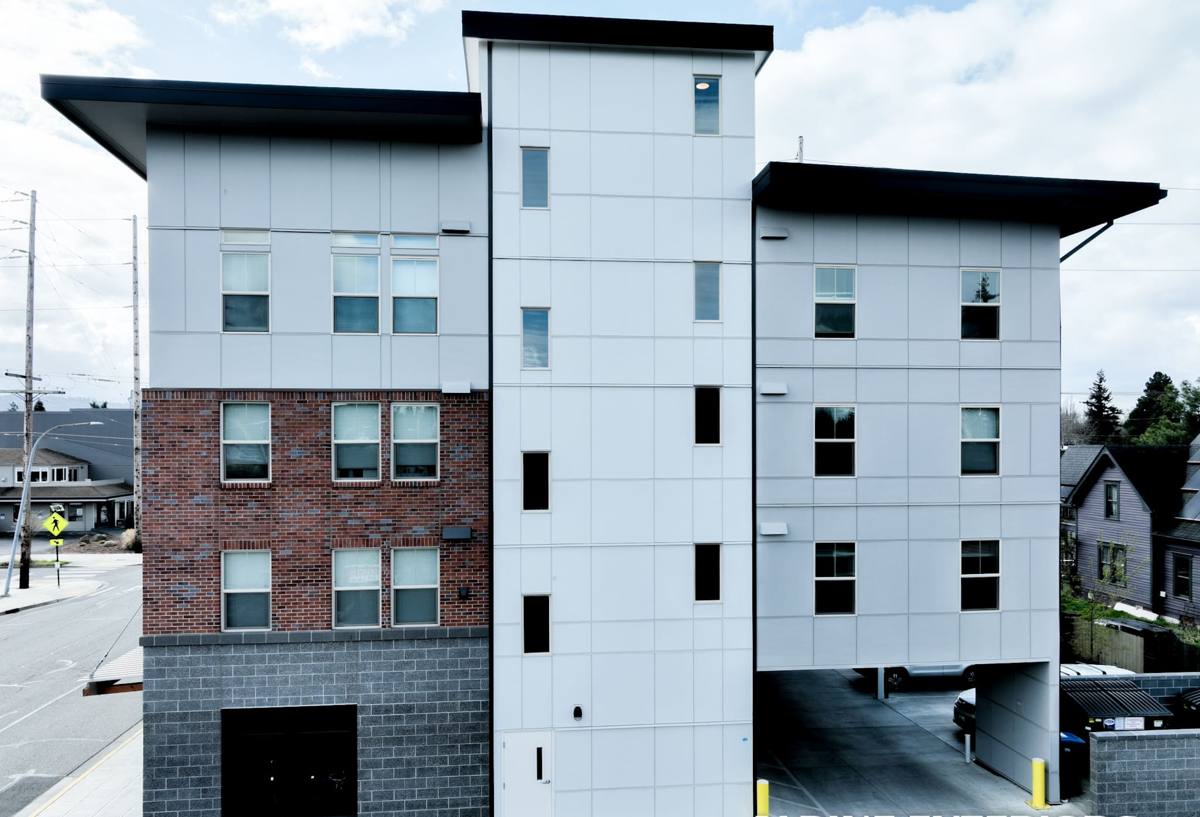
Why We Install James Hardie Here — and Only Hardie
We install James Hardie fiber cement exclusively. We don't offer vinyl, LP SmartSide, cedar, or primed spruce, and in a location like Birch Bay that standard isn't arbitrary. Each of those alternatives has a specific weak point that this climate exposes faster than it would somewhere drier and calmer.
Salt Air and Material Stability
Vinyl siding expands and contracts with temperature swings and can become brittle over time; salt air accelerates the breakdown of a lot of the fasteners, trim, and hardware that hold a building envelope together. Wood-based products — cedar, primed spruce, LP SmartSide — depend on an intact paint or coating layer to keep moisture out, and once that layer is compromised by salt exposure and constant damp, the wood substrate underneath is vulnerable to swelling and rot. James Hardie is fiber cement: it's non-combustible, dimensionally stable, and it doesn't rely on an unbroken paint film to keep its structure intact the way wood-based siding does.
The ColorPlus Finish and Fade Resistance
James Hardie's ColorPlus finish is baked on at the factory in a controlled environment, which gives it more consistent coverage and better fade and chalk resistance than field-applied paint. On a shoreline home, that matters more than it does inland — direct sun reflecting off open water plus salt air is a harder combination on a painted finish than shade and calm air. A factory finish also means touch-up paint isn't guesswork; Hardie sells matched touch-up kits for exactly this reason.
Engineered for Climate Zones
James Hardie makes region-specific HZ product lines engineered for different climate exposures, including wetter, more humid coastal zones. That's a meaningful difference from a one-size-fits-all siding product — the plank formulation is built with a specific climate profile in mind rather than a generic national spec.
What Correct Installation Actually Involves
James Hardie siding is only as good as the installation behind it. In a high-exposure spot like Birch Bay, the details that get skipped on an easy inland job are exactly the details that cause callbacks here within a year or two.
Water Management Comes First
Before a single plank goes up, the wall needs a correctly lapped weather-resistant barrier, properly integrated window and door flashing, and flashing at every horizontal transition — roof-to-wall intersections, deck ledgers, trim bands. Siding sheds the bulk of the water, but flashing is what handles the water that gets behind it. On a wind-driven-rain site, that redundancy isn't optional.
Gaps, Clearances, and Fastening
James Hardie's own installation instructions specify clearances from grade, roof lines, and adjacent surfaces, plus specific gap and caulking requirements at butt joints and trim. Skipping these is the single most common way fiber cement siding fails early — not because the material was wrong, but because it was installed like a product that doesn't need those details. Fastener pattern and spacing matter too, and in salt air we favor corrosion-resistant fasteners rated for the exposure rather than whatever's cheapest on the truck.
Cut Edges and Field Painting
Every field-cut edge of a Hardie board needs to be primed and sealed before it's closed up. It's a small step that's easy to rush, and it's exactly the kind of shortcut that shows up as a soft spot or a paint failure line a couple of years later, especially with the added stress of salt air.
| Material | Behavior in salt air / driving rain | Moss & algae exposure |
|---|---|---|
| James Hardie fiber cement | Dimensionally stable, factory finish resists fading and chalking | Doesn't feed mold/mildew growth the way organic materials can |
| Vinyl | Fasteners and trim hardware degrade faster; can become brittle with age | Surface staining common in shaded, damp areas |
| Cedar / primed spruce | Wood substrate vulnerable once coating is compromised by salt exposure | Organic material is more susceptible to moss/algae colonization |
| LP SmartSide (engineered wood) | Depends on intact coating and correct sealing at cuts and edges | Requires consistent maintenance to resist moisture-driven wear |
How We Approach a Birch Bay Siding Job
The process starts with a full walk-around, not just a look at the siding itself. We check trim, window flashing, deck ledgers, and any spot where past water intrusion may already have done damage that isn't visible from the street. On a coastal home, we're also looking for signs that fasteners or metal flashing have started to corrode, since that's often the first real warning sign here.
From there:
- We determine whether a tear-off to the sheathing is needed, or whether the existing wall assembly is sound enough to build on correctly — we don't cover up rot or hidden moisture damage
- We install or verify a continuous weather-resistant barrier and properly lapped flashing at every penetration and transition
- We install James Hardie panels or lap siding to manufacturer spec: correct clearances, fastener pattern, and butt-joint treatment
- We prime and seal every field-cut edge before it's closed up
- We finish trim, caulking, and touch-up to match the ColorPlus finish
- We walk the finished job with the homeowner before we consider it done
What Drives Cost on a Job Like This
| Factor | Why it matters in Birch Bay |
|---|---|
| Wall condition underneath | Hidden moisture or rot from past water intrusion adds repair scope before new siding goes on |
| House exposure | Walls facing the water and prevailing wind need more attention to flashing and fastening detail |
| Product line and profile | Lap siding, panel systems, and trim options carry different material and labor costs |
| Access and site conditions | Waterfront lots and tighter setbacks can affect staging and scaffolding needs |
| Trim and detail work | More corners, windows, and roof transitions mean more flashing and finish work |
We don't quote a job without seeing the house. Anyone offering a firm number over the phone for a coastal home hasn't accounted for what's actually on the wall.
Signs Your Current Siding Is Past Its Job
- Persistent moss or algae growth that comes back within weeks of cleaning
- Soft spots, bubbling, or visible swelling, especially near the bottom courses or trim
- Rust streaking from fasteners or metal flashing
- Paint that's chalking, peeling, or fading unevenly, particularly on water-facing walls
- Gaps opening at butt joints or trim that weren't there when the siding was new
- Any musty smell or visible staining on interior walls that back up to exterior siding
Why It Matters That We Already Work in Birch Bay
A crew that's worked this stretch of Whatcom County shoreline knows what a wind-driven storm off the bay does to a wall that wasn't flashed right the first time, because we've been called out to fix exactly that. That's different from general siding experience. It means we don't treat a Birch Bay job like an inland job with a nicer view — we build in the extra flashing detail, the corrosion-resistant fasteners, and the clearance discipline that this exposure actually requires, from the first day of the install rather than after a callback.
It also means straightforward answers about permitting and what's realistic for a given house, without guesswork borrowed from a different climate.
Maintenance Going Forward
James Hardie siding installed correctly is low-maintenance, not no-maintenance, especially this close to the water. An occasional gentle wash to knock back salt residue and any early moss growth, a yearly look at caulking and trim, and prompt attention to any fastener or flashing issue will keep a correctly installed Hardie exterior performing for decades. The ColorPlus finish means repainting isn't a recurring chore the way it is with field-painted wood siding, but it's still worth a visual check each year, particularly on the walls that face the water and take the worst of the weather.
If your Birch Bay home's siding is showing wear, or you're planning ahead for a replacement, we're glad to come take a look and give you a straightforward, no-pressure estimate — no obligation, just an honest read on where your house stands.