 Bellingham Exterior
 Building New in Columbia? Windows Are Where New Homes Go Wrong First
Columbia sits close enough to Bellingham Bay that new construction here deals with a specific mix of conditions: salt-laden air moving in off the water, long stretches of driving rain through fall and winter, and a moss season that seems to start earlier and last longer every year. None of that is a problem for a well-built home. But it is a problem for a window that was installed fast, flashed wrong, or chosen without the coast in mind. On a new build, the window opening is one of the few places in the entire house where the weather barrier is deliberately interrupted — and how that interruption is sealed back up determines whether the wall behind it stays dry for the next thirty years or starts rotting quietly behind the drywall in five.
We install new-construction windows for builders and homeowners throughout Whatcom County, and Columbia is one of the neighborhoods we know well. That matters more than it sounds like it should, because window installation done right isn't just about the window — it's about how that window integrates with the specific wall assembly, siding type, and drainage plan the builder is using on that particular house.
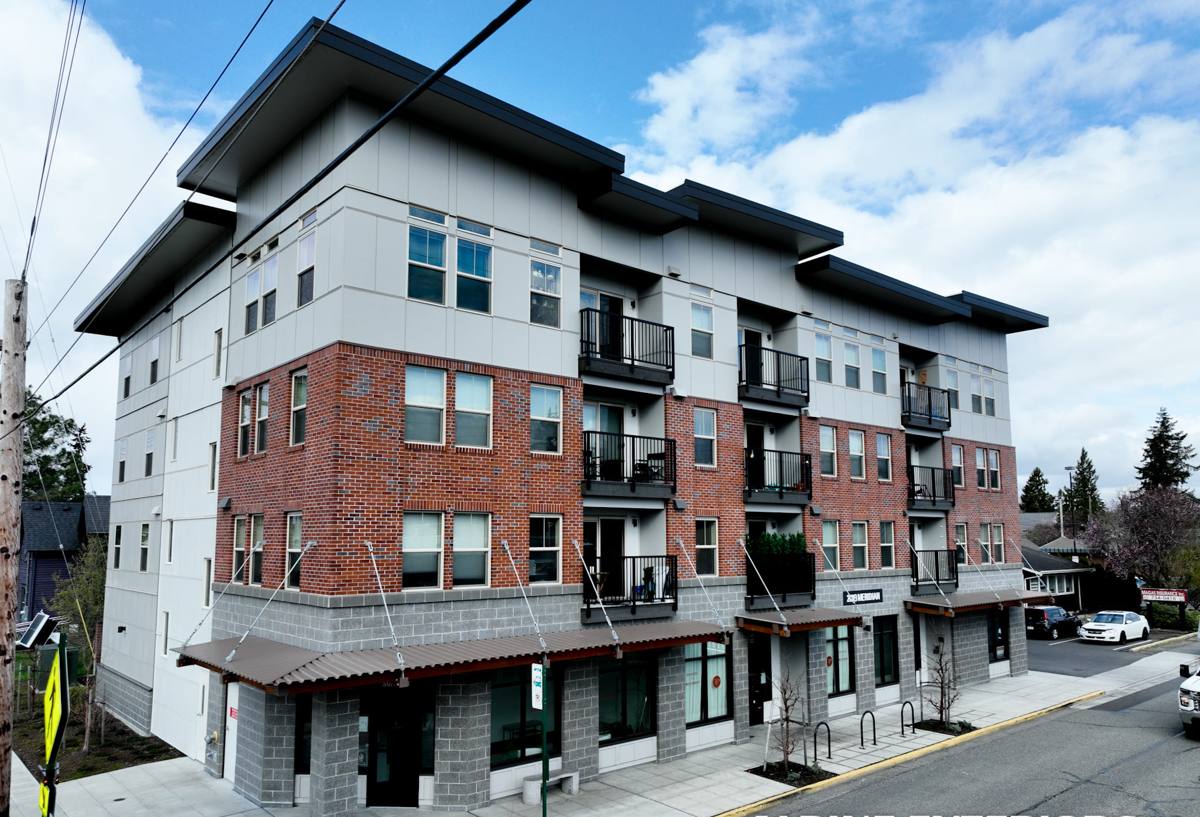
New-Construction Windows Aren't the Same Job as Replacement Windows
It's worth being clear about the distinction, because a lot of homeowners assume any window contractor can do either job equally well. They're related trades, but the work is genuinely different.
A replacement window goes into an existing rough opening, usually working around finished siding and interior trim that's staying in place. A new-construction window gets installed before the siding goes on, with a nailing flange that ties directly into the house's weather-resistive barrier (WRB) and flashing system. That means the installer is building the actual water-management layer of the house, not just fitting a product into a hole. Get it wrong on a new build, and you don't find out for a few years — until moisture starts showing up somewhere it shouldn't.
Why This Distinction Matters More Near the Bay
In a drier climate, a mediocre flashing job might never get tested hard enough to fail. In Columbia, with wind-driven rain hitting west and south-facing walls repeatedly through the wet months, every shortcut gets tested — often in the first winter.
What Bellingham's Climate Actually Demands From a Window Installation
We're not just talking about "it rains here." A few specific conditions shape how we approach every new-construction window install in this area:
- Wind-driven rain: Rain here doesn't just fall, it's pushed sideways against walls and up under trim during storms, which means flashing has to shed water outward and downward at every layer, with no reliance on caulk alone to do the job.
- Salt air corrosion: Proximity to the bay accelerates corrosion on unprotected fasteners, poor-quality flashing, and some hardware finishes. We choose materials that hold up to it rather than ones that just look fine on install day.
- Moss and organic growth: Long damp seasons mean any spot where water can sit — a poorly sloped sill, a gap in sealant — becomes a place where moss, algae, and mildew take hold and hold moisture against the frame.
- Extended humidity: Even without active rain, coastal humidity stays high for months, so wall assemblies need to be able to dry out, not just stay sealed.
A window that's rated fine on paper can still perform poorly here if it's installed without accounting for these conditions. That's why installation quality matters at least as much as the product itself.
The Part Most Homeowners Never See: Flashing and the Weather Barrier
On a new-construction install, the window itself is almost the easy part. The critical work happens in the layers around it.
Every rough opening gets a sloped sill pan so any water that gets past the window has somewhere to go besides the framing below it. Flashing tape integrates with the house wrap in a specific shingled sequence — bottom, sides, then top — so water is always directed outward over the layer beneath it, never trapped behind it. The window's nailing flange ties into that sequence, and the head flashing above the window is what actually keeps water from working its way down behind the siding during a hard blow off the bay.
Done correctly, this system doesn't depend on sealant staying perfect forever. Caulk and sealant are a backup layer, not the primary defense — because sealant is exactly the kind of thing that degrades first in salt air and constant damp.
Sealing and Insulating the Gap Around the Frame
The gap between the window frame and the rough opening needs to be insulated and air-sealed without restricting the window's ability to operate or expand and contract with temperature changes. Overfilling this gap with the wrong material can bow the frame; underfilling it leaves an air and moisture path straight into the wall cavity. We use low-expansion foam or backer rod and sealant matched to the window manufacturer's specifications, not a one-size-fits-all approach.
Meeting Washington's Energy Code Without Guesswork
Washington's energy code sets minimum performance requirements for new-construction windows, and those requirements have gotten stricter in recent code cycles. U-factor (how much heat the window lets through) and, in some cases, solar heat gain coefficient are both checked against the whole-house energy compliance path your builder or designer is using.
On a new build, window selection isn't just a style decision — it's part of the energy compliance package for the whole house. We coordinate with builders and homeowners early so the windows specified actually meet the path the house is being permitted under, rather than discovering a mismatch during inspection.
Choosing Frame Materials for a Coastal, Rainy Climate
Frame material affects how a window handles humidity, salt air, and the freeze-thaw swings that happen here in a mild but wet winter. There's no single "correct" answer for every project — it depends on budget, the home's design, and how much upkeep the homeowner wants to take on.
| Frame Material | How It Handles This Climate | Maintenance |
|---|---|---|
| Vinyl | Good moisture resistance, won't corrode in salt air, stable performance | Low — occasional cleaning |
| Fiberglass | Excellent dimensional stability, holds up well to damp/dry cycling | Low |
| Wood-clad | Strong appearance option; performance depends heavily on cladding and installation quality | Moderate to higher — watch cladding seams over time |
| Aluminum | Can perform well but is more prone to corrosion near the bay without proper finishes | Moderate — inspect fasteners and finish periodically |
We'll walk through these trade-offs honestly during your estimate rather than steering you toward whatever is easiest for us to install. The right call depends on your home's exposure, your budget, and how it fits with the rest of the exterior.
How We Coordinate With Builders on a New-Construction Timeline
New-construction window installs happen on a schedule set by the framing and siding crews, not on their own timeline. We work directly with general contractors and homeowners acting as their own GC to slot window installation in at the right point — after the WRB is up and framing is squared, before siding closes everything in.
Before install day, we confirm rough openings are square and correctly sized, check that the WRB is properly lapped and ready to integrate with flashing, and verify the specified windows match the energy code path and the plan set. Catching a sizing or spec issue before the window shows up on site saves everyone a delay.
What Happens on Install Day
- Rough opening inspection and sill pan installation
- Window set, leveled, and shimmed to manufacturer tolerances
- Flashing integrated in proper shingled sequence with the WRB
- Frame fastened per manufacturer spec — attention to salt-air-resistant fasteners
- Gap insulated and air-sealed around the full perimeter
- Final check for square, level, and smooth operation before sign-off
Common Mistakes We See on New Builds in This Area
Most window problems on new construction trace back to a handful of recurring issues, and they're almost always installation issues rather than product defects:
- Flashing installed in the wrong order, directing water behind the barrier instead of over it
- No sill pan, so any water that does get past the window sits directly on the framing
- Relying on caulk as the primary seal instead of a backup layer
- Fasteners that aren't rated for coastal exposure, leading to early corrosion and staining
- Windows specified without checking them against the house's energy code compliance path
None of these show up on a walkthrough right after install. They show up as a stain on the drywall two winters later, which is exactly why the installation details matter more than they seem to at the time.
Why Local Experience in Columbia Specifically Matters
Whatcom County covers a lot of ground, and exposure conditions shift depending on how close a lot is to the water, how it's oriented, and what's blocking or funneling wind across it. A crew that's worked in and around Columbia has a feel for how these homes sit relative to the bay, how the rain tends to hit them, and which details are worth extra attention on that side of Bellingham. That's not something you get from a general installation manual — it comes from doing the work here, on homes like yours, through more than one wet season.
Get a Straightforward Estimate
If you're building new in Columbia or elsewhere in Bellingham, we're happy to walk through your plans, talk through window and frame options for your home's exposure, and give you a clear, honest estimate — no pressure, no upsell. Reach out using the form below to get started.