 Bellingham Exterior
 Ferndale's Roofs Work Harder Than Most
Ferndale sits close enough to Bellingham Bay and the Salish Sea that salt-laden air is a daily fact of life for anything mounted on a roof deck. Add Whatcom County's long, wet winters and the moss season that follows every one of them, and you've got a climate that quietly wears down roofing materials faster than homeowners expect. It's not usually one dramatic storm that causes trouble — it's the slow accumulation of moisture cycles, UV exposure, and organic growth that eventually finds the weak point in a roof system.
We do roof repair work throughout Ferndale and the surrounding parts of Whatcom County, and the patterns we see here are consistent. Fasteners corrode faster near the water. Moss holds moisture against shingles and shakes for months at a time. North-facing slopes that never get direct sun stay damp long after a storm has passed. None of this means Ferndale homes need constant repair — it means repairs, when they're needed, have to be done with this specific climate in mind, not treated like a generic patch job.
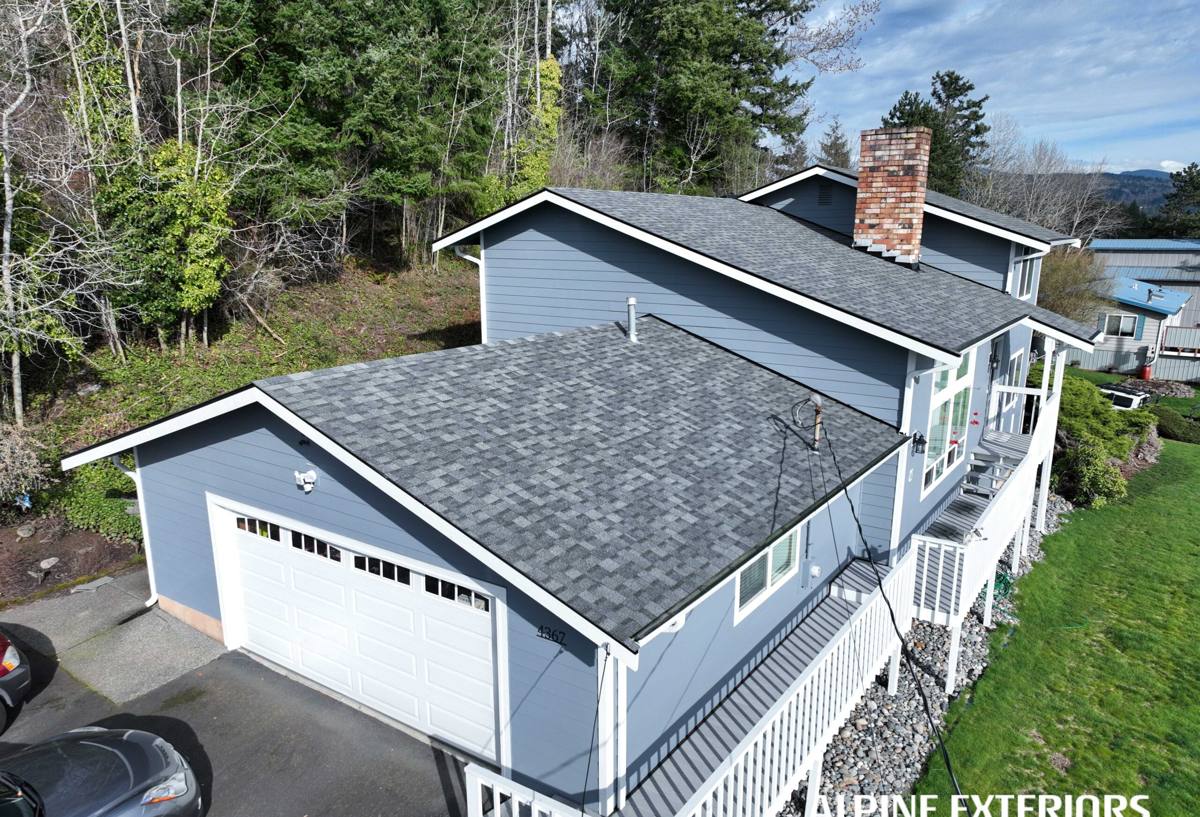
What Driving Rain and Salt Air Actually Do to a Roof
Driving rain off the water doesn't just fall straight down — wind pushes it sideways and up under laps, edges, and flashing that would stay dry in a calmer climate. Over time, that wind-driven moisture finds its way past aging sealant, worn flashing, or shingles that have lost their granule protection. Salt air accelerates corrosion on exposed metal: nail heads, flashing, gutter fasteners, and vent boots all age faster here than they would inland.
The combination matters more than either factor alone. A roof that only dealt with rain, or only dealt with salt air, would hold up longer. In Ferndale, both are working on the roof at once, along with the moss and algae that thrive in the shade and moisture this region provides for a good chunk of the year. A correct repair accounts for all of it — not just the visible symptom, but the conditions that caused it.
Signs a Ferndale Roof Needs Repair — Not Just a Look
Most roof problems show themselves in more than one place if you know what to look for. Homeowners often notice one symptom and miss the others that explain what's really going on.
- Granules collecting in gutters or at downspout outlets — a sign shingles are aging and losing UV protection
- Dark streaking or thick moss patches, especially on north-facing or shaded slopes
- Curling, cracked, or lifted shingle edges, particularly on slopes that catch the most wind-driven rain
- Rust staining around nail heads, vent boots, or flashing
- Soft or spongy spots underfoot on a walked roof, which often means decking has absorbed moisture
- Water stains on interior ceilings or in the attic, especially near chimneys, skylights, or valleys
- Gutters pulling away from the fascia, which changes how water sheds off the roof edge
Any one of these on its own might be minor. Several together usually mean water has been getting past the roof's outer layer for a while, and it's worth having someone look at the whole system rather than just the spot that's visibly failing.
What a Correct Roof Repair Actually Involves
A roof repair that holds up in this climate is rarely just "replace the shingle you can see." The visible damage is usually the last stage of a problem that started somewhere else — a flashing seam, a failed underlayment lap, or a fastener that let go first.
Diagnosis before repair
We start by tracing water back to its actual entry point, which is often several feet from where the stain or damage shows up inside. Water travels along rafters and sheathing before it announces itself, so a repair based only on where the ceiling stain appears can miss the real source entirely.
Flashing and transitions
Most leaks in this region start at a transition — a chimney, a skylight, a valley, a wall intersection — not in the open field of the roof. Flashing that's rusted, undersized, or improperly lapped is a common culprit, and it needs to be replaced and correctly integrated with the roofing material, not just resealed with caulk.
Decking and structure
If water has been getting in for a while, the plywood or board decking underneath may be soft, delaminated, or rotted. Repairing over damaged decking just hides the problem and gives the next round of moisture somewhere weaker to attack. Any soft decking needs to be cut out and replaced before new roofing goes back down.
Matching materials and appearance
On a partial repair, matching the existing shingle or shake profile, color, and exposure matters — both for weather performance and so the repair doesn't stand out. When an exact match isn't available because a roof has faded or the product is discontinued, we'll walk through the realistic options rather than promising a seamless blend we can't deliver.
Common Roofing Materials on Ferndale Homes
Whatcom County has a mix of roofing types, and each one has different repair considerations in a marine climate. Here's how the common options generally hold up and what repair typically involves for each.
| Material | Common Issues in This Climate | Typical Repair Approach |
|---|---|---|
| Asphalt composition shingle | Granule loss, curling edges, moss holding moisture on shaded slopes | Section replacement with matched shingle, flashing renewal at transitions |
| Wood shake or shingle | Moss and algae growth, splitting, moisture retention on north slopes | Selective shake replacement, moss treatment, improved ventilation where possible |
| Metal roofing | Fastener corrosion, sealant failure at penetrations, oil-canning from movement | Fastener and washer replacement, re-sealing penetrations with compatible materials |
| Low-slope / flat membrane | Ponding water, seam separation, UV breakdown over time | Seam repair or patching, addressing drainage slope where feasible |
None of these materials are wrong choices for this area — each has trade-offs in maintenance, lifespan, and repair cost. What matters more than the material itself is whether it was installed correctly and whether it's being maintained in a way that suits our wet, salt-air climate.
Our Roof Repair Process in Ferndale
We keep the process straightforward because homeowners deserve to know exactly what's happening on their roof and why.
- Inspection: We get on the roof (not just a look from the ground) and check the field, all flashing transitions, penetrations, and the attic from below where accessible.
- Diagnosis: We identify the actual point of water entry and any secondary damage to decking or framing, and explain what we found in plain terms.
- Written scope: You get a clear explanation of what needs to be repaired, what materials will be used, and why — no vague line items.
- Repair work: Damaged decking is replaced, flashing is renewed at transitions, and roofing material is matched and installed to shed water correctly, including in wind-driven rain.
- Cleanup and check: Debris and old material are cleared, and we confirm the repair area sheds water as intended before we consider the job done.
We don't upsell a full replacement when a targeted repair will genuinely solve the problem, and we're equally direct when a roof has reached the point where repair is just delaying an inevitable replacement. Either way, you get our honest read, not the answer that's easiest for us.
Moss, Algae, and the Maintenance That Protects a Repair
Ferndale's moss season is long, and it's one of the biggest threats to a roof repair's lifespan if it's ignored afterward. Moss doesn't just sit on the surface — its root structure lifts shingle edges and holds water against the roofing material for weeks at a time, which is exactly the kind of sustained moisture that breaks down asphalt granules and rots wood shakes.
After a repair, a bit of ongoing attention goes a long way:
- Keep gutters and valleys clear of needles and debris so water has a clean path off the roof
- Address moss growth before it thickens, especially on shaded north-facing slopes
- Trim back overhanging branches that keep sections of the roof shaded and damp longer than the rest
- Have the roof looked at after any major windstorm, since wind-driven rain events are when marginal flashing or shingles tend to fail
None of this is about selling unnecessary maintenance visits — it's simply what protects the repair investment you just made in a climate that doesn't let up.
What Roof Repair Typically Costs — and What Changes the Price
Every roof and every leak is different, so we won't quote a number without seeing the roof, but the factors below are what generally move a repair estimate up or down.
| Factor | Why It Matters |
|---|---|
| Extent of decking damage | Rotted plywood or boards found under the surface adds material and labor beyond the visible repair |
| Number of flashing transitions involved | Chimneys, skylights, and valleys each require careful flashing work, which takes more time than open-field repair |
| Roof pitch and access | Steeper roofs and difficult access require more safety setup and time |
| Material match availability | Discontinued or faded shingle and shake products may require a larger repair area to blend acceptably |
| Extent of moss or organic growth | Heavy growth may need to be cleared and treated before the repair area can be properly assessed |
A small, contained flashing repair is a modest job. A repair that uncovers rotted decking across a wider area costs more, simply because more has to be rebuilt correctly. We'll always show you what we found before we do work beyond the original scope.
A Checklist for Hiring a Roof Repair Crew in Ferndale
Roof repair is one of those trades where a rushed or incomplete job doesn't show its true cost until the next heavy rain. Before hiring anyone, it's worth asking:
- Are they licensed and insured to do roofing work in Washington State, and will they show proof without hesitation?
- Will they actually get on the roof and inspect it, or are they quoting from a ground-level look or photos alone?
- Do they explain what caused the damage, not just what they plan to replace?
- Will they check for and disclose decking damage before closing the roof back up?
- Do they have regular experience with this area's climate — wind-driven rain, salt air, and moss — or is that an afterthought?
- Is the scope of work put in writing before they start?
A crew that can answer all of these plainly, without getting defensive, is usually one that does the work the same way whether or not you're watching.
Why Local Experience in Ferndale Matters
A roofer who mostly works drier, inland climates will sometimes underestimate how much wind-driven rain and salt air change what a "good enough" repair looks like. Flashing details that hold up fine elsewhere can fail here within a season or two if they weren't built for water coming in sideways during a coastal storm. Knowing which slopes in this area tend to hold moss longest, which transitions take the brunt of driving rain, and how fast fasteners corrode near the water isn't something you learn from a manual — it's something you learn from doing the work here, repeatedly, through a few full wet seasons.
That local pattern recognition is what separates a repair that lasts from one that needs to be redone in a year or two. We're not guessing at how Ferndale's climate behaves — we've seen how it treats roofs across a lot of properties in this part of Whatcom County, and we build every repair around that.
Get an Honest Look at Your Roof
If you're seeing moss buildup, granule loss, a stain on a ceiling, or you just want a second opinion before a small problem becomes a bigger one, we're happy to take a look. Fill out the form below for a free, no-pressure estimate — we'll tell you plainly what we find and what it would take to fix it right.