 Bellingham Exterior
 Board & Batten Siding in Barkley: Built for This Specific Corner of Bellingham
Barkley sits close enough to the water and the surrounding tree cover that its homes take a different kind of weather beating than siding fifteen minutes inland. Salt-laden air moves through the neighborhood off Bellingham Bay, driving rain comes in sideways for months at a stretch, and the tree canopy that makes the area attractive also means shaded siding stays damp longer and grows moss faster. Board and batten siding — with its bold vertical lines and deep shadow reveals — is one of the most requested looks for homes in and around Barkley, but it's also one of the least forgiving styles if it's installed wrong. Every seam, batten, and fastener location is a decision point that either sheds water correctly for decades or starts trapping it within a few seasons.
This page is specifically about board and batten siding for Barkley homes — not a generic overview of the style. If you're comparing bids or trying to understand what "correct" actually looks like on a house in this part of Whatcom County, this is the detail that matters.
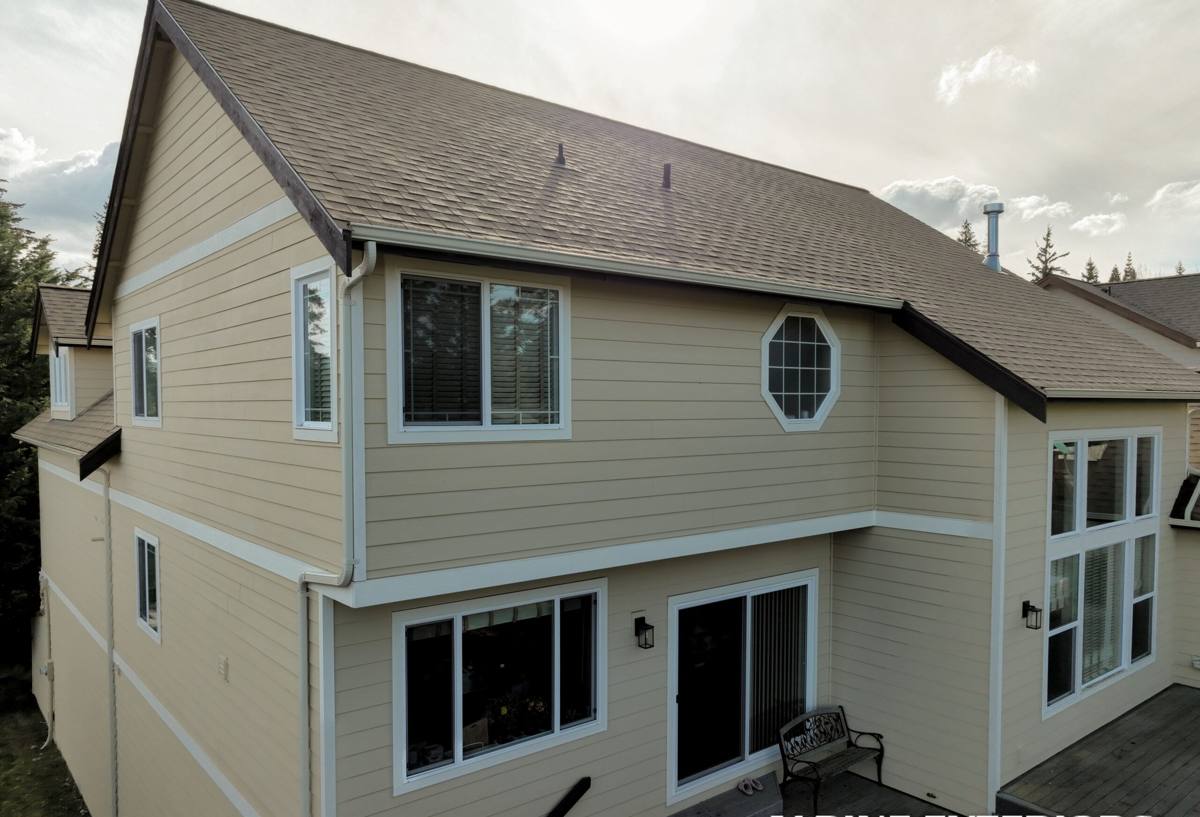
Why Barkley's Climate Changes How Board & Batten Should Be Installed
Salt Air and Corrosion
Homes closer to the bay deal with airborne salt that accelerates corrosion on fasteners, flashing, and trim. Board and batten relies on a lot of exposed vertical seams and batten strips, each one fastened through the field of the panel. If the fastener schedule uses the wrong hardware or spacing, those fastener points become the first place rust and staining show up — usually as thin dark streaks bleeding down the face of the batten within a couple of years.
Driving Rain
Bellingham's rain doesn't fall straight down for much of the year — it's pushed sideways by wind off the water, which means it hits vertical siding at an angle and works its way behind battens and around butt joints if there's no drainage path behind the cladding. Board and batten depends entirely on correct water-resistive barrier lap, flashing at every horizontal joint, and a rainscreen gap to let any water that does get behind the boards drain and dry out. Skip that gap and you're building a system that holds moisture against the sheathing instead of shedding it.
Moss and Shade
Wherever mature trees shade a wall for most of the day — common on lots throughout Barkley — moss and algae take hold faster on any surface that stays damp. This isn't just cosmetic. Moss holds moisture against the siding face and, on the wrong substrate, that moisture cycle degrades the material over time. It matters what the board and batten is made of, not just how it's installed.
What "Correct" Board & Batten Installation Actually Involves
- A properly lapped and sealed water-resistive barrier behind the entire wall assembly, not just behind the seams
- A rainscreen gap (furring strips or a drainage mat) so any incidental moisture behind the panel can drain and dry
- Flashing at every horizontal panel joint, window and door head, and roof-to-wall intersection — not caulk used as a substitute for flashing
- Battens fastened on-center into framing at the correct spacing, not just into the panel or sheathing
- Corrosion-resistant fasteners appropriate for a coastal-influenced climate
- Correct clearance at grade, decks, and patios so the bottom edge of the siding never sits in standing water or contacts soil
- Factory-finished material with sealed cut edges in the field, so field cuts don't become the first point of moisture intake
Any one of these steps skipped is usually invisible on the day the job finishes. They show up two, five, or ten years later as staining, soft spots, or boards that have to come off and get replaced early — which almost always costs more than doing it right the first time.
Why We Install James Hardie Fiber Cement Board & Batten — Not Cedar, Not Vinyl, Not Engineered Wood
Board and batten is traditionally a wood look, and homeowners in Barkley often start their research picturing cedar. Cedar earns that reputation honestly — it's a genuinely attractive, time-tested material. But in a climate with this much sustained moisture and shade-driven moss pressure, cedar board and batten demands a maintenance schedule most homeowners underestimate: refinishing on a multi-year cycle, ongoing caulk and seal maintenance at every batten, and vigilance against rot at any spot the finish fails. We don't install cedar siding because we don't want to hand a homeowner a product that punishes a missed maintenance year with real structural repair costs.
Engineered wood siding (like LP SmartSide) improves on solid wood's dimensional stability, but it's still a wood-based substrate — it can swell or degrade at cut edges and panel joints if moisture gets in and stays in, which is exactly the failure mode Barkley's climate is built to cause. Vinyl board and batten is low-maintenance and inexpensive, but it's a thin plastic product that can warp in temperature swings, fades over time, and simply doesn't hold the crisp, deep shadow lines that make board and batten look right — the reveals read flat instead of substantial.
We install James Hardie fiber cement exclusively. It's non-combustible, dimensionally stable in wet-dry cycles, and comes with a factory-applied ColorPlus finish that's engineered to resist fading and doesn't require the refinishing cycle wood siding does. Hardie's HZ5 product line is specifically engineered for climates with sustained moisture exposure like ours, and the material's density holds a genuinely crisp batten reveal that keeps its shape and shadow line for decades, not just the first few years. For a style built entirely on clean vertical lines and shadow depth, that stability is the difference between board and batten that still looks sharp at year fifteen and board and batten that's visibly wavy or faded by year five.
Our Process for a Barkley Board & Batten Project
1. On-Site Assessment
We walk the specific exposures on your home — which walls take direct wind-driven rain, which stay shaded and moss-prone, where grade or hardscape sits close to the wall — because those conditions drive real decisions about flashing, clearance, and rainscreen detailing.
2. Tear-Off and Substrate Check
Existing siding comes off and we inspect the sheathing underneath for any hidden moisture damage before anything new goes on. Board and batten installed over a compromised substrate fails regardless of how good the new material is.
3. Water Management Layer
Water-resistive barrier, flashing, and rainscreen furring go in first, sequenced and lapped correctly at every penetration, window, and joint.
4. Panel and Batten Installation
Hardie panels and battens are installed to manufacturer fastening specs, with corrosion-resistant fasteners driven into framing at the correct spacing and reveal.
5. Trim, Caulk, and Touch-Up
Factory-finish touch-up paint on any field cuts, correct sealant at transitions (not as a substitute for flashing, but as a finishing detail), and a final walk-through.
Board & Batten Material Comparison for Barkley's Climate
| Material | Moss/Moisture Resistance | Maintenance | Shadow Line Stability |
|---|---|---|---|
| James Hardie Fiber Cement | High — non-combustible, dimensionally stable | Low — factory finish, no refinishing cycle | Holds crisp reveal long-term |
| Cedar | Moderate — vulnerable if finish fails | High — periodic refinishing and sealing | Can cup or warp over time |
| Engineered Wood (LP SmartSide) | Moderate — wood-based substrate risk at edges | Moderate — finish maintenance required | Generally stable if maintained |
| Vinyl | High resistance to rot, but can trap moisture behind | Low | Flatter profile, can warp in heat |
Cost Factors for Board & Batten in Barkley
Every board and batten quote should account for more than just material and labor per square foot. In this neighborhood specifically, the factors that most often move a price are:
- How many walls face prevailing wind-driven rain and need extra flashing attention
- Whether tear-off reveals hidden moisture or rot damage in the existing sheathing
- The number of window and door openings, since each one requires correct head flashing
- Whether a rainscreen system is being added where one didn't exist before
- Trim complexity — corner boards, fascia, and transitions all add labor
- Access — tree cover, tight side yards, and multi-story walls affect staging and time
A fair estimate walks through these specifics on your actual house rather than quoting a flat per-square-foot number sight unseen.
Why Hiring a Crew That Already Works in Barkley Matters
Board and batten failures in this climate are rarely about the product — they're about installation decisions that don't account for local conditions. A crew that hasn't worked Bellingham's coastal-influenced weather before might follow a generic fastening schedule or skip a rainscreen gap because it "usually" isn't necessary where they normally work. A crew that already does this work in Whatcom County knows which walls in a neighborhood like Barkley take the worst of the wind-driven rain, how much shade-driven moss pressure to plan for, and where salt air makes fastener selection non-negotiable. That local pattern recognition is what keeps a board and batten job looking right ten years out instead of needing early repair.
If you're considering board and batten siding for a home in Barkley, we're happy to walk the property, look at your specific exposures, and put together a straightforward, no-pressure estimate — just fill out the form below to get started.