 Bellingham Exterior
 Why Barkley Roofs Take a Different Kind of Beating
Barkley sits close enough to Bellingham Bay and the Nooksack lowlands that roofs here deal with a specific combination of stresses most inland homes never see. Salt-tinged air off the Sound accelerates corrosion on exposed metal — fasteners, flashing, gutter hangers, vent caps. Driving rain off winter storms doesn't just fall straight down; wind pushes it sideways and up under laps, ridge caps, and anywhere a seal has aged past its useful life. And because this part of Whatcom County stays cool and shaded for long stretches of the year, moss gets a head start every fall and doesn't let go until late spring.
None of that means Barkley roofs fail faster than roofs anywhere else in the region — it means the damage shows up in different places, and a repair that doesn't account for wind-driven rain and moss growth patterns tends to fail again within a season or two.
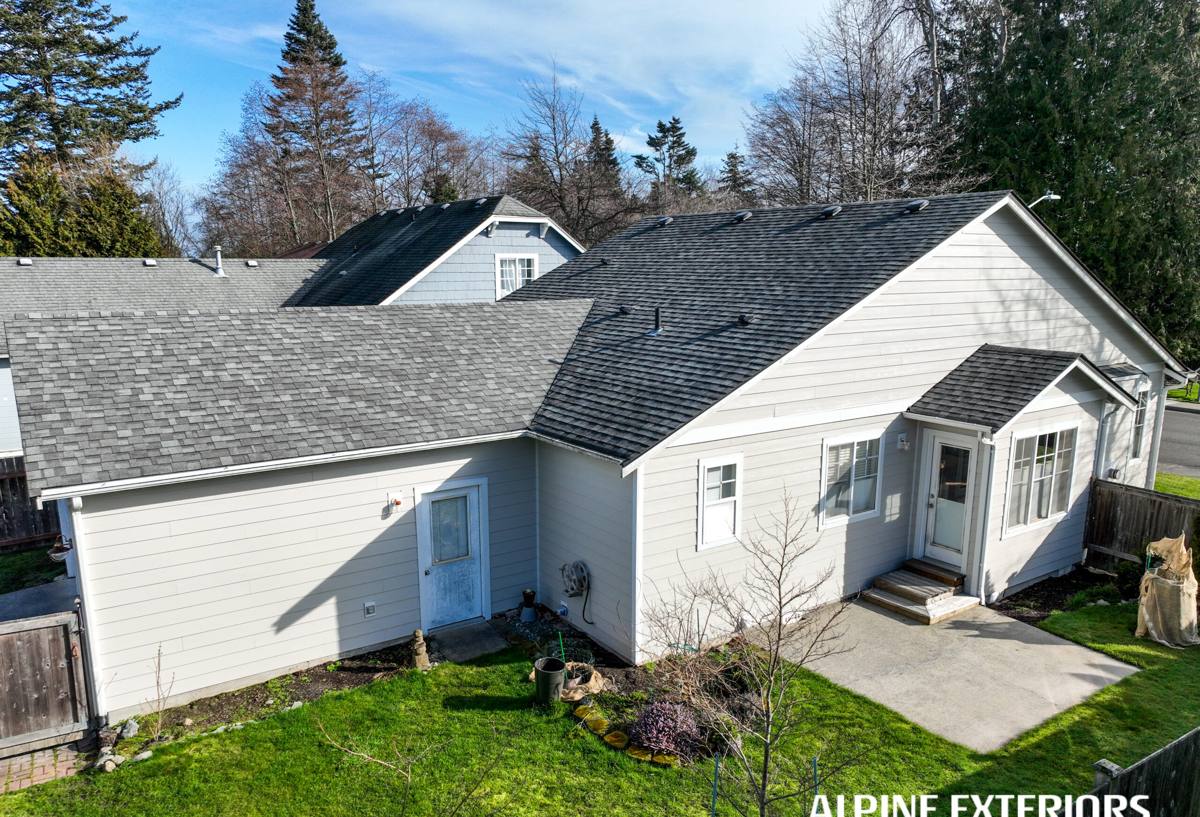
What Storm Damage Actually Looks Like on a Barkley Roof
Storm damage rarely announces itself with a hole. Most of what we get called out for after a wind event or a stretch of hard rain is subtler:
- Lifted or creased shingles along ridgelines and roof edges, where wind gets the most leverage
- Blown or loosened ridge cap — often the first thing to go in a gusty system
- Torn or lifted flashing around chimneys, skylights, and roof-to-wall transitions
- Granule loss from wind-driven debris, which shows up as bare patches or grit collecting in gutters
- Water staining in the attic or on ceilings that wasn't there before the last storm
- Moss-weakened zones where organic growth already loosened shingle edges, making that section the first to fail once wind got under it
That last one is worth sitting with. A lot of what looks like sudden storm damage is really moss and moisture that had been quietly working on a roof for a year or two, with the storm just being the event that finished the job. If we find storm damage concentrated in one area, we're going to check whether pre-existing moss or moisture damage set that area up to fail.
What a Correct Storm Damage Repair Actually Involves
It starts with finding the real extent of the problem
A rushed repair patches the visible damage and leaves the roof vulnerable to the next storm. A correct repair starts by tracing water intrusion back to its actual entry point, which is often several feet from where the stain or the drip shows up inside. Water follows the roof deck and rafters before it finds a gap to drop through, so the ceiling stain and the failure point are frequently not in the same spot.
Then it addresses the underlying material, not just the surface
If shingles lifted because the sealant strip failed or because moss undermined the bond, replacing just the torn shingle without dealing with the surrounding material is a short-term fix. We check the felt or synthetic underlayment underneath any repair area — if water got past the shingle layer, the underlayment may already be compromised, and that's the actual waterproofing layer doing the real work.
And it matches materials correctly
Shingle color and profile change over the years, so an exact match isn't always possible on an older roof. We're honest about that upfront rather than promising a seamless blend we can't deliver — the priority is a repair that performs correctly and holds up to the next storm, with the best reasonable match available.
Our Process, From Call to Completion
- Initial contact and scheduling — we get a description of the damage and timeline, and prioritize active leaks
- On-site inspection — we walk the roof (not just look from the ground) and check the attic from inside where accessible
- Written scope and estimate — what needs repair, what materials, and a real price range before any work starts
- Temporary protection if needed — tarping or emergency sealing if there's an active leak and full repair has to wait on materials or weather
- Repair work — completed to the scope, with attention to flashing and underlayment, not just the top layer
- Final walkthrough — we show you what was done and what to watch for going forward
Repair vs. Replace: How We Help You Decide
Not every storm-damaged roof needs a full replacement, and not every repair is the right call either. The honest answer depends on a few factors:
| Factor | Leans toward repair | Leans toward replacement |
|---|---|---|
| Age of roof | Under 12–15 years, otherwise sound | Nearing or past expected lifespan |
| Extent of damage | Isolated to one section or edge | Scattered across multiple slopes |
| Underlayment condition | Dry and intact beneath repair area | Saturated or deteriorated in multiple spots |
| Moss/moisture history | Minimal prior growth | Long-standing moss with deck-level staining |
| Insurance involvement | Minor claim, targeted scope | Storm-wide damage supports full replacement claim |
We'll give you a straight recommendation based on what we actually find on your roof, not the most expensive option on the list.
Working With Storm Damage Insurance Claims
If your damage is significant enough to involve your homeowner's insurance, we can document what we find with photos and a written scope that an adjuster can work from. We're not a public adjuster and we don't handle the claim itself, but a clear, specific damage report from a roofer who actually got on the roof tends to move a claim along faster than a vague description. If you're unsure whether damage is claim-worthy, that's a reasonable thing to ask us during the inspection — we'll tell you honestly if it's a repair better paid out of pocket than filed.
Materials We Use for Storm Repairs in This Climate
For repair work specifically, matching the existing roofing material is usually the right call rather than introducing a different product into one section. Where we do have latitude — flashing, fasteners, sealants — we lean toward materials that hold up to the salt air and moisture cycle common to this part of Whatcom County: corrosion-resistant fasteners and flashing over standard-grade alternatives, and sealants rated for sustained wet exposure rather than intermittent weather. It costs a little more upfront on a repair; it's also the difference between a fix that lasts and one we get called back for in two winters.
Why a Crew That Already Works Barkley Matters
There's a practical reason to hire a contractor who already works this specific area rather than one dispatching from further out. We know what a normal amount of moss growth looks like on a Barkley roof at a given age versus what signals a bigger moisture problem. We know how the wind tends to move through this part of Bellingham during a winter system, and which roof orientations take the brunt of it. That local pattern recognition means less time spent diagnosing and more time spent actually fixing the problem correctly the first time.
It also means we can usually respond faster after a storm event, when half the neighborhood may be dealing with the same wind and every day with an active leak makes the underlying damage worse.
After a Storm: A Quick Checklist
Before you call anyone, here's what's worth checking (safely, from the ground — we don't recommend homeowners get on the roof after a storm):
- New water stains on ceilings or upper walls, especially near chimneys or skylights
- Shingle pieces or granules in the yard, gutters, or downspouts
- Visibly lifted or missing shingles along ridges and edges, viewed with binoculars if needed
- Gutters pulling away from the fascia or sagging under debris
- Any musty smell in the attic, which can mean moisture intrusion before it shows on the ceiling
- Damaged or missing flashing around vents and chimneys, visible from the ground on a clear day
If you notice any of these, don't wait for the next storm to check the roof — get it looked at while the damage is still limited to one repair rather than a bigger problem underneath.
If you're dealing with storm damage on a Barkley roof — or you just want a second set of eyes after a rough winter system — we're happy to come take a look. The estimate is free, there's no pressure to book anything on the spot, and you'll get a straight answer about whether it's a repair or something bigger. Fill out the form below to get started.