 Bellingham Exterior
 Why Birchwood Roofs Wear Differently Than Roofs Inland
Birchwood sits close enough to Bellingham Bay and the broader Puget Sound air mass that homes here deal with a combination most inland Whatcom County neighborhoods don't: salt-laden air, near-constant winter drizzle punctuated by hard driving rain, and a moss season that can run eight months or longer. None of these factors is dramatic on its own. Together, over ten or fifteen years, they add up to roofs that fail earlier than their rated lifespan would suggest.
Salt air accelerates corrosion on exposed metal — nail heads, flashing, vent caps, and gutter hardware all take the hit faster than they would in a dry inland climate. Driving rain, especially when it comes in sideways off a stiff westerly, finds every weak seam, undersized flashing detail, and poorly lapped shingle course. And moss doesn't just look bad — its root structure lifts shingle edges, holds moisture against the roof deck, and quietly rots the substrate underneath while the shingles above still look intact from the ground.
A roof replacement in this part of Bellingham has to account for all three. That means material choices, fastening details, and ventilation strategy that are appropriate for Birchwood's specific exposure, not just whatever spec sheet a manufacturer publishes for a generic Pacific Northwest climate.
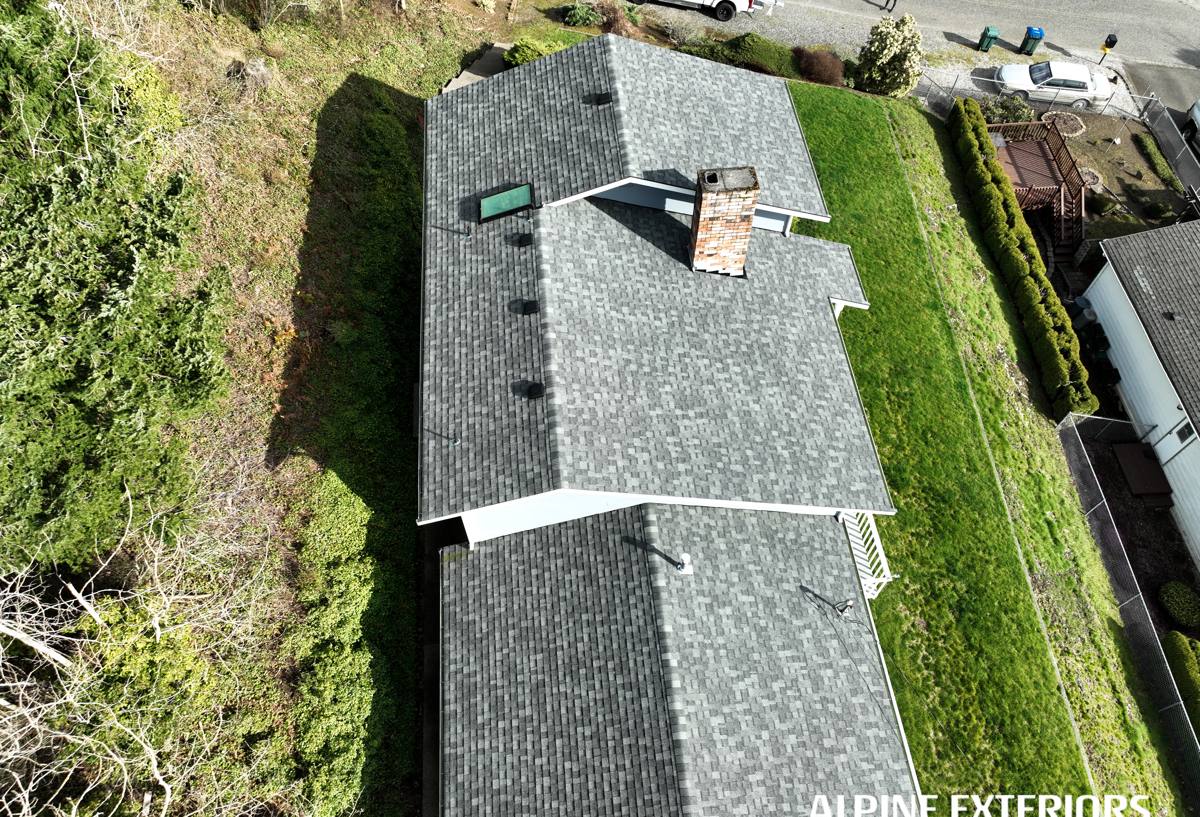
Signs a Birchwood Roof Has Crossed From "Repair" Into "Replace"
Homeowners often call us for a repair quote and end up learning the roof is past the point where patching makes financial sense. Some reliable signals:
- Granule loss heavy enough that you're finding grit in gutters and downspouts every time it rains
- Moss that keeps returning within a season or two of cleaning, even after treatment
- Soft or spongy spots underfoot when walking the roof, indicating deck rot
- Daylight visible through the attic sheathing, or damp insulation after a wind-driven storm
- Shingles curling, cracking, or losing their tab edges, especially on south and west-facing slopes
- Flashing around chimneys, skylights, or roof-to-wall transitions that's rusted, lifted, or was never properly step-flashed to begin with
- A roof that's already had two or more repair visits in the past three years for different leaks
Any one of these on its own might still be a repair. Two or three together, especially on a roof already in its second or third decade, usually means the underlying materials are failing faster than the surface suggests.
Why "It Still Looks Fine" Isn't Enough
This is the trap we see most often in Birchwood: a roof that looks presentable from the street but has been holding moisture against the deck for years because of moss buildup or marginal flashing. By the time staining shows up on an interior ceiling, the deck underneath has often already been compromised. A proper inspection before you commit to replacement — or even before you decide repair is enough — should include time on the roof itself, not just a look from the ladder or the driveway.
What a Correct Roof Replacement Actually Involves
A roof replacement done right in this climate is a system, not a single product. Skipping or under-specifying any one layer is what leads to the early failures we get called out to fix on other contractors' work.
Tear-Off and Deck Inspection
Full tear-off to bare sheathing lets us actually see the deck condition — soft spots, delamination, or rot that's invisible from above. Any damaged sheathing gets replaced before anything else goes down. Roofing over a compromised deck just hides the problem for a few more years.
Underlayment
Given how much wind-driven rain Birchwood sees, we treat underlayment as more than a formality. Ice-and-water shield at eaves, valleys, and penetrations, paired with a synthetic underlayment across the field, gives a second line of defense if wind ever drives water up under the primary roofing material.
Flashing
Flashing is where most premature leaks originate — not in the field of the roof. Chimneys, skylights, sidewall transitions, and valleys all need properly formed, corrosion-resistant flashing, step-flashed and counter-flashed correctly rather than relied on caulk to seal a gap that shouldn't exist.
Ventilation
Balanced intake and exhaust ventilation keeps moisture from condensing inside the attic, which matters as much for roof longevity as anything happening on the exterior surface. Under-ventilated attics trap humidity, which speeds up deck rot from the inside — a problem that's easy to prevent during a full replacement and expensive to fix afterward.
Roofing Material
The material itself, installed correctly over a sound system beneath it, matters less than people assume — but it still matters. See the comparison below for how common options hold up specifically against Birchwood's salt air and moss exposure.
Material Comparison for Birchwood's Climate
| Material | Moss Resistance | Salt Air / Corrosion | Typical Lifespan Here | Maintenance |
|---|---|---|---|---|
| Architectural asphalt shingle | Moderate — benefits from zinc/copper strips | Good if fasteners and flashing are corrosion-resistant | 20-30 years | Periodic moss treatment, gutter clearing |
| Standing seam metal | High — sheds moisture, little for moss to root in | Depends on coating; coastal-rated finishes hold up well | 40-50+ years | Low; occasional fastener/seam check |
| Composite/synthetic shake | Moderate to high | Good — minimal exposed metal | 30-50 years | Low to moderate |
| Cedar shake | Low without diligent upkeep | Neutral, but moisture retention is the bigger issue | 15-25 years in this climate | High — regular treatment needed to resist rot |
We'll walk through which of these fits your budget, roof pitch, and how the house sits relative to wind and shade — a heavily tree-shaded lot holds moisture differently than an open, wind-exposed one, even two streets apart.
Our Process for a Birchwood Roof Replacement
- On-roof inspection — we walk the roof, not just the ground, and check the attic from the inside for ventilation and moisture signs.
- Written estimate — a clear scope covering tear-off, deck repair allowances, underlayment, flashing, material, and ventilation, so there are no surprise change orders mid-project.
- Scheduling around weather windows — we watch the forecast closely and plan tear-off days to avoid leaving a deck exposed when rain is likely, which matters more here than in drier climates.
- Tear-off and deck repair — old material removed, deck inspected and repaired as needed before anything new goes down.
- System installation — underlayment, flashing, ventilation, and final roofing material installed to manufacturer specification.
- Site cleanup and final walkthrough — magnetic sweep for stray fasteners, debris hauled off, and a walkthrough so you know exactly what was done and what to watch for going forward.
Cost Factors Homeowners Should Understand
| Factor | Why It Matters |
|---|---|
| Roof size and pitch | Steeper roofs take longer and require more safety setup, affecting labor cost |
| Deck condition | Rot found during tear-off means sheathing replacement — budget a contingency |
| Material choice | Asphalt, metal, and composite carry different material and labor costs |
| Number of penetrations | Chimneys, skylights, and vents each add flashing labor |
| Access and layout | Tight lots, fencing, or landscaping near the house can affect staging and disposal |
| Tear-off layers | A roof with two layers already on it takes longer to strip than a single-layer tear-off |
We'd rather walk a Birchwood roof in person and give you real numbers than quote a per-square estimate over the phone that doesn't hold up once we're actually up there.
Why It Matters to Hire a Crew That Already Works This Neighborhood
Birchwood's lot sizes, tree cover, and street access vary block to block, and a crew that's already worked in the neighborhood knows what to expect before the trucks show up — where staging and material drop-off are realistic, how tree canopy affects drying time and moss regrowth on a given lot, and what the City of Bellingham's permitting process requires for a full roof replacement. That familiarity translates into fewer surprises during the job and a more accurate estimate up front.
It also means we're not learning the local climate on your roof. We've seen how flashing details that work fine in a drier climate fail here within a few winters, and we build accordingly rather than defaulting to minimum code.
Contractor Vetting Checklist
- Washington State contractor license, active and in good standing
- Current liability insurance and workers' compensation coverage
- A written estimate that itemizes tear-off, deck repair allowance, underlayment, flashing, and material — not a single lump-sum number
- Willingness to walk the roof in person before quoting, not just estimate from photos or satellite imagery
- Clear manufacturer warranty terms plus a stated workmanship warranty from the contractor itself
- References or a portfolio of completed local work you can ask about
- A plan for weather contingencies during tear-off, given how much rain this area gets
Ready to Talk About Your Roof?
If your Birchwood roof is showing its age — persistent moss, granule loss, aging flashing, or just a lot of birthdays — we're happy to come take a look and give you an honest read on whether repair still makes sense or it's time to plan a replacement. Reach out using the form below for a free, no-pressure estimate.