 Bellingham Exterior
 Decking Built for Blaine's Coastline, Not a Generic Backyard
Blaine sits right on Semiahmoo Bay and Drayton Harbor, which means most decks here are dealing with something inland Whatcom County homes don't: near-constant salt-laden air, wind-driven rain that hits at an angle instead of falling straight down, and a moss season that can stretch from October well into April. A deck that would hold up fine in a drier, more sheltered yard can start showing problems within a couple of seasons out here — hardware corrosion, slick green growth on the walking surface, moisture trapped under boards that never fully dries out. Composite decking, installed correctly for this specific environment, solves most of that. Installed the way a lot of decks get installed — fast, with stock fasteners and no real attention to drainage — it just delays the same problems by a year or two.
This page is specifically about composite decking for Blaine properties. We also build and repair decks throughout Bellingham and the rest of Whatcom County, but the coastal conditions in Blaine change enough about the job — hardware choice, ventilation, board spacing, even how we sequence the work around weather — that it's worth talking about on its own.
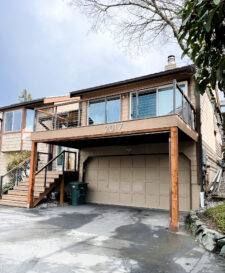
What Blaine's Climate Actually Does to a Deck
Salt Air
Airborne salt from the bay settles on every exposed surface, including fasteners, joist hangers, and any metal flashing. Standard galvanized hardware can start pitting and staining within a few years this close to the water. It's not usually the composite boards themselves that fail first in a salt environment — it's the screws, brackets, and ledger connections underneath them.
Driving Rain
Wind off the water pushes rain sideways, which means water gets forced into gaps and joints that would stay relatively dry on a more sheltered lot. Ledger flashing, end-cuts, and any point where the deck meets the house siding need to be sealed and detailed with that in mind, not just "code minimum."
Moss and Prolonged Damp
Blaine's long wet season keeps deck surfaces damp for extended stretches, especially on north-facing or shaded decks. Moss and algae need that sustained moisture to establish, and once they get a foothold on a walking surface they're not just unsightly — they're a slip hazard on stairs and ramps.
Why Composite Makes Sense Here — and Where It Still Needs Help
Composite decking's main advantage in a climate like this is that the boards themselves don't rot, splinter, or need annual staining the way wood does. That's a real advantage in a place where a maintenance window of dry, mild days can be hard to find for months at a time. But composite isn't maintenance-free, and it isn't immune to the coastal environment — it just moves the weak points. The board surface can still grow moss and mildew if it stays damp and shaded. Hidden fastener systems can still corrode if the wrong hardware grade is used. And a substructure built without enough airflow underneath will trap moisture regardless of what's on top of it.
Capped vs. Uncapped Composite
Most composite boards sold today are "capped" — a wood-plastic composite core wrapped in a solid polymer shell that resists staining and moisture absorption far better than older, uncapped composite products. In a salt-air, high-rain environment like Blaine, we treat capped composite as the standard, not an upgrade. Uncapped or lower-grade composite tends to absorb more moisture at cut ends and fastener holes, which shows up as swelling or discoloration sooner in a coastal climate than it would inland.
Composite vs. Other Decking Materials for a Blaine Home
| Material | How it handles salt air & rain | Typical maintenance | Where it fits |
|---|---|---|---|
| Capped composite | Strong resistance to moisture absorption and salt staining when installed with corrosion-rated hardware | Periodic cleaning to prevent moss/algae buildup | Most Blaine decks, especially exposed or waterfront lots |
| Pressure-treated wood | Prone to cupping, splitting, and fastener corrosion in sustained damp conditions | Annual sealing/staining, moss treatment | Budget-conscious projects where upfront cost matters most |
| PVC decking | Excellent moisture resistance, no wood fiber to absorb water | Low; occasional cleaning | Homeowners prioritizing minimal upkeep over wood-grain look |
| Natural hardwood (cedar, etc.) | Handles moisture well when maintained, but salt air accelerates weathering | Regular oiling/sealing, more frequent in coastal exposure | Homeowners who want a natural look and will keep up with upkeep |
What a Correct Composite Deck Build Involves in Blaine
Substructure First
The framing underneath the boards matters more than the boards themselves. We build the substructure with adequate ground clearance and joist spacing suited to composite's flex characteristics, and we make sure there's real airflow underneath — not a sealed, low-clearance cavity where moist coastal air just sits and never dries out.
Ledger and Flashing Details
Where the deck attaches to the house, the ledger board connection is the single most common source of hidden water damage on any deck, and driving rain off the bay makes it worse. We flash that connection so water sheds away from the house rather than tracking behind the siding.
Joist Protection
We run joist tape or an equivalent moisture barrier across the top of every joist before boards go down. It's a small material cost that keeps rainwater from soaking directly into the framing lumber at every fastener point — the exact spot where salt-air corrosion and trapped moisture do the most damage over time.
Hidden Fastener Systems
Most composite boards today use a hidden clip system rather than face-screwing, which gives a cleaner look and eliminates the exposed screw heads that corrode fastest in salt air. Where face fasteners are still needed — stair stringers, picture-frame borders, fascia — we use stainless steel or coated hardware rated for coastal/marine exposure, not the standard-grade screws that come in a big-box fastener box.
Board Spacing and Drainage
Gapping between boards is set to allow water to actually drain through rather than pool on the surface, which matters more here than in a drier climate because Blaine decks simply see more total rain hours per year.
Our Process for a Blaine Composite Deck
- On-site assessment — we look at sun/shade exposure, proximity to the water, existing structure (if replacing boards on an existing frame), and drainage around the footprint.
- Design and material selection — board color, profile, and railing system, matched to your budget and how exposed the site is to wind and salt spray.
- Substructure build or inspection — new framing built to coastal-appropriate spacing and clearance, or a full inspection of existing framing if we're re-decking over it.
- Moisture barrier and hardware installation — joist tape, flashing, and corrosion-rated fasteners throughout.
- Composite board installation — hidden-fastener system, proper gapping, clean edge and stair detailing.
- Final walkthrough — we go over basic care so the deck stays looking right through its first few wet seasons.
Living With a Composite Deck in a Coastal Climate
Composite cuts down maintenance dramatically compared to wood, but "low maintenance" isn't "no maintenance," especially this close to the bay. A simple seasonal routine keeps a Blaine composite deck performing the way it's supposed to:
- Rinse or sweep salt residue and debris off the surface periodically, especially after storms
- Clean shaded or north-facing sections more often, since they hold moisture longer and are the first spots moss takes hold
- Keep gutters and downspouts near the deck clear so runoff isn't dumping directly onto the deck surface or substructure
- Check railing posts and stair connections annually for any sign of hardware corrosion
- Trim back vegetation that's shading the deck or blocking airflow underneath it
- Use a composite-safe cleaner rather than harsh pressure-washing that can etch the cap surface
Permits and Local Considerations
Deck projects in Blaine and unincorporated Whatcom County typically require a building permit, especially for anything attached to the house or built above a certain height — the exact thresholds and process depend on your specific jurisdiction, so we confirm requirements for your address before work starts rather than assuming. If your property is close to the shoreline, there may be additional setback or shoreline management considerations worth checking into early, before design decisions are locked in.
Why It Matters That We Already Work in Blaine
A lot of what makes a composite deck last in Blaine isn't in the manufacturer's installation manual — it's knowing that this particular street or this particular lot gets more direct wind off the bay, or that a north-facing deck two blocks from the water is going to need more attention to drainage than the spec sheet accounts for. A crew that mostly builds decks in drier, more sheltered parts of Whatcom County isn't wrong about composite decking in general, but they're guessing about the coastal-specific details — hardware grade, ventilation, moss exposure — that determine whether a deck still looks and performs well five or ten years in. We build and maintain decks in this area regularly, so those adjustments aren't an afterthought; they're just part of how we spec the job from the start.
Questions to Ask Before You Hire
- Will you use corrosion-rated (stainless or coated) hardware given the salt air, or standard fasteners?
- Is joist tape or an equivalent moisture barrier included, or is that an add-on?
- How will the substructure be ventilated to prevent trapped moisture underneath the deck?
- Do you pull the required permit, and have you built decks near the shoreline in Blaine before?
- What's the manufacturer's warranty on the specific composite line you're proposing, and does it cover coastal/marine environments?
If you're planning a new composite deck or replacing an aging one in Blaine, we're happy to take a look and give you a straightforward, no-pressure estimate. Use the form below to get in touch and we'll go over what your specific site needs.