 Bellingham Exterior
 Why Blaine's Coastal Climate Is Hard on Siding
Blaine sits about as close to the water and the border as a Whatcom County town gets, and that location comes with a specific set of siding problems. Salt-laden air off the Strait of Georgia and Semiahmoo Bay works differently than inland weather — it doesn't just get siding wet, it deposits fine salt residue on exterior surfaces that accelerates corrosion of fasteners, trim, and any material that isn't built to handle it. Combine that with driving rain that comes in sideways off the water during winter storms, and you have a wall assembly that needs to shed water aggressively, not just tolerate it.
Then there's the moss. Whatcom County's long wet season, mild temperatures, and shaded lots near tree lines create ideal moss and algae growing conditions on north-facing and shaded siding runs for much of the year. On the wrong material, that moss holds moisture directly against the surface, and what starts as a cosmetic problem becomes a durability problem.
None of this is unique to any one house in Blaine — it's the baseline every home in this part of the county deals with. The siding decision matters more here than it does in a drier, inland climate.
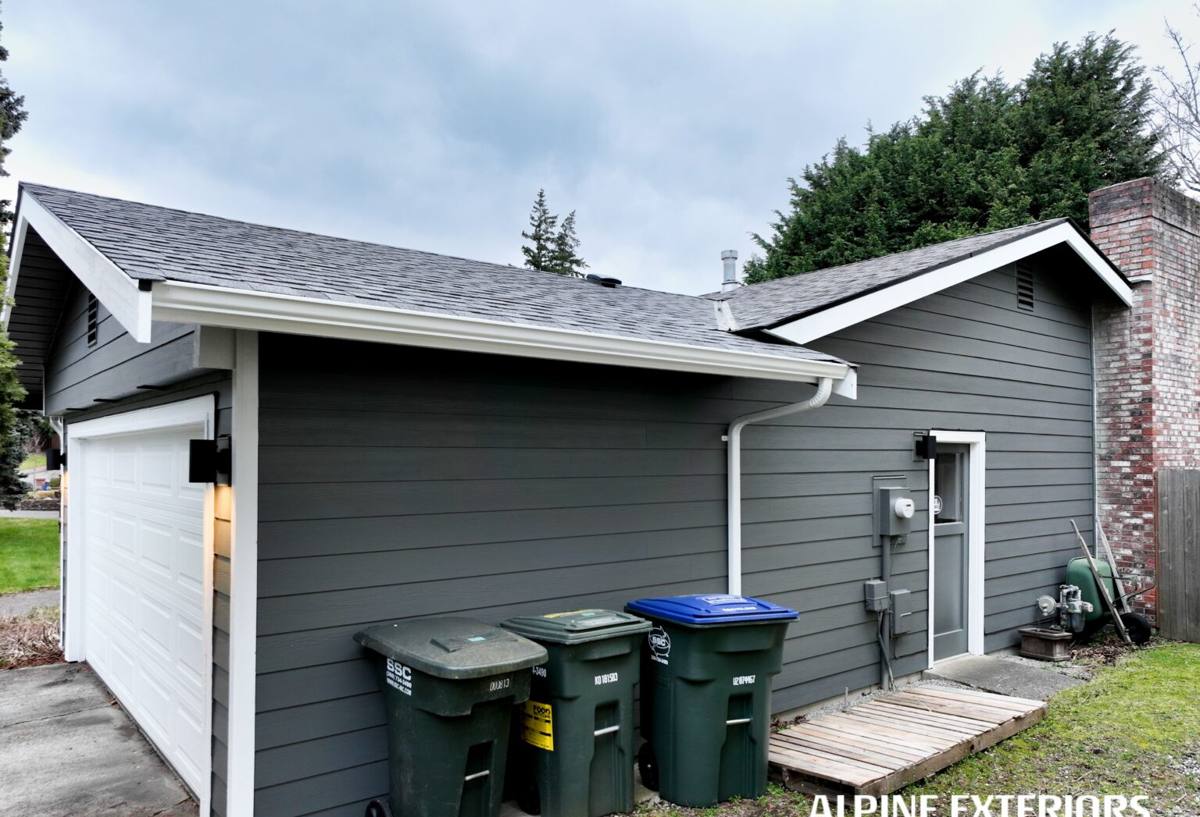
What Blaine Homes Actually Need From Their Siding
Moisture Management, Not Just Moisture Resistance
A lot of siding products are rated to resist water. Fewer are engineered to manage water that's already found its way behind the surface — through a nail hole, a caulk joint that's aged out, or wind-driven rain forced past a lap. In a climate like Blaine's, where rain isn't occasional but a season-long fact, the second kind of performance matters more.
Salt Air Tolerance
Materials and fasteners near the water need to resist the slow corrosive effect of salt air. This affects everything from the siding material itself to the nails, flashing, and trim used alongside it. Corner-cutting on fastener quality shows up faster here than it would forty miles inland.
A Surface That Doesn't Feed Moss and Mildew
Wood-based products give organic growth something to hold onto. A factory-finished, non-organic surface gives moss and algae far less to grab, which means less pressure-washing, less staining, and a longer stretch between maintenance cycles.
Why We Only Install James Hardie Fiber Cement Here
We install James Hardie fiber cement siding exclusively — we don't offer vinyl, LP SmartSide, primed wood, or cedar as alternatives, and Blaine's climate is a big part of why. Hardie's fiber cement is non-combustible, dimensionally stable in wet-dry cycling, and factory-finished with ColorPlus technology, which means the color coat is baked on before the boards ever reach the jobsite — not brushed on in the field where weather and timing affect the result.
James Hardie also engineers regional product lines (their HZ5 line is built for climates like ours) specifically for moisture exposure and temperature swings, rather than shipping one general-purpose board everywhere. For a town like Blaine that sits right at the edge of the water, that regional engineering isn't a marketing detail — it's the difference between siding that's rated for the coast and siding that just happens to be sold there.
We've made installing only Hardie a standard, not a preference, because a strong product installed to spec outperforms alternatives that ask homeowners to accept more maintenance, more caulking, or more monitoring in exchange for a lower upfront number.
What a Correct Fiber Cement Installation Involves
Fiber cement siding is only as good as the assembly it's installed into. Reputation and product quality matter, but installation details are where most real-world siding failures actually originate — not in the board itself.
- Water-resistive barrier: A continuous, properly lapped weather barrier behind the siding, sealed at every penetration.
- Rainscreen or drainage gap: A gap that lets any moisture that gets behind the siding drain and dry out, instead of sitting against the sheathing — especially important given Blaine's rain volume.
- Correct fastener placement and spacing: Hardie specifies exact nailing patterns and fastener types; skipping this affects both warranty coverage and long-term board performance.
- Proper flashing at every penetration: Windows, doors, vents, and roof-to-wall transitions are where water intrusion actually starts on most homes.
- Correct clearances: Siding held at proper distance from grade, decks, and roof lines so it isn't sitting in standing water or snow load.
- Factory-cut edges sealed: Any field cuts primed and sealed per manufacturer spec so raw edges aren't exposed to weather.
Skip any one of these and you can still end up with moisture problems behind a product that's rated to prevent them. This is why we treat installation process as seriously as material choice.
Our Process for a Blaine Fiber Cement Project
1. On-Site Assessment
We walk the exterior, check current siding and sheathing condition, look at drainage and grading around the foundation, and identify any areas — north walls, shaded sections, ground-level runs — that are already showing moss or moisture wear.
2. Scope and Product Selection
We go over which James Hardie profile and line fits the home — lap siding, panel systems, or a mix with trim and accent work — and walk through ColorPlus color options versus field-painted options.
3. Tear-Off and Sheathing Check
Old siding comes off and we inspect the sheathing underneath before anything new goes up. Hidden moisture damage from years of coastal exposure needs to be addressed before a new water-resistive barrier goes on top of it.
4. Barrier, Drainage Plane, and Flashing
This is the step that determines how the house performs in year ten and year twenty, not just on installation day.
5. Installation to Manufacturer Spec
Fastener pattern, clearances, and joint treatment installed to James Hardie's published specifications — which is also what keeps the manufacturer warranty intact.
6. Final Walkthrough
We review the finished work with the homeowner before considering the job done.
Fiber Cement vs. Other Siding Materials in a Coastal Climate
| Factor | James Hardie Fiber Cement | Vinyl | Wood / Cedar |
|---|---|---|---|
| Salt air / corrosion resistance | Non-organic, engineered for coastal exposure | Can become brittle and discolor over time in harsh coastal exposure | Vulnerable to rot without diligent maintenance |
| Moss and algae resistance | Factory finish gives organic growth little to hold onto | Can trap moisture at seams and panel joints | Highly susceptible; organic surface feeds growth |
| Fire resistance | Non-combustible | Can soften, warp, or melt under heat exposure | Combustible |
| Finish durability | Factory-baked ColorPlus finish | Color molded through, but can fade and chalk | Requires repainting/staining on a recurring cycle |
| Maintenance in this climate | Periodic washing; no repainting cycle with ColorPlus | Low maintenance but limited repair options | Regular painting, sealing, and moss treatment |
Cost Factors for a Blaine Fiber Cement Project
Every home is different, but a few factors consistently drive cost on fiber cement projects in this area, and it's worth understanding them before requesting a quote:
- Tear-off scope: Removing existing siding down to sheathing versus installing over an already-prepared surface.
- Sheathing repair: Homes with hidden moisture damage from years of coastal exposure may need sheathing replaced before new siding goes on.
- Profile and trim complexity: Lap siding versus panel systems, plus the amount of trim, corner, and accent detail on the home.
- Home size and stories: Square footage and access (single-story versus multi-story) affect labor time.
- Finish choice: Factory-applied ColorPlus versus field-painted finishes.
We give homeowners a real number after seeing the home, not a generic estimate — the factors above vary too much house to house to make an honest ballpark useful.
Why a Crew That Already Works Blaine Matters
Siding installation isn't just about following a manufacturer's printed spec sheet — it's about knowing how that spec plays out against the specific conditions a house actually faces. A crew that's worked on homes along this stretch of Whatcom County already knows which walls take the worst of the driving rain, where moss tends to establish first, and how salt exposure differs from a block near the water versus one set back from it. That local pattern recognition shows up in better flashing decisions, smarter drainage planning, and fewer callbacks.
It also matters for something more practical: a local crew is accountable locally. If a question comes up two years after installation, you're not chasing down a company that did one job in the area and moved on.
Get a Free, No-Pressure Estimate
If your Blaine home's siding is showing moss, chalking, soft spots, or just isn't holding up to the coastal weather the way it should, we're happy to take a look. We'll walk the exterior, answer questions honestly, and give you a straight estimate for James Hardie fiber cement siding — no pressure, no obligation. Use the form below to get started.