 Bellingham Exterior
 Composite Decking for Happy Valley Homes
Happy Valley sits close enough to Bellingham Bay to catch salt-laden air off the water, and its tree cover and hillside lots mean a lot of decks here spend much of the year in partial shade. That combination — moisture that doesn't fully clear, driving rain off the Sound, and a long moss season that runs from fall through spring — is hard on any outdoor structure. Composite decking, installed correctly for this specific setting, holds up to it far better than most wood options and requires a lot less of your weekends to keep looking good.
This page covers what we look at specifically for Happy Valley: the site conditions that matter, what a correct installation actually involves, what it costs to do right, and why local experience on hillside and shaded lots changes how a deck should be built here.
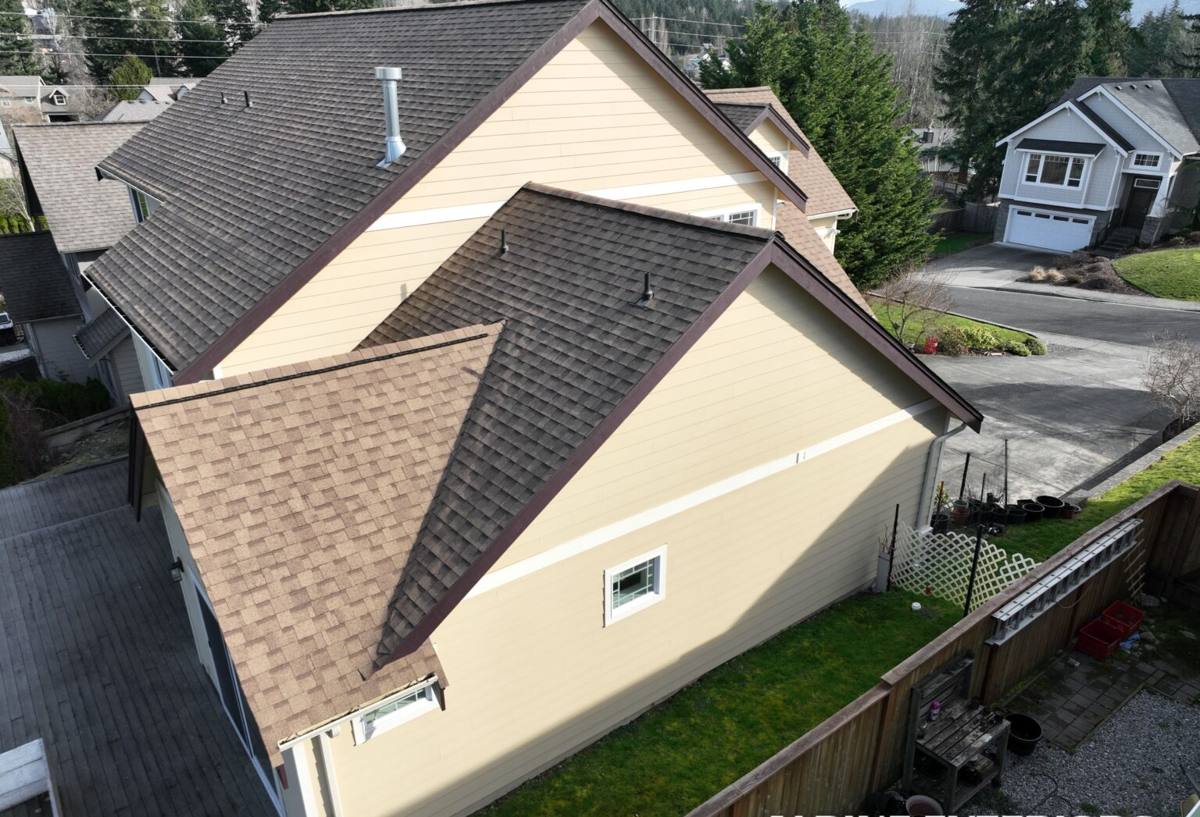
Why This Setting Is Tough on Decking
Shade and Moisture That Won't Let Go
A lot of Happy Valley properties have mature trees and neighboring homes close enough to block direct sun for large parts of the day. Decking in that kind of shade dries slower after rain, which means more time for moss, algae, and mildew to take hold on the surface and in the gaps between boards. Wood decking in these conditions needs frequent cleaning and re-sealing just to stay safe underfoot; composite handles it with far less upkeep, but the board and installation choices still matter.
Salt Air and Driving Rain
Proximity to Bellingham Bay means fasteners, flashing, and any exposed metal on a deck are exposed to salt-tinged moisture, which accelerates corrosion in anything not rated for it. Whatcom County's rain doesn't just fall straight down — wind off the water drives it sideways into ledger boards, stair stringers, and the wall connection points where a deck meets the house. Those are the spots where a poorly flashed deck starts rotting from the inside, long before the surface boards show any wear.
Slope and Drainage
Many Happy Valley lots have real grade to them. That's good for keeping water moving away from a foundation, but it also means deck framing often needs to account for uneven ground, taller footings on the downhill side, and drainage paths that have to be planned rather than assumed. Get this wrong and water pools under the deck instead of running off, which keeps the substructure damp far longer than it should be.
What a Correct Composite Deck Installation Involves
Composite boards are only as good as what's underneath them. A deck that looks right the day it's finished but was rushed on the framing will show problems within a few wet seasons — usually as soft spots, uneven boards, or fastener pop.
- Pressure-treated or engineered framing sized and spaced for the specific composite board being installed — composite spans differently than wood, and manufacturer spacing tables aren't optional
- Joist tape or flashing on top of every joist to keep moisture from wicking into the framing under the decking
- Proper ledger board flashing and a positive gap or drip edge where the deck meets house siding, so wind-driven rain doesn't track behind the cladding
- Corrosion-resistant, coated fasteners rated for treated lumber and coastal exposure
- Grading and, where needed, gravel or drainage matting underneath the deck so water has somewhere to go besides sitting under the boards
- Board gapping set for the expected humidity and temperature swings so the deck doesn't buckle or gap unevenly over time
- Ventilation at the perimeter and any skirting, so the space under the deck can actually dry out between rain events
Skipping any one of these doesn't usually show up on install day. It shows up two or three winters later, after the shaded, damp cycle Happy Valley gets every year has had time to work on the weak point.
Composite vs. Other Decking Materials
Homeowners in this neighborhood usually compare composite against pressure-treated wood or PVC. Here's how they stack up for a shaded, moisture-heavy lot like the ones common in Happy Valley:
| Material | Moss/Mildew Resistance | Maintenance | Typical Lifespan |
|---|---|---|---|
| Pressure-Treated Wood | Low — porous surface holds moisture and organic growth | Annual cleaning, periodic sealing/staining | 10–15 years in shaded, wet exposure |
| Capped Composite | High — sealed cap resists moisture absorption and staining | Occasional wash, no sealing or staining | 25–30+ years |
| PVC Decking | High — fully synthetic, no wood fiber to feed growth | Occasional wash | 25–30+ years |
We install capped composite as our standard recommendation for this area because it balances moisture and moss resistance with a wood-grain appearance most homeowners want, at a lower cost than full PVC. We'll talk through PVC as an option too — it has real advantages in fully shaded, low-airflow spots — but for most Happy Valley decks, a quality capped composite board is the more practical fit for the budget and the look homeowners are after.
Our Process
1. On-Site Assessment
We walk the property, note sun exposure, slope, drainage paths, and how the deck ties into the house. On hillside lots this is where we plan footing depth and access for equipment and materials.
2. Framing and Structure
Old, undersized, or rot-compromised framing gets replaced — not decked over. This is the step that determines whether the deck lasts one decade or three.
3. Flashing and Waterproofing
Ledger connections, joists, and any spots where the deck meets the house get flashed and taped before a single composite board goes down.
4. Board Installation
Boards are installed with manufacturer-specified gapping and hidden or approved fastening systems, laid out to shed water and drain cleanly off the edges.
5. Final Walkthrough
We go over care, what to expect in year one as the deck settles in, and what maintenance actually looks like for the specific product installed.
Living With a Composite Deck Through Moss Season
Composite decking doesn't need staining or sealing, but it isn't zero-maintenance in a climate like this. A little routine care keeps it looking new and keeps the surface safe to walk on when it's wet.
- Sweep off leaves, needles, and organic debris regularly in fall — left to sit, they hold moisture against the board surface
- Rinse or wash the deck a couple of times a year with a soft-bristle brush and a composite-safe cleaner to clear early moss and algae before it takes hold
- Keep gutters and downspouts near the deck clear so runoff isn't dumping directly onto the decking or the framing below
- Trim back overhanging branches where possible to improve airflow and sun exposure across the deck surface
- Check that under-deck ventilation and skirting vents aren't blocked by plantings or debris
- Inspect fasteners and railing connections annually for movement, especially after the first couple of wet seasons
What Affects the Cost
Every Happy Valley property is a little different, and the honest range for a composite deck depends on a handful of site-specific factors more than square footage alone.
| Factor | Why It Matters |
|---|---|
| Slope and access | Steeper lots need deeper or additional footings and can complicate material delivery and equipment access |
| Existing structure condition | Rebuilding rotted framing costs more than decking over sound structure, but it's not optional if the framing has already failed |
| Board tier and brand | Capped composite costs more than basic composite; PVC costs more than either but needs the least long-term upkeep |
| Railing and stair complexity | Multi-level decks and custom railing add labor beyond the deck surface itself |
| Drainage work | Lots that pool water under the deck may need grading or gravel drainage added before decking goes down |
We give a straight, itemized estimate after seeing the actual site — not a phone quote — because on lots like these, the framing and drainage work often matter more to the final number than the decking material itself.
Why Local Experience in Happy Valley Matters
A deck built without accounting for this neighborhood's shade, slope, and salt-air exposure can look fine for a season or two and then start showing problems that trace back to decisions made on day one — under-flashed ledgers, framing that wasn't sized for the actual span, or drainage that was never planned for the site's grade. We work on homes throughout Bellingham and Whatcom County, and the patterns specific to Happy Valley — heavier tree cover, hillside footings, and bay-driven weather — shape how we frame, flash, and space every deck we build here. That's the difference between a deck that needs real repair in five years and one that just needs an occasional wash for the next two or three decades.
If you're planning a new composite deck or replacing one that's struggling with moss, soft spots, or drainage issues, we're happy to take a look and walk you through your options. Reach out for a free, no-pressure estimate using the form below.