 Bellingham Exterior
 Windows Built for Edgemoor's Waterfront Climate
Edgemoor sits close enough to Bellingham Bay that salt-laden air is a real factor in how exterior materials age, not just a talking point. Add in Whatcom County's driving rain, heavy tree canopy, and the long stretch of gray, damp months that let moss and algae get a foothold on anything that stays wet, and you've got a climate that's genuinely hard on windows. Old aluminum-frame or single-pane windows that were fine when they went in decades ago are now the weak point in a lot of Edgemoor homes — cold to the touch, prone to condensation, and leaking conditioned air out (and moisture in) at every gap.
Energy-efficient window replacement isn't just about lowering a power bill, though that's part of it. Done right, it's about closing off the paths where wind-driven rain and salt-tinged moisture get into wall assemblies, and giving the house a window system that can actually handle the exposure it sits in year after year.
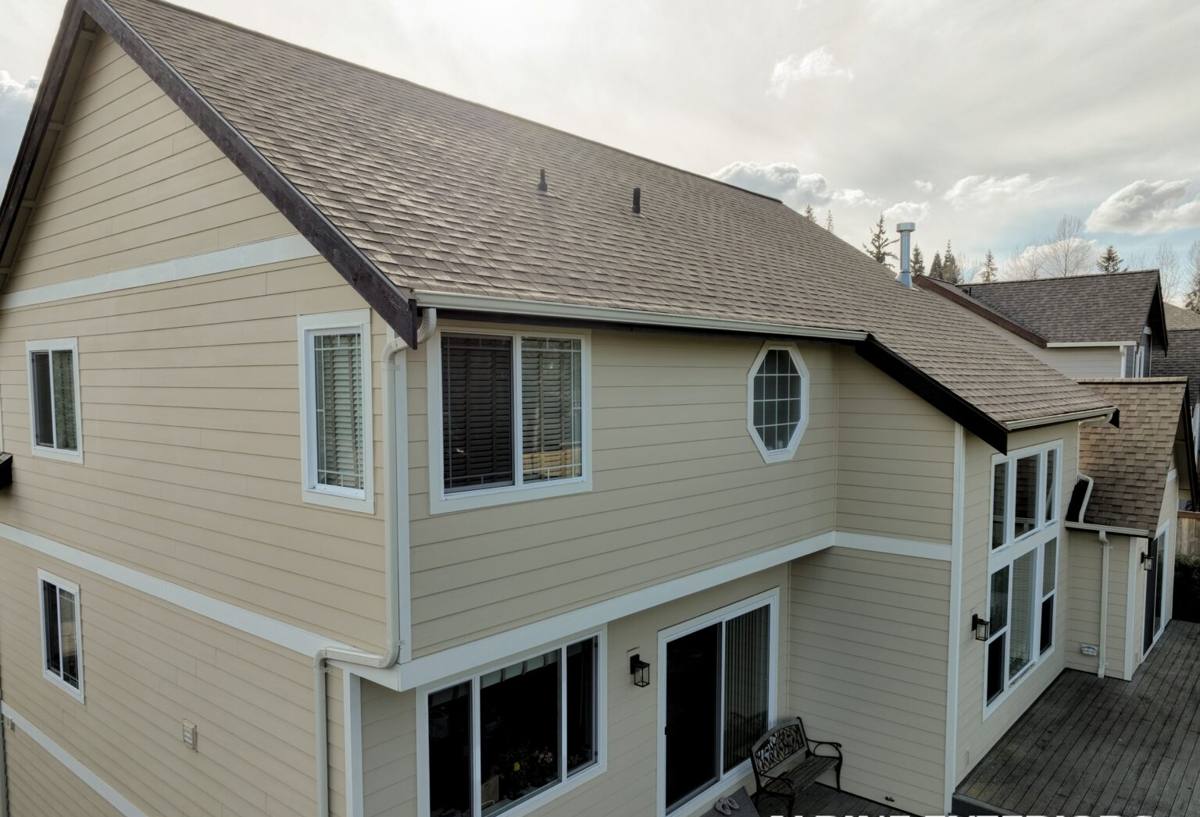
What Edgemoor Homes Actually Need From a Window Upgrade
Salt Air and Hardware
Homes closer to the water deal with airborne salt settling on hardware, screens, and frame seams. Over time this accelerates corrosion on lower-grade fasteners, hinges, and locking mechanisms, especially on lesser aluminum components. Frame and hardware choices matter more here than they would a few miles inland — it's worth picking materials and finishes rated for coastal or near-coastal exposure rather than a generic inland spec.
Wind-Driven Rain
Storms off the Sound don't just bring rain, they bring rain moving sideways under pressure. That's a much tougher test on a window than a straight-down downpour. It exposes weak flashing, undersized sealant joints, and windows that weren't shimmed and set square. A window can carry a great energy rating on paper and still leak if the installation doesn't account for wind-driven water at the sill and jambs.
Moss, Algae, and Sustained Dampness
Bellingham's long moss season means anything that holds moisture — a poorly sloped sill, a low spot in a drip cap, wood trim without adequate protection — becomes a growth surface. That's less a glass issue and more a detailing issue: how the window is trimmed, flashed, and finished on the outside determines whether water sheds cleanly or sits and breeds problems.
Condensation and Indoor Humidity
Western Washington's damp climate also shows up on the inside. Older, poorly insulated windows are usually the first place condensation forms in a home, which over years can lead to sill rot and mold at the corners. A properly rated, well-sealed window with a warm interior glass surface largely eliminates this.
Frame Material Comparison for This Climate
There's no single "best" frame material for every house — it depends on exposure, budget, and the look of the home. Here's how the common options hold up for a bay-adjacent, wet-climate neighborhood like Edgemoor.
| Material | Salt Air / Coastal Exposure | Maintenance | Relative Cost |
|---|---|---|---|
| Vinyl | Very good — won't corrode or pit | Low, occasional cleaning | Lower |
| Fiberglass | Excellent — highly stable, resists expansion/contraction | Low | Higher |
| Wood-clad (vinyl/aluminum exterior) | Good on the exterior, but any breach in the cladding exposes wood to moisture | Moderate — watch cladding seams | Higher |
| Aluminum | Weaker — prone to corrosion and thermal loss near salt air unless a marine-grade finish is specified | Moderate | Lower to moderate |
We generally steer Edgemoor homeowners away from standard-grade aluminum frames for this reason — not because aluminum is a bad material everywhere, but because in this specific setting the corrosion and thermal-bridging trade-offs usually outweigh the upfront savings. Vinyl and fiberglass tend to be the more durable long-term fit for the exposure this neighborhood sees.
Understanding the Numbers That Actually Matter
Every energy-efficient window comes with an NFRC label, and two figures matter most in this climate:
- U-factor — measures how well the window resists heat loss. Lower is better for our cool, heating-dominated climate. This is the number that most directly affects your winter heating costs.
- SHGC (Solar Heat Gain Coefficient) — measures how much solar heat passes through the glass. In the Pacific Northwest we don't have the intense summer sun that drives SHGC decisions in hotter climates, so this matters less here than U-factor, but it's still worth balancing on south- and west-facing exposures.
Low-E coatings and argon or krypton gas fills between panes are what get a window to a strong U-factor. They're standard on any genuinely energy-efficient window today — the differences between manufacturers usually come down to coating quality, spacer design (the material separating the panes, which affects both insulation and long-term seal life), and how well the whole unit is built to hold its performance for decades, not just pass a lab test.
What a Correct Installation Actually Involves
The window unit itself is maybe half the job. The other half — the part that determines whether it performs and stays watertight — is the installation detailing:
- Removing the old window and inspecting the rough opening for hidden rot or water damage before anything new goes in
- Installing sill pan flashing so any water that does get past the window drains back out, not into the wall
- Integrating the window flanges correctly with the home's existing weather-resistive barrier, shingle-lapped so water sheds downward and outward
- Shimming and setting the unit square and plumb so it operates correctly and seals evenly for its full lifespan
- Using sealants and backer rod compatible with both the window frame material and the home's siding, not a one-size-fits-all caulk
- Insulating the gap between the frame and rough opening properly — too little leaves cold spots, too much (or the wrong material) can bow the frame
- Finishing exterior trim and drip caps so water is directed away from the top and sides of the unit, not left to pool
Skip any of these steps and even a top-tier window can leak, fog, or underperform within a few years — which is exactly the kind of failure that shows up as a moisture problem long before it shows up as a comfort complaint.
Our Process
1. On-Site Assessment
We look at your current windows, the condition of the rough openings, sun and wind exposure on each elevation of the house, and any existing signs of moisture or air leakage. This is also where we talk through style, whether that's matching existing sightlines on an older home or updating the look.
2. Product Selection
We walk through frame material, glass package, and grille options based on your home's exposure and budget — including where a higher-spec frame or coating is worth it and where it isn't.
3. Installation
Old units are removed and openings are inspected and repaired as needed before the new windows go in, using the flashing and sealing approach outlined above.
4. Final Check and Cleanup
Every window is operated, checked for square operation and a tight seal, and the site is cleaned up — old units and debris hauled off, not left for you to deal with.
Signs It's Time to Replace
- Visible condensation or fogging between the panes (a failed seal — this can't be fixed, only replaced)
- Drafts you can feel near the frame even with the window latched
- Difficulty opening, closing, or locking — often a sign the frame has shifted or warped
- Soft or discolored wood trim around the window, especially at the sill
- Visible corrosion or pitting on aluminum frames or hardware
- Noticeably cold interior glass or frames in winter
- Rooms near older windows that are harder to heat than the rest of the house
Why a Crew That Already Works in Edgemoor Matters
A lot of window problems in this part of Bellingham trace back to installations that were done to a generic spec rather than the specific conditions of a bay-adjacent, tree-shaded property. A contractor who regularly works in Edgemoor and the surrounding Bellingham neighborhoods has a feel for how the local exposure — wind direction off the water, the amount of shade and dampness from mature trees, the age and construction style common to the area's homes — should shape material choices and installation details. That's the difference between a window that looks right on install day and one that's still performing correctly ten winters from now.
We also handle the City of Bellingham permitting that can apply to window replacement projects, so that part isn't left on your plate.
Get a Straightforward Estimate
If your windows are drafty, fogged, or just past their useful life, we're happy to come take a look and give you an honest read on what your home needs — no pressure, no upsell. Fill out the form below to schedule a free estimate for energy-efficient window replacement in Edgemoor.