 Bellingham Exterior
 Why Fairhaven Roofs Age Differently Than Roofs Inland
Fairhaven sits close to Bellingham Bay, and that proximity changes what a roof deals with over its lifespan. Salt-laden air moves off the water and settles on exposed metal — nails, flashing, vent stacks, gutter hardware — accelerating corrosion in ways that roofs a few miles inland simply don't experience at the same rate. Add in Whatcom County's long stretch of driving rain each fall and winter, and you've got moisture finding every gap in a roof system that wasn't detailed correctly the first time.
Fairhaven's tree canopy is another factor. Mature conifers shade large sections of many roofs for much of the day, keeping shingles damp longer after storms and creating ideal conditions for moss and algae to take hold. Combine shade, moisture, and salt air, and you get a roofing environment that punishes shortcuts — thin underlayment, skipped flashing details, or ventilation that was never sized for the moisture load. A roof built for a drier climate, or installed by a crew that doesn't normally work this close to the water, tends to show problems years before it should.
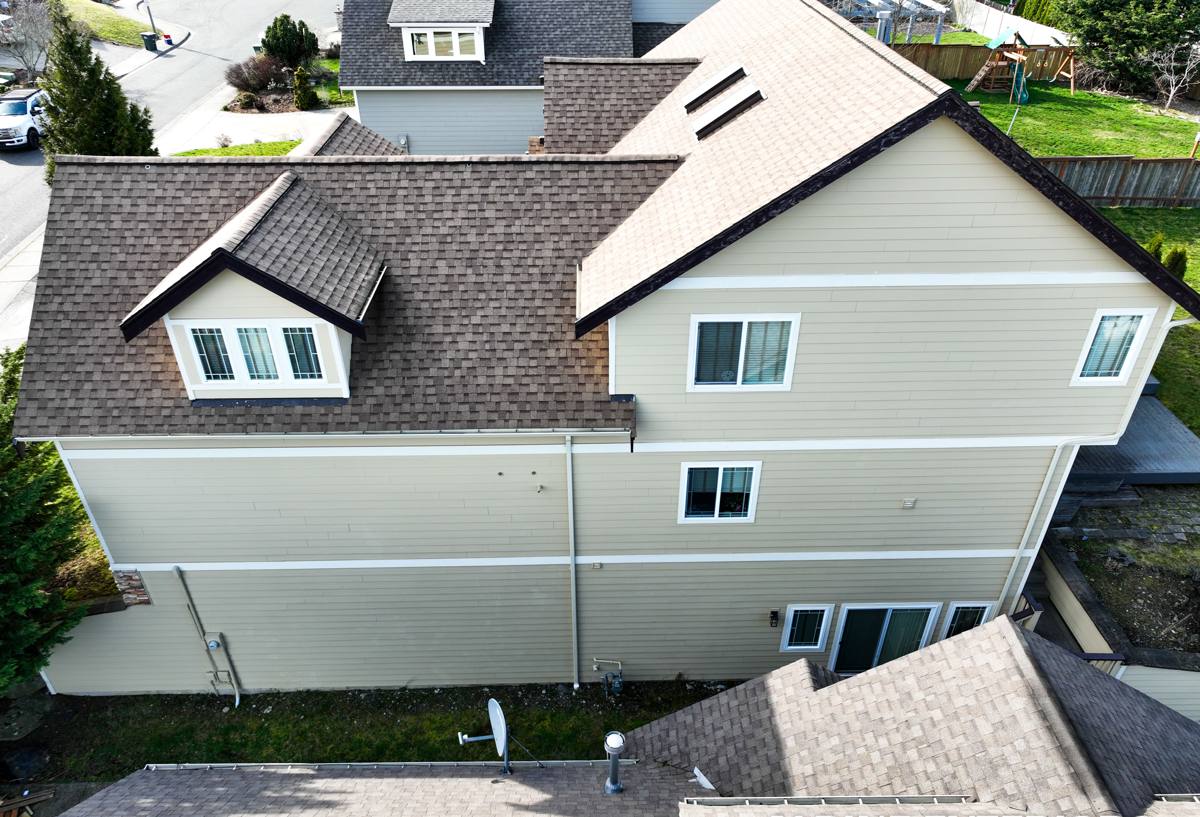
Signs a Fairhaven Home Actually Needs a New Roof
Not every roof problem means full replacement — sometimes a repair is the honest answer. But certain signs point to a roof that's past the point where patching makes sense:
- Shingles that are cupping, curling at the edges, or losing granules in visible patches
- Moss colonies that keep returning within a season or two of cleaning, especially on north-facing or shaded slopes
- Dark streaking (algae) that spreads across the roof faster each year
- Soft or spongy spots underfoot when walking the roof, which usually means deck rot underneath
- Daylight visible through the roof deck from inside the attic, or nail points showing through
- Rusting, lifting, or separated flashing around chimneys, vents, or valleys
- A roof that's 20-25+ years old and has never had underlayment or ventilation upgraded
- Interior water stains on ceilings or upper walls that show up during heavy rain, not just after storms
If a roof is showing two or more of these at once, it's usually more cost-effective to replace it properly than to keep chasing repairs on a system that's structurally tired.
What a Correct New Roof Installation Actually Involves
Tear-Off and Deck Inspection
A new roof starts with removing the old roofing down to the deck — not layering over it. Layering hides deck problems and voids most manufacturer warranties. Once the old material is off, the deck gets inspected board by board. Any rotted, delaminated, or soft sheathing gets replaced before anything new goes down. Skipping this step is one of the most common ways a "new roof" fails early, because fasteners driven into compromised wood never hold the way they should.
Underlayment and Water Barrier
Given how much driving rain this area gets, underlayment choice matters more here than in drier climates. Self-adhered ice-and-water membrane belongs at eaves, valleys, and around penetrations — the spots where wind-driven rain is most likely to be pushed backward under shingles. The rest of the deck gets a synthetic underlayment rated for the exposure. This layer is the roof's real backup plan; the shingles are the first line of defense, but the underlayment is what keeps a home dry if wind ever drives water past them.
Flashing Details
Flashing failures — not worn-out shingles — cause the majority of roof leaks. Step flashing at wall intersections, counter-flashing at chimneys, and properly lapped valley flashing all need to be installed in the correct sequence with the underlayment and roofing material, not caulked on afterward as an easier shortcut. Given the corrosion pressure from salt air near the bay, flashing material and fastener choice also matter more here than they would inland.
Ventilation
A roof needs balanced intake (soffit) and exhaust (ridge) ventilation to manage moisture and temperature in the attic. In a shaded, damp climate like Fairhaven's, poor ventilation traps humidity against the underside of the deck, which shortens the life of the roof from the inside out and can encourage rot long before the shingles show visible wear. Ventilation is not optional trim — it's part of what makes a roof system actually perform for its full expected lifespan.
Material Options for a Coastal, Moss-Prone Roof
There's no single "best" roofing material — the right choice depends on the home's structure, budget, and how much maintenance the owner wants to take on. Here's how the common options compare for a home in Fairhaven's specific conditions:
| Material | Moss/Algae Resistance | Salt Air Durability | Maintenance |
|---|---|---|---|
| Architectural asphalt shingle (standard) | Moderate — benefits from algae-resistant granules | Good with proper fasteners/flashing | Periodic moss removal on shaded slopes |
| Architectural asphalt shingle (algae-resistant/copper-infused) | Higher — granules resist algae growth longer | Good with proper fasteners/flashing | Lower than standard shingle |
| Standing seam metal | High — moss struggles to grip smooth metal | Very good with coated/corrosion-resistant fasteners | Low, occasional debris clearing |
| Cedar shake | Lower in shaded, damp exposure without upkeep | Fair — needs regular treatment near salt air | Higher — periodic cleaning and treatment |
We're happy to walk through the trade-offs for a specific home. Our general standard is to steer homeowners toward products with a proven track record in wet, shaded, coastal-adjacent conditions rather than the cheapest option on paper — a roof that needs replacing again in twelve years isn't actually a good value, even if it costs less up front.
Our Installation Process, Start to Finish
- On-site inspection: We walk the roof and attic, check the deck, flashing, and ventilation, and photograph problem areas so the homeowner sees exactly what we saw.
- Written estimate: A clear scope of work and pricing — no vague allowances that turn into surprise add-ons mid-project.
- Material selection: We help match the product to the home's exposure, budget, and how the homeowner wants to handle long-term upkeep.
- Permitting: We handle the permit process required for roof replacement in the City of Bellingham.
- Tear-off and deck repair: Full removal of old roofing, deck inspection, and replacement of any compromised sheathing.
- Underlayment, flashing, and ventilation installed to spec: Not rushed, not skipped, in the correct sequence.
- New roofing installed: Following manufacturer fastening patterns for the wind exposure this area sees.
- Site cleanup and magnetic nail sweep: Yard, driveway, and landscaping cleared of debris and stray fasteners.
- Final walkthrough: We review the finished roof with the homeowner before calling the job done.
Cost Factors Homeowners Should Understand
Roofing costs vary widely based on the specifics of the home, not just square footage. The biggest swing factors:
| Factor | Why It Matters |
|---|---|
| Roof pitch and complexity | Steep pitches, multiple valleys, and dormers take longer and require more safety setup and material waste |
| Number of existing layers | Tear-off of two layers costs more in labor and disposal than tear-off of one |
| Deck condition | Rotted or soft sheathing found during tear-off adds material and labor not visible until the old roof is off |
| Material choice | Standard shingle, algae-resistant shingle, and metal carry different material and labor costs |
| Access and site conditions | Tree cover, tight lot access, or multi-story sections affect staging and safety requirements |
| Flashing and ventilation scope | Chimneys, skylights, and the amount of ridge/soffit venting needed all add to the scope |
We won't quote a number without seeing the roof — anyone who does is either guessing or leaving room to pad the invoice later. What we can say honestly: a roof installed with proper underlayment, flashing, and ventilation costs more up front than a bare-minimum install, but it's the difference between a 25-30 year roof and one that needs attention again in a decade.
Why Hiring a Crew That Already Works Fairhaven Matters
A roofer who works this neighborhood regularly already knows what the shaded, older lots tend to hide — where moss builds up fastest, which roof orientations catch the worst of the wind off the bay, and how much underlayment and flashing detail actually holds up here versus what looks fine on paper. That familiarity shows up in fewer surprises during tear-off and fewer callbacks after the job is done.
It also matters for permitting and code compliance specific to the City of Bellingham and Whatcom County, and for knowing which material reps and suppliers actually stock the products that perform well in this climate rather than whatever is easiest to order. A crew that treats every roof the same, regardless of where it sits, is more likely to under-spec ventilation or skip the flashing details that this environment doesn't forgive.
Maintenance After Installation
A correctly installed roof still benefits from basic upkeep, especially given the tree cover and moisture common to Fairhaven properties:
- Clear gutters and valleys of needles and debris at least twice a year, more often under heavy tree cover
- Have moss growth treated before it spreads, rather than waiting until it's visibly thick
- Check flashing and sealant points annually, particularly after major storms
- Keep overhanging branches trimmed back to reduce shade, debris, and abrasion on the roof surface
- Have the attic checked periodically to confirm ventilation is still performing as intended
None of this requires a large time investment, but skipping it is how a well-installed roof ends up with preventable problems years before it should.
If your Fairhaven home is showing signs of roof wear, or you'd simply like an honest opinion on where things stand, we're glad to take a look. There's no pressure and no obligation — just a straightforward inspection and a written estimate you can use to make a decision on your own timeline. The form below is the fastest way to get started.