 Bellingham Exterior
 Why Ferndale Roofs Wear Differently Than Roofs Further Inland
Ferndale sits close enough to the water that homes here deal with a different combination of stress than roofs twenty or thirty miles inland in Whatcom County. Salt-laden air moving in off the water accelerates corrosion on exposed metal — flashing, fasteners, vent caps — long before the shingles themselves show their age. Add in wind-driven rain that comes in sideways during winter storms, rather than falling straight down, and you get water intrusion at points a roof built for a drier climate was never designed to handle: exposed nail heads, shallow shingle laps, and flashing that's just barely adequate on paper.
Then there's moss. Whatcom County's combination of shade, moisture, and mild temperatures gives moss and algae a long growing season — realistically most of the year on north-facing slopes and anywhere tree cover keeps a roof from drying out between rain events. A roof that would stay clean for years in a drier, sunnier climate can develop a real moss problem in Ferndale in a fraction of the time if it isn't detailed correctly from the start.
None of this means Ferndale is a uniquely hard place to roof a house. It means the details that don't matter much elsewhere — underlayment choice, fastener quality, ventilation balance, flashing overlap — matter more here. A roofing job that's "good enough" in a mild, dry climate can fail early in this one.
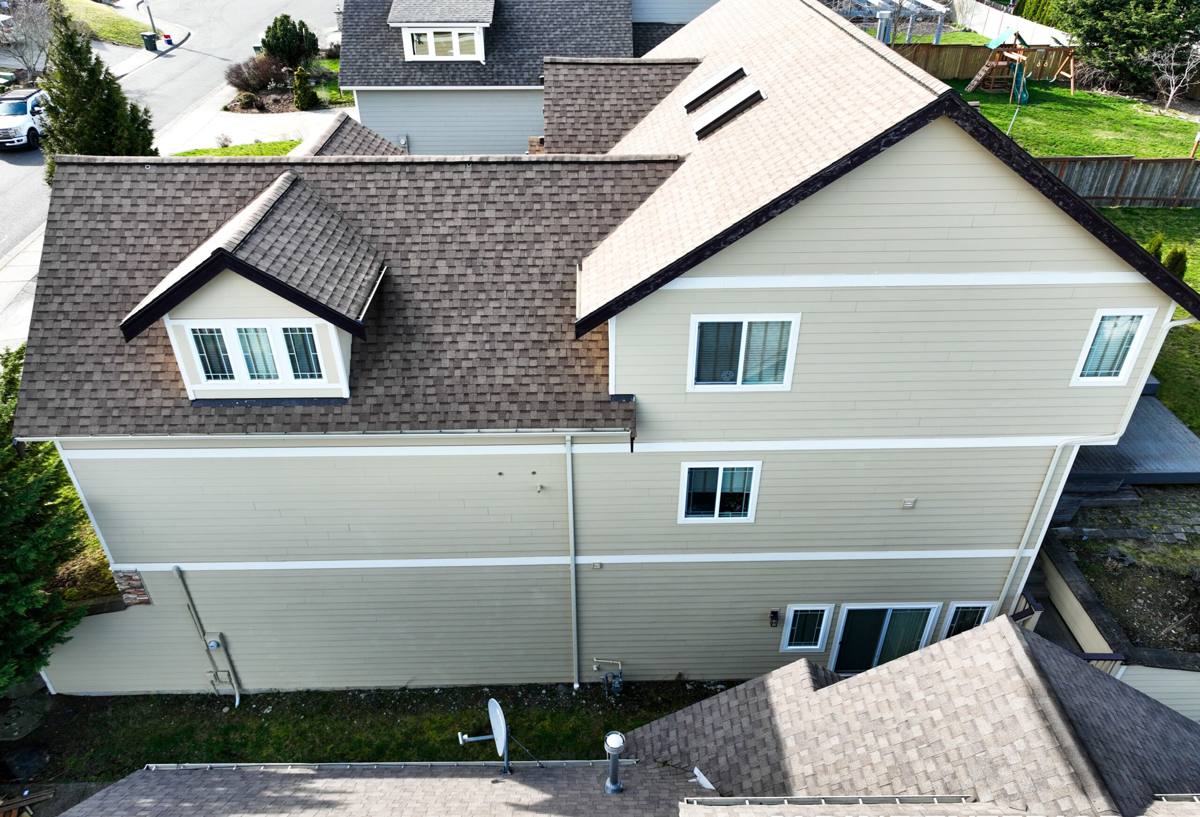
What a Correctly Installed Asphalt Shingle Roof Involves
Asphalt shingles are still the most practical roofing material for the large majority of homes in this area — the cost, availability, and repairability are hard to beat, and modern shingle products have come a long way. But "asphalt shingles" as a category covers a wide range of installation quality, and in a climate like this one, the installation matters as much as the shingle itself.
Underlayment and Water-Shedding Layers
Under the shingles, we use a synthetic underlayment rather than old-style felt paper — it holds up better to the repeated wet-dry cycles typical of a Whatcom County winter and doesn't degrade as quickly if it's exposed to moisture during construction. At eaves, valleys, and any roof-to-wall transition, we install self-adhering ice-and-water membrane. This isn't primarily an ice-dam product out here — it's there because those are the spots where wind-driven rain is most likely to get pushed backward under a shingle course, and a membrane layer stops that water before it reaches the roof deck.
Flashing
Flashing failures cause more leaks than worn-out shingles do. Chimneys, skylights, sidewalls, and any roof penetration need step flashing and counter-flashing that's properly layered with the underlayment and shingle courses, not just caulked over. In salt-air exposure, we pay attention to the flashing material itself — some metals corrode faster than others near the coast, and a flashing detail that lasts decades in a drier inland town can pit and fail years sooner here.
Nailing and Fastening
Correct nail placement, count, and depth is one of the most common things done wrong on production roofing jobs — nails set too high, too few per shingle, or driven at an angle so the head cuts into the shingle instead of sitting flush. Overdriven or misplaced nails are a leading cause of shingle blow-off in wind, and they void manufacturer warranties. We follow the shingle manufacturer's nailing pattern exactly, adjusted for Ferndale's wind exposure where the roof geometry calls for it.
Ventilation
A shingle roof needs balanced intake (usually at the soffits) and exhaust (usually at or near the ridge) to let the attic breathe. Get this wrong and you trap moisture in the attic, which shortens the life of the roof deck and shingles from underneath — a problem that shows up years later as soft decking or premature shingle failure, often blamed on the shingles when the real cause was trapped moisture.
Choosing the Right Shingle for This Climate
Not every asphalt shingle product is a good fit for a coastal Whatcom County home. The biggest factor we weigh with homeowners is algae and moss resistance, followed by wind rating and overall durability.
| Shingle Type | Typical Lifespan | Best Fit For |
|---|---|---|
| 3-tab (standard) | 15–20 years | Budget-conscious projects, simpler rooflines, rental properties |
| Architectural / dimensional | 25–30+ years | Most Ferndale homes — better wind resistance, more common with algae-resistant granule options |
| Impact-resistant (Class 4) | 25–30+ years | Homes with heavy tree cover or exposure to wind-blown debris |
For nearly every home we look at in Ferndale, we steer toward architectural shingles with algae-resistant (copper- or zinc-infused) granules. They cost more up front than 3-tab, but the combination of better wind performance and slower algae/moss growth pays off over the life of the roof — especially on shaded, north-facing slopes where a standard shingle will show streaking within a few years.
We also pay attention to a shingle's actual wind rating, not just its marketing name. Homes on more exposed lots — open to wind off the water with fewer windbreak trees — benefit from a higher wind-rated product and tighter fastening, regardless of which shingle line it is.
Moss, Algae, and Salt Air: What Ongoing Maintenance Actually Looks Like
Even a well-installed shingle roof in this area needs periodic attention to stay ahead of moss and organic growth. This isn't a defect in the roof — it's the reality of the climate.
- Keep overhanging branches trimmed back so shaded areas of the roof get more light and air movement, which slows moss growth significantly
- Clear gutters and valleys of needles and debris at least twice a year — clogged gutters hold moisture against the roof edge, which is exactly where moss and rot like to start
- Have moss physically removed (not just chemically treated) before it gets thick enough to lift shingle edges and hold water underneath them
- Check exposed metal — flashing, vent caps, gutter hardware — periodically for early corrosion, especially on homes with more direct exposure to salt air off the water
- Avoid pressure washing shingles; it strips granules and shortens the roof's life. Soft washing or manual removal is the safer approach
Zinc or copper strips near the ridge can help slow future moss growth on a new roof, and we'll talk through whether that makes sense for your specific roof layout and tree exposure.
Signs a Ferndale Roof Needs Attention
Because damage from wind-driven rain and trapped moisture often starts out of sight, it helps to know what to check for before a small problem becomes a bigger repair.
- Granules collecting in gutters or at downspout outlets — a sign shingles are aging or were damaged by wind or debris
- Dark streaking or thick moss growth, especially on shaded or north-facing slopes
- Curling, cracking, or lifted shingle edges, particularly after a windy winter
- Soft or spongy spots when walking the roof, which can indicate moisture has reached the deck
- Rust staining or visible corrosion around flashing, vent boots, or metal roof hardware
- Daylight visible through the attic roof deck, or damp insulation, when viewed from inside the attic
- Water stains on interior ceilings, especially near chimneys, skylights, or roof valleys
Our Process, From Estimate to Cleanup
We keep the process straightforward and communicate clearly at each step, since a roof replacement is disruptive enough without added uncertainty.
- On-site inspection: We walk the roof (weather permitting) and check the attic from inside, looking at ventilation, decking condition, and existing flashing details, not just the shingles.
- Written estimate: A clear breakdown of scope, materials, and cost — no vague allowances that turn into surprise add-ons later.
- Material selection: We walk through shingle options suited to your roof's exposure, shade, and budget, including algae-resistant and higher wind-rated products where they make sense.
- Deck inspection during tear-off: Any soft or damaged decking is identified and addressed before new underlayment goes down — this gets called out and priced separately if found, not buried into the original estimate.
- Installation: Ice-and-water membrane at vulnerable areas, correctly lapped underlayment, proper flashing at every penetration, manufacturer-spec nailing, and balanced ventilation.
- Cleanup and magnetic sweep: Job site debris and stray fasteners are cleared from the yard and driveway before we consider the job finished.
- Final walkthrough: We go over the completed roof with you, including care and maintenance specific to your property's shade and exposure.
Cost Factors for a Ferndale Roofing Project
Every roof is different, so exact pricing depends on a site visit, but these are the main factors that move cost up or down on projects in this area.
| Factor | Effect on Cost |
|---|---|
| Roof size and number of layers to remove | Larger roofs and tear-off of existing layers increase labor and disposal cost |
| Roof pitch and accessibility | Steep or hard-to-access roofs require more safety setup and time |
| Shingle grade selected | Architectural and impact-resistant shingles cost more than 3-tab but last longer |
| Decking condition | Soft or rotted decking found during tear-off adds material and labor to replace |
| Number of penetrations | Chimneys, skylights, and multiple vents each require additional flashing work |
| Ventilation upgrades | Adding or correcting intake/exhaust venting adds modest cost but protects the new roof |
We give you a firm, itemized number before any work begins, and we flag anything (like unexpected deck damage) that could change scope before we proceed — not after.
Why a Crew That Already Works in Ferndale Makes a Difference
A roofer who works regularly in Ferndale and the surrounding Whatcom County area has already seen how homes here actually age — which slopes tend to hold moss, which flashing details tend to corrode first in salt air exposure, and which shingle products hold up and which underperform in this specific combination of rain, wind, and shade. That's different from general roofing experience gained in a drier or more sheltered climate. It shows up in small decisions: which side of the roof gets extra membrane, how tight the fastening needs to be on an exposed gable end, whether a particular shade pattern calls for algae-resistant granules or standard ones are fine.
It also matters for warranty support and follow-up. A local crew that's still working in the area next year and the year after is the one that can actually come back and stand behind the work if a question comes up down the road.
If you're weighing a repair, a full replacement, or just want an honest read on how much roof you have left, we're glad to take a look. Fill out the form below to schedule a free, no-pressure estimate for your Ferndale home.