 Bellingham Exterior
 What Ferndale Homes Actually Need From Their Siding
Ferndale sits close enough to the water and low enough in the Nooksack delta that its homes take on a specific combination of punishment: salt-laden air drifting in off the Sound, rain that arrives sideways more often than straight down, and a moss and mildew season that barely takes a break most years. None of that is unique to any one street or subdivision in town — it's the baseline condition for exterior materials across this part of Whatcom County. Siding here doesn't just need to look good going up. It needs a water management system underneath it that keeps working for decades without babysitting.
That's the frame we bring to every Ferndale siding job, and it's why we install James Hardie fiber cement exclusively rather than offering a menu of options. This page focuses on one thing specifically: what a correct James Hardie installation looks like on a Ferndale home, what the climate here demands of that installation, and how our process is built around getting it right the first time.
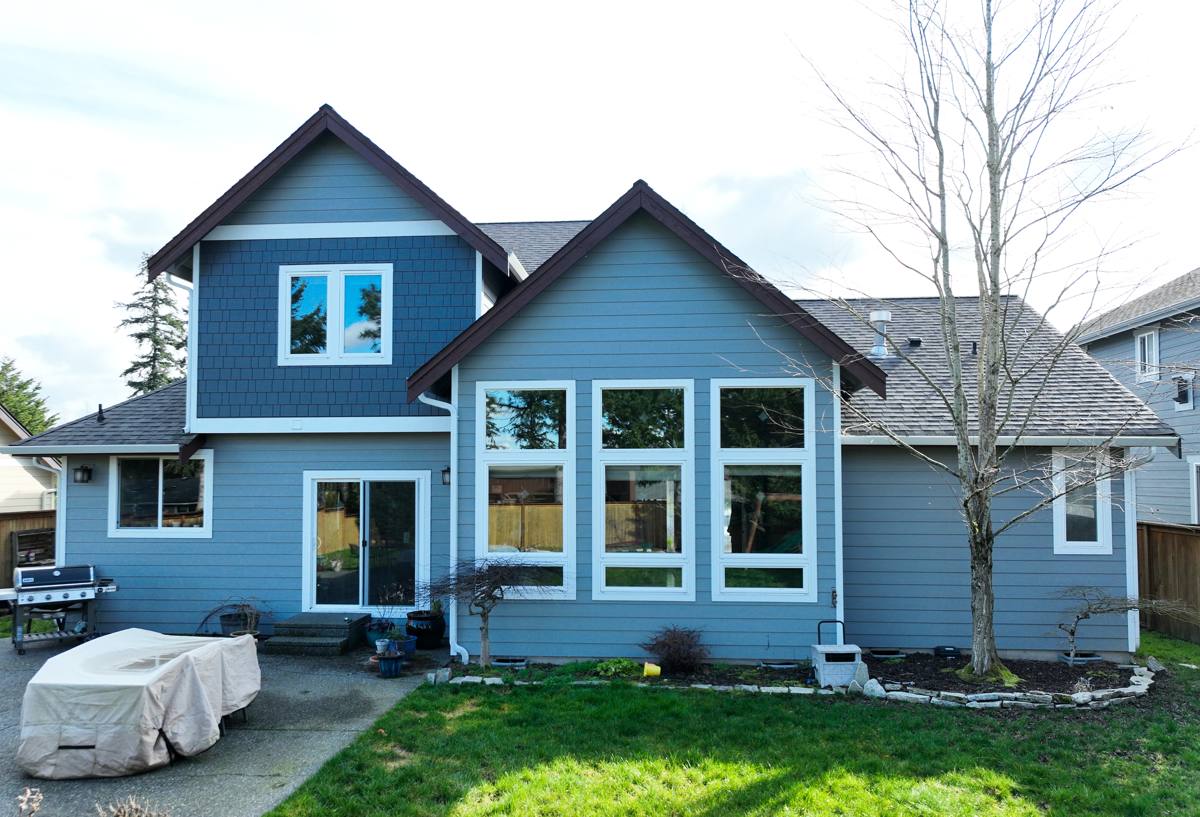
Why Fiber Cement Fits This Climate
James Hardie siding is manufactured from cement, sand, and cellulose fiber — an inorganic core that doesn't absorb and swell the way wood-based products can when they take on sustained moisture. That matters a lot in a place where the siding is dealing with wind-driven rain and damp, shaded conditions for a large share of the year. A material that doesn't feed off moisture at cut edges and fastener points removes one of the biggest long-term failure modes we see with wood-based and engineered-wood siding in this county.
Fiber cement is also non-combustible, which matters increasingly for insurance considerations even in a wetter climate not typically associated with wildfire risk, and it holds paint and factory finish differently than wood-based substrates because it doesn't move seasonally the way wood does. None of that is marketing — it's the physical reason we standardized on this one product system instead of stocking multiple lines.
What Correct Installation Actually Involves
James Hardie siding performs close to its engineered lifespan when it's installed to the manufacturer's specification. It performs noticeably worse when it isn't — and the gap between a spec-correct install and a rushed one is exactly where most long-term siding problems in this region originate, regardless of brand. Here's what we mean by correct, broken into the parts that actually determine how the wall performs over the next 20 to 30 years.
Water-Resistive Barrier and Flashing First
The siding itself is the last layer, not the first line of defense. Before any Hardie board goes up, the wall needs a continuous water-resistive barrier, correctly lapped and taped at every seam, with flashing integrated at every window, door, and horizontal transition so water is directed out and down rather than trapped behind the cladding. On a Ferndale home taking wind-driven rain from multiple directions across a year, a gap or reverse-lap in this layer is the single most common source of hidden rot years later — and it's invisible once the siding is up, which is exactly why it has to be done right the first time.
Rainscreen Gap
We install with a drainage gap between the back of the siding and the water-resistive barrier rather than nailing the boards flush to the sheathing. That gap lets any moisture that does get past the outer layer drain and lets the wall assembly dry rather than trapping dampness against the substrate. In a climate with Ferndale's moss and mildew pressure, that ventilation gap is doing real work every wet month of the year, not just in a hard storm.
Fastening and Nailing Pattern
James Hardie specifies exact nail placement, spacing, and blind- versus face-nailing depending on the product line and exposure. Fasteners driven too close to the edge, over-driven so they crush the fiber cement, or spaced incorrectly all create weak points and voided warranty coverage. It's a detail that's easy to rush on a large job and easy to verify on a finished one if you know what to look for.
Joints, Caulking, and Butt Seams
Every horizontal and vertical joint needs the correct gap, backer, and sealant — installed per Hardie's written specifications, not general caulking practice. Joints are also where a lot of installation shortcuts show up first, because they're less visible than a flat panel run. We treat joint detailing as a checklist item on every job, not a judgment call left to whoever's on the ladder that day.
Product Lines: Matching the Board to the Exposure
James Hardie makes several distinct product lines, and part of a correct installation is specifying the right one for each part of the house rather than treating "Hardie siding" as one product. HardiePlank lap siding covers most wall area. HardiePanel works for vertical applications and accent sections. HardieTrim finishes out corners, fascia, and window and door surrounds in a material that matches the core's moisture and combustion performance rather than mixing in a wood trim product that behaves differently in the weather. Getting this matching right at the estimate stage avoids mismatched expansion behavior and finish inconsistency later.
HZ5 Engineering and Why It's the Right Zone Spec for This Region
James Hardie engineers its products by climate zone, and the Pacific Northwest falls into the HZ5 category — the zone spec built for regions with sustained damp, cool conditions rather than dry heat or freeze-thaw extremes. HZ5 product is formulated and tested for moisture resistance and long-term performance under exactly the kind of weather pattern Whatcom County sees most of the year: consistent rainfall, high humidity, and limited stretches of hard drying sun. Specifying HZ5 rather than a generic national product is a small detail on paper and a meaningful one over a 30-year service life.
ColorPlus Factory Finish vs. Field-Applied Paint
Most of what we install carries James Hardie's ColorPlus factory finish rather than being field-painted after installation. The finish is baked on under controlled factory conditions, which gives more even, durable coverage than a job-site paint application exposed to weather and temperature swings during application. It also comes with its own finish warranty separate from the substrate warranty. Field-primed and site-painted Hardie board is still a legitimate option in some cases, but for most Ferndale re-sides we recommend ColorPlus specifically because it removes a variable — the quality and timing of the paint job — from the long-term performance equation.
Our Process on a Ferndale Job
1. Walkthrough and Assessment
We look at the existing siding condition, the state of the water-resistive barrier where it's exposed at trim and penetrations, and any signs of moisture intrusion around windows, decks, and roof-to-wall transitions — all common trouble spots on homes in this area regardless of current siding type.
2. Tear-Off and Substrate Check
Removing the old siding is also our chance to check the sheathing underneath for soft spots or hidden rot before anything new goes up. Covering a compromised substrate with new siding just delays the problem and hides it deeper.
3. Water Management Rebuild
New water-resistive barrier, flashing at every opening and transition, and the rainscreen gap — all installed before a single piece of Hardie board goes on the wall.
4. Installation to Spec
HZ5 James Hardie product installed with the fastening pattern, joint detailing, and clearances the manufacturer specifies, matched by product line to where it's going on the house.
5. Trim, Caulk, and Final Detail
Trim and joint work finished to the same standard as the field of the siding — this is where a lot of the visual quality and long-term water resistance actually gets decided.
6. Walkthrough and Documentation
We go over the finished work with the homeowner and register the product for warranty coverage where applicable.
Cost Factors for a Ferndale Hardie Job
We don't publish fixed per-square-foot pricing because every home's tear-off condition, trim complexity, and access varies, but these are the factors that move a bid up or down on a typical Ferndale project:
| Factor | Why It Matters |
|---|---|
| Existing siding type and condition | Some tear-offs are straightforward; others reveal substrate repair that has to happen before new siding can go up |
| Substrate and sheathing condition | Water-damaged sheathing found at tear-off adds repair scope that wasn't visible during the initial estimate |
| Trim and architectural detail | Homes with more corners, dormers, and window trim take more labor hours per square foot than a simple rectangular wall |
| Product line mix | Lap siding, panel sections, and trim components are priced differently and a correct spec often uses more than one |
| ColorPlus vs. field-painted finish | Factory finish shifts cost structure compared to installing primed board and painting on site |
| Access and site conditions | Multi-story sections, tight lot lines, and landscaping all affect scaffolding and labor time |
Why a Crew That Already Works Ferndale Matters
A lot of what determines whether a siding job holds up here isn't visible on the day it's finished — it's in the flashing details, the water-resistive barrier lap direction, and the joint spacing that only show their quality years down the line. A crew that has worked repeatedly in this specific stretch of Whatcom County has already seen where those details go wrong on homes with this exposure, and builds the job around avoiding those specific failure points rather than following a generic checklist written for a different climate. That's a meaningful difference between a contractor who occasionally does a siding job and one who does this work, in this weather, as their standard.
What to Check Before You Hire
- Ask whether the crew is a certified James Hardie installer and how many Hardie jobs they've completed in Whatcom County specifically.
- Confirm the bid specifies HZ5 product, not a generic climate-zone spec.
- Ask what water-resistive barrier and flashing details are included — a bid that only lists "siding installation" without describing the water management layer underneath is missing the part that determines longevity.
- Confirm whether the quote is ColorPlus factory finish or field-primed-and-painted, since these are priced and warrantied differently.
- Ask what happens if rot or substrate damage is found during tear-off, and how that's priced before work starts, not after.
- Get the warranty terms in writing, including what's covered by the manufacturer versus the installer's own workmanship guarantee.
Warranty Coverage
James Hardie backs its fiber cement products with a transferable limited warranty on the substrate, and ColorPlus finish carries its own separate finish warranty. Warranty coverage depends on installation meeting manufacturer specifications, which is one more reason correct installation isn't optional — a shortcut on fastening or flashing detail can affect coverage even when the product itself is sound. We install to spec specifically so that warranty protection is intact if it's ever needed, not just so the job looks right on day one.
Maintenance After Installation
Fiber cement asks less of homeowners over time than wood-based siding, but it isn't maintenance-free. A rinse to knock off accumulated moss and mildew before it establishes, an occasional check of caulked joints for cracking, and prompt attention to any impact damage keep a correctly installed system performing the way it's designed to. None of that is heavy upkeep — it's closer to a once- or twice-a-year check than an ongoing project, which is part of why fiber cement is a lower-maintenance choice for a climate like this one to begin with.
If you're weighing a re-side in Ferndale or want a second opinion on a bid you've already received, we're happy to walk the exterior with you and give you a straightforward, no-pressure estimate — no obligation, just an honest look at what your home needs.