 Bellingham Exterior
 Siding Built for Lynden's Corner of Whatcom County
Lynden sits inland from Bellingham Bay, surrounded by farmland, but it still lives under the same wet, gray weather pattern that defines this whole corner of Washington. Long stretches of drizzle, heavy fall and winter downpours, and short winter days that don't dry anything out quickly all add up to siding that stays damp far more often than it stays dry. Add in Whatcom County's marine-influenced air moving in off the Sound, and you get a climate that's genuinely hard on exterior wall materials, whether a house sits closer to the water or out among the berry fields near Lynden.
Moss and algae growth is the most visible sign of this. Homes here can go months without a real drying stretch, and any siding material with seams, checks, or absorbent surfaces gives moss a foothold. Once it takes hold on wood or lower-grade composite siding, it holds moisture against the wall longer, which accelerates whatever problem started it in the first place. Fiber cement doesn't stop moss spores from landing, but it removes the soft, absorbent surface that lets them dig in and spread.
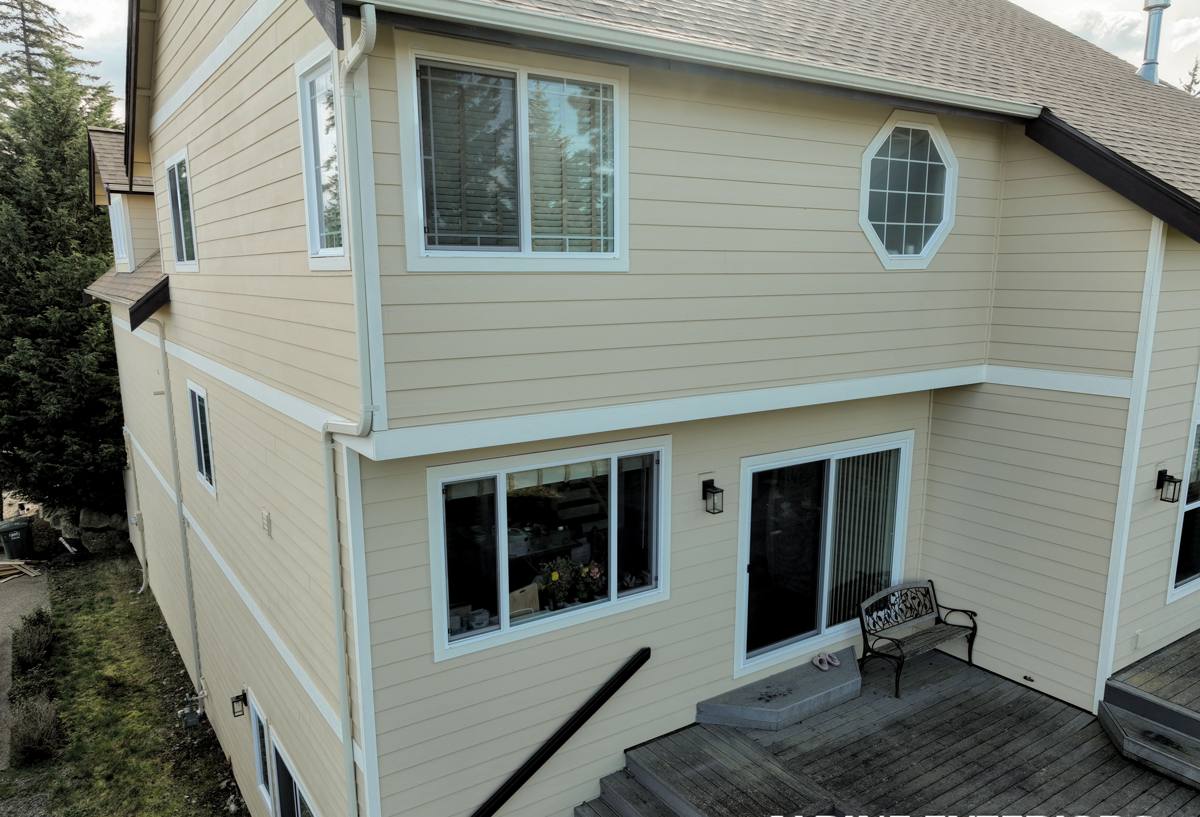
What James Hardie Fiber Cement Actually Solves
We install James Hardie fiber cement exclusively, and it's worth being specific about why, rather than just saying "it's better." Fiber cement is a mix of cement, sand, and cellulose fibers, pressed and cured into a dense, stable board. That density means it doesn't swell and shrink the way wood does when it cycles between wet and dry, and it doesn't provide the organic material that rot and mold need to spread. It's also non-combustible, which matters more each fire season as Washington's summers trend drier and longer, even up here near the border.
James Hardie's ColorPlus finish is baked on at the factory under controlled conditions, rather than field-painted after installation. That matters in a climate like ours because field-applied paint has a narrow window of dry weather to cure properly, and a rushed paint job in marginal weather is a common source of early peeling. A factory finish sidesteps that problem entirely and comes with its own finish warranty separate from the substrate warranty.
We also specify Hardie's HZ5 product line for this region, which is engineered for areas with sustained moisture exposure and freeze-thaw cycling. It's not a marketing label — the formulation and moisture management are tuned for exactly the kind of weather Whatcom County sees most winters.
What a Correct Installation Actually Involves
Fiber cement is only as good as its installation. Most of the siding failures we get called out to inspect aren't material failures — they're installation shortcuts that let water behind the board, where fiber cement can't do its job. A correct install includes:
- A drainage plane and weather-resistive barrier installed and lapped correctly behind the siding, not just under it
- Proper clearance from grade, roof lines, decks, and hardscaping — Hardie's own specs call for a minimum gap, and skipping it is one of the most common corner-cuts we see
- Correctly flashed and sealed window and door penetrations, since these are the top entry points for water intrusion
- Fastener placement and depth matched to the manufacturer's specification, not just "close enough"
- Proper joint treatment at butt seams and inside/outside corners, using the right sealant and gapping rather than caulking everything shut
- Correct nailing pattern for our wind exposure, since panels fastened too loosely or too tightly both cause premature cracking
None of this is visible once the job is finished and painted, which is exactly why it gets skipped by crews trying to move fast. It's also exactly why a homeowner can't judge installation quality by looking at a finished wall — you're relying on the crew's discipline during the two or three days when it actually matters.
Trim, Soffit, and Transitions
A siding job is rarely just flat panels. Trim boards, soffit returns, and transitions around vents, hose bibs, and light fixtures are where water problems usually start. We treat these as part of the core job, not an afterthought, using Hardie trim products designed to match the panel system rather than mixing in incompatible materials that expand and contract at different rates.
Our Process for Lynden Projects
Every job starts with an in-person walk-around, not a drive-by estimate. We look at existing siding condition, moisture staining, soffit and gutter condition, and anywhere water has clearly been running somewhere it shouldn't. From there:
- Written estimate covering material, tear-off, disposal, and any sheathing repair contingencies before work starts
- Removal of existing siding down to sheathing, with an inspection for rot or water damage before anything new goes up
- Repair of any compromised sheathing or framing — this gets called out and priced separately, never hidden inside a flat quote
- Weather-resistive barrier and flashing installed per manufacturer spec
- James Hardie panel, trim, and accessory installation to manufacturer fastening and clearance requirements
- Final walk-through with the homeowner before we consider the job done
We don't subcontract this out to whoever's available that week. The same crew that bids the job installs it, which is the only way we can stand behind the clearances and flashing details above.
Comparing Siding Options for a Lynden Home
| Material | Moisture Behavior | Fire Resistance | Maintenance | Typical Longevity |
|---|---|---|---|---|
| James Hardie Fiber Cement | Doesn't swell, warp, or rot from repeated wetting | Non-combustible | Low — factory finish, occasional wash | Decades with proper install; strong transferable warranty |
| Cedar / Primed Spruce | Absorbs moisture; prone to cupping, checking, rot at joints | Combustible | High — repainting and caulk maintenance on a cycle | Shorter, heavily dependent on upkeep |
| Vinyl | Doesn't rot, but seams and edges let moisture behind it undetected | Combustible, can deform in heat | Low, but limited repair options — often full replacement | Moderate; fades and becomes brittle over time |
| LP SmartSide / other engineered wood composites | Better than raw wood, but still wood-based and edge-sensitive to moisture | Combustible | Moderate — edge sealing and inspection matter | Moderate; warranty often more conditional on maintenance |
This is a general comparison, not a knock on every homeowner who has one of these products on their house today. Plenty of these materials perform fine when installed carefully and maintained on schedule. Our reason for standardizing on fiber cement is that it performs well with less dependence on that ongoing maintenance discipline, which matters in a climate that doesn't give you many dry weeks to catch up on it.
Signs Your Current Siding Is Already Struggling
Whether you're in Lynden proper or out on the surrounding farmland, these are the signs worth acting on before they turn into sheathing damage:
- Moss or dark algae staining that keeps coming back after cleaning
- Soft spots when you press on the siding, especially near the bottom courses
- Paint peeling or bubbling in sheets rather than fading evenly
- Visible gaps opening at seams, corners, or trim joints
- Cupping, warping, or boards pulling away from the wall
- Rising heating bills that suggest air and moisture moving through the wall assembly
- Insect activity at the base of exterior walls
Any one of these is worth a look. Several together usually mean moisture has been getting behind the siding for a while, and the fix is more than cosmetic.
Cost Factors Specific to Fiber Cement Projects
Pricing on any siding job depends on the same handful of variables: square footage, number of stories, complexity of trim and rooflines, condition of the sheathing underneath, and accessibility of the site. Homes with a lot of window and door penetrations, dormers, or multiple roof transitions take longer to flash correctly and cost more than a simple rectangular footprint of the same size. Any hidden rot discovered during tear-off adds cost, which is why we call it out as a contingency rather than guessing at it in the initial number. We give straightforward, itemized estimates rather than a single vague figure, so you know what you're paying for material versus labor versus any repair work.
Why a Crew That Already Works Lynden Matters
Fiber cement installation quality comes down to the details a homeowner can't inspect after the fact — flashing behind the panel, correct clearance from grade, fastener depth, and joint treatment. A crew that regularly works Whatcom County's wet-weather pattern has already made the adjustments that matter here: scheduling around the drying windows we actually get, sequencing tear-off and weather barrier work so a wall isn't left exposed overnight during a rain system, and specifying the HZ5 line rather than a generic version of the product. None of that is guesswork when it's the normal way you do the job, rather than something you're figuring out for the first time on a customer's house.
If your siding is showing moss, soft spots, or open joints, or you're planning ahead for a replacement, we're glad to walk the exterior with you and give a straightforward, no-pressure estimate — no obligation, just a clear look at what your home actually needs.