 Bellingham Exterior
 Blaine's Climate Is Tougher on Siding Than People Realize
Blaine sits right on the water at the northern edge of Whatcom County, and that location comes with a specific set of siding problems. Salt-laden air off Semiahmoo Bay and Drayton Harbor works its way into paint film and seams year-round. Driving rain off the Strait of Georgia hits west- and south-facing walls at an angle, not straight down, which pushes moisture into laps, corners, and trim joints that a fair-weather installation might never have to deal with. And because Blaine rarely gets the kind of hard freeze or dry spell that interrupts organic growth, moss and algae get a long runway on any surface that stays damp and shaded.
None of this is exotic weather. It's just persistent, and persistence is what wears siding out. A product or an installation that would hold up fine in a drier inland town can fail early in Blaine simply because it never gets a real chance to dry out between rain events.
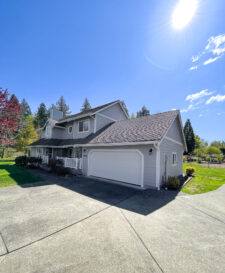
Why We Only Install James Hardie Fiber Cement
We don't install vinyl, LP SmartSide, cedar, or other fiber cement brands. That's a standard we hold across every job we do, and Blaine's climate is a good example of why. James Hardie siding is non-combustible fiber cement — it doesn't rot, it doesn't feed moss the way wood-based products can, and it's engineered specifically for wet coastal climates like this one. Hardie's HardieZone system rates products for different climate exposures, and homes in this part of Washington fall into HZ5, the zone built around moisture resistance and freeze-thaw performance rather than dry-heat durability.
That's not marketing language, it's an actual engineering distinction. A product designed and tested for a humid coastal zone behaves differently at the seams, under the paint film, and at the fastener points than a general-purpose siding product does. For a home a few blocks from saltwater, that difference matters over a 20- or 30-year timeline, not just in year one.
ColorPlus Finish and Salt Air
Standard field-painted siding is only as good as the paint job and the maintenance behind it. James Hardie's ColorPlus finish is baked on at the factory in multiple coats under controlled conditions, which gives it better fade and chip resistance than most site-applied paint — a real advantage in a location where salt air and UV both work against a finish. It also means touch-up paint is formulated to match, instead of homeowners guessing at a color match years later.
Product Lines That Fit Blaine Homes
Most Blaine homes end up using one of three Hardie product lines, sometimes combined:
- HardiePlank lap siding — the standard horizontal siding for most single-family homes, available in several exposure widths and textures
- HardiePanel — vertical panel siding, often used for a modern look or on accent walls and gables
- HardieShingle — used for accent areas or full shingle-style homes where a coastal or craftsman look is wanted
Trim is just as important as the field siding in a wet climate, so we pair the siding with HardieTrim boards rather than cheaper alternatives — trim is where a huge share of moisture intrusion problems start if it's not the same climate-rated material.
What a Correct Installation Actually Involves
Fiber cement siding is only as good as the install behind it. In a marine climate, the details that get skipped on a rushed job are exactly the details that cause problems within a few wet seasons. A correct James Hardie installation on a Blaine home includes:
- A weather-resistant barrier installed and lapped correctly behind the siding, with all penetrations properly sealed
- Flashing at every window, door, and roofline intersection, installed to shed water outward rather than trap it
- Proper fastener placement and spacing per Hardie's published installation instructions — this affects both warranty coverage and long-term performance
- Correct clearances at the ground, roofline, and any horizontal trim so water has somewhere to go instead of wicking into the bottom edge of the board
- Caulking only where Hardie's specifications call for it, with a product rated for the exposure — over-caulking traps moisture just as badly as under-caulking
- Field-cutting and painting cut edges per manufacturer guidelines to preserve moisture resistance at every seam
Every one of those steps is written into James Hardie's own installation requirements. Skipping them doesn't just risk a callback — it can void the manufacturer's warranty, which defeats the entire point of choosing a premium product in the first place.
How Hardie Compares for a Home Like Yours
| Factor | James Hardie Fiber Cement | Vinyl | Cedar |
|---|---|---|---|
| Moisture behavior | Engineered for wet coastal climates (HZ5) | Doesn't rot, but can warp and gap over time | Absorbs moisture; needs consistent upkeep to resist rot |
| Moss and algae resistance | Dense, non-organic surface resists growth better than wood | Resists growth but shows dirt and mildew film | Organic material, more prone to moss and mildew in shade |
| Finish durability | Factory-baked ColorPlus finish, fade-resistant | Color molded in but can fade and chalk | Requires repainting or restaining on a recurring cycle |
| Fire resistance | Non-combustible | Combustible | Combustible |
| Long-term maintenance | Occasional wash and inspection | Low maintenance but limited repair options | Regular sealing, staining, and repair |
We're not going to tell you cedar or vinyl are bad products in general — plenty of people use them successfully in drier climates. Our position is narrower: for a home exposed to salt air, sideways rain, and a long damp season the way Blaine homes are, we think fiber cement engineered for this exact climate zone is the more honest recommendation, and it's the only thing we put our name on.
Our Process on a Blaine Job
We start with a walk-around assessment of the home, looking specifically at west- and water-facing walls, existing moisture damage, trim condition, and any spots where past patch jobs or mismatched materials have created weak points. From there:
- We remove the old siding and inspect the sheathing underneath for hidden rot or moisture damage before anything new goes up
- We repair or replace any compromised sheathing — covering over a wet wall with new siding just hides the problem
- We install a new weather-resistant barrier and flash every opening before the first piece of Hardie goes up
- We install the siding, trim, and any accent shingle work to Hardie's published specifications
- We do a final walkthrough to check caulking, fastener lines, and clearances before calling the job finished
We also pay attention to weather windows. Coastal jobs get scheduled around Blaine's rain patterns where possible, because fiber cement, house wrap, and fresh caulk all perform best installed under reasonably dry conditions rather than rushed between storms.
Why a Crew That Already Works in Blaine Matters
Siding contractors who mostly work inland don't always think about how differently a coastal wall behaves. A crew that's used to Blaine and the rest of Whatcom County's coastline already knows which elevations take the worst weather, how much lead time moss and mildew need to become a real problem, and how local permitting and inspection expectations work. That familiarity shows up in small decisions — where extra flashing gets added, which trim details get extra attention, how the schedule gets built around the weather — that a homeowner may never notice unless they get skipped.
Living With Fiber Cement Siding in a Moss-Prone Climate
James Hardie siding is low-maintenance, not no-maintenance. In Blaine's climate we recommend:
- An annual rinse-down, especially on shaded north-facing walls where moss and algae get the most encouragement
- A visual check of caulking and trim joints once a year, since caulk is the one component that ages faster than the siding itself
- Prompt attention to any gutter or downspout issues, since consistent water running down a wall section will outpace what any siding product is designed to handle
- Keeping vegetation and sprinklers from holding moisture against the siding surface
Warranty and Long-Term Value
James Hardie backs its products with a non-prorated, transferable limited warranty — meaning if you sell the home, the remaining warranty coverage typically transfers to the new owner, which is a real selling point in a market like Blaine's. That warranty depends on correct installation, which is exactly why we install strictly to Hardie's specifications rather than cutting corners that would put a homeowner's coverage at risk down the road.
If you're weighing a siding replacement on a Blaine home, we're happy to walk the property, point out what your climate exposure actually looks like, and give you a straightforward, no-pressure estimate for a correctly installed James Hardie system. Use the form below to get started.