 Bellingham Exterior
 Building New in Sehome Means Getting the Window Install Right the First Time
Sehome sits on one of Bellingham's more established hillside neighborhoods, close to Bellingham Bay and shaded by mature fir and cedar canopy that's grown in over decades. When a home here is going up new — whether it's ground-up construction or a major addition tied into the original structure — the window install is one of the few parts of the build where mistakes don't show up right away. A flashing detail done wrong, a nailing fin set at the wrong reveal, a sill pan skipped to save an hour — none of that fails on day one. It fails in year three or four, after a few wet winters have worked the water into places it was never supposed to reach.
New-construction window work is different from a retrofit or replacement job. The window goes in before the siding, before the housewrap laps are finished, while the rough opening is still just framing lumber and building paper. That's actually the best possible time to get the water management right — but only if the crew treats it that way instead of just setting glass and moving on to the next opening.
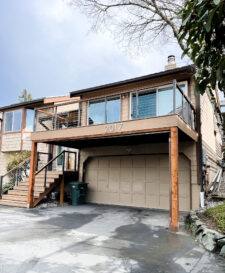
What Sehome's Climate Actually Does to a New Window Installation
Whatcom County's marine climate is the reason window details matter more here than in drier parts of the country. Three things specific to this area put real, ongoing stress on a new window install:
- Salt-laden air off Bellingham Bay. Prevailing westerly winds carry moisture and salt inland, which accelerates corrosion on exposed fasteners, hinges, and lower-grade cladding over time. Hardware and flashing metal need to be rated for it, not just whatever came in the box.
- Driving rain, not just steady rain. Bellingham doesn't get the heaviest rainfall totals in the Northwest, but wind-driven rain is common, and it pushes water sideways into gaps that would stay dry in a calm downpour. That's a flashing and sealant problem more than a "how much rain fell" problem.
- A long moss and algae season. Sehome's tree cover keeps a lot of the neighborhood shaded and damp well into the dry months. Moss and algae growth on sills, trim, and cladding around windows is a maintenance reality here, and it can trap moisture against the frame if the install didn't leave room for drainage and airflow.
None of this means Sehome is a hard place to build — it just means the window package and the install sequence need to be chosen for this climate, not for a generic spec sheet.
New-Construction vs. Retrofit: Why the Installation Method Matters
"New-construction window" usually refers to a window with a nailing fin — a flange around the perimeter of the frame that gets fastened directly to the wall sheathing and integrated into the housewrap and flashing before siding goes on. This is different from a block-frame or retrofit window, which gets set into an existing finished opening without disturbing the exterior cladding.
Nail-Fin (Flush-Fin) Installation
For a true new build or an addition where the wall is open to the sheathing, nail-fin windows are almost always the right call. They let the installer build a proper drainage plane around the opening — sill pan, jamb flashing, head flashing, and housewrap integration — all before the window is even in place. Done correctly, water that gets past the exterior cladding has a clear path back out, instead of pooling at the sill.
The Flashing and Water Management Sequence
The order of operations is what separates a window that will hold up through a Whatcom County winter from one that won't. In general terms, that sequence is: prep and flash the rough opening, install a sloped sill pan, set the window and fasten the nailing fin, flash the jambs so they lap over the sill flashing, flash the head so it laps over the jamb flashing, then integrate the housewrap so every layer sheds water downward and outward — never into the wall. Skipping or reversing any one of those steps is how a window that looks fine on install day ends up with rot in the framing a few years later.
| Detail | Nail-Fin / New Construction | Block-Frame / Retrofit |
|---|---|---|
| Best used when | Wall is open to sheathing (new build, addition) | Existing finished wall, siding staying in place |
| Water management | Full sill pan and flashing sequence built into the wall | Relies on existing wall flashing plus sealant at the frame |
| Long-term performance in driving rain | Stronger — layered, gravity-fed drainage | Depends heavily on the condition of the original flashing |
| Typical use in Sehome | New builds, additions, full rebuilds | Remodels where siding isn't being removed |
Choosing a Window Package for a Sehome New Build
Frame material matters as much as installation method, especially with salt air and long wet seasons in the mix. Vinyl frames are the most common choice for cost reasons and hold up fine when properly installed and reinforced at larger sizes. Fiberglass frames cost more up front but resist expansion and contraction better across our temperature swings and tend to hold paint and finish longer near the coast. Wood and wood-clad windows look great and are common in this neighborhood's older housing stock, but they carry the highest maintenance burden in a climate with this much sustained moisture — that's a real trade-off to weigh, not a knock on the product itself.
Whatever frame material you land on, we don't recommend cutting corners on glazing. Double-pane, low-E glass with argon fill is the baseline we build around for new construction in this area; it's a meaningful difference in comfort and condensation resistance during Bellingham's damp, gray stretches.
Whatcom County Energy Code and Permit Considerations
New-construction windows in Washington have to meet the state energy code's fenestration requirements, which set maximum U-factor and solar heat gain limits based on the compliance path the rest of the home is built to. On a new build or addition in Bellingham, the window schedule needs to match what's on the approved permit set — swapping in a different U-factor window mid-build can trip up final inspection. We coordinate window specs against the permit documents before ordering, so there's no mismatch discovered at the worst possible time.
Our Process for New-Construction Window Installs
For Sehome jobs, our approach stays consistent whether it's one opening on an addition or a full house:
- Walk the rough openings against the window schedule and framing plans before any windows are ordered.
- Confirm flashing materials and sill pan approach for each opening, accounting for exposure — a window under a deep eave doesn't need the same detailing as one facing open weather off the bay.
- Install sill pans, then set and fasten each window plumb, level, and square to the fin.
- Flash jambs and heads in the correct shingle-lap order, integrated with the housewrap.
- Seal and insulate the interior gap between frame and rough opening — a step that affects both energy performance and long-term air sealing.
- Document each opening's flashing before it's covered by siding, so there's a record of what's behind the wall.
Checklist: What to Confirm Before Your Windows Go In
- Window U-factor and SHGC match what's on the approved permit set
- Sill pan flashing is specified for every opening, not just the exposed ones
- Flashing tape and metal are rated for coastal/salt-air exposure
- Housewrap laps are planned to integrate with window flashing before siding starts
- Frame material and finish are matched to sun and moss exposure at each elevation
- Rough opening sizes are confirmed against actual window dimensions before ordering, not after
Why Hire a Crew That Already Works in Sehome
A lot of window problems in this part of Bellingham trace back to details that work fine in a drier climate but don't hold up here — flashing sequences borrowed from a different region, sealant used in place of proper mechanical drainage, or a frame material chosen without accounting for shade and moss buildup. A crew that's done this work elsewhere in Whatcom County knows what driving rain off the bay actually does to a wall, how much shade Sehome's tree canopy really provides, and which details are worth the extra time versus which ones are just upsells. That local pattern recognition is hard to substitute for.
If you're planning new-construction window work in Sehome — a new build, an addition, or a full rebuild — we're happy to walk the plans with you and put together a straightforward, no-pressure estimate. Use the form below to get started.