 Bellingham Exterior
 Siding Built for Life Near the Water
Homes in the Puget area carry a different kind of weather load than houses ten miles inland. Salt-laden air off the Sound works on fasteners and finishes year-round, driving rain hits siding sideways more often than it falls straight down, and the long gray stretch of moss season keeps north and shaded walls damp for weeks at a time. Siding that would hold up fine in a drier part of Whatcom County can start showing problems here in a fraction of the time — swelling at the bottom courses, streaking, soft spots around trim, paint that won't hold.
This page is specifically about siding installation for homes in the Puget area near Bellingham — not siding in general. The material, the detailing, and the installation sequence all need to account for what this particular stretch of coastline does to a house over the years.
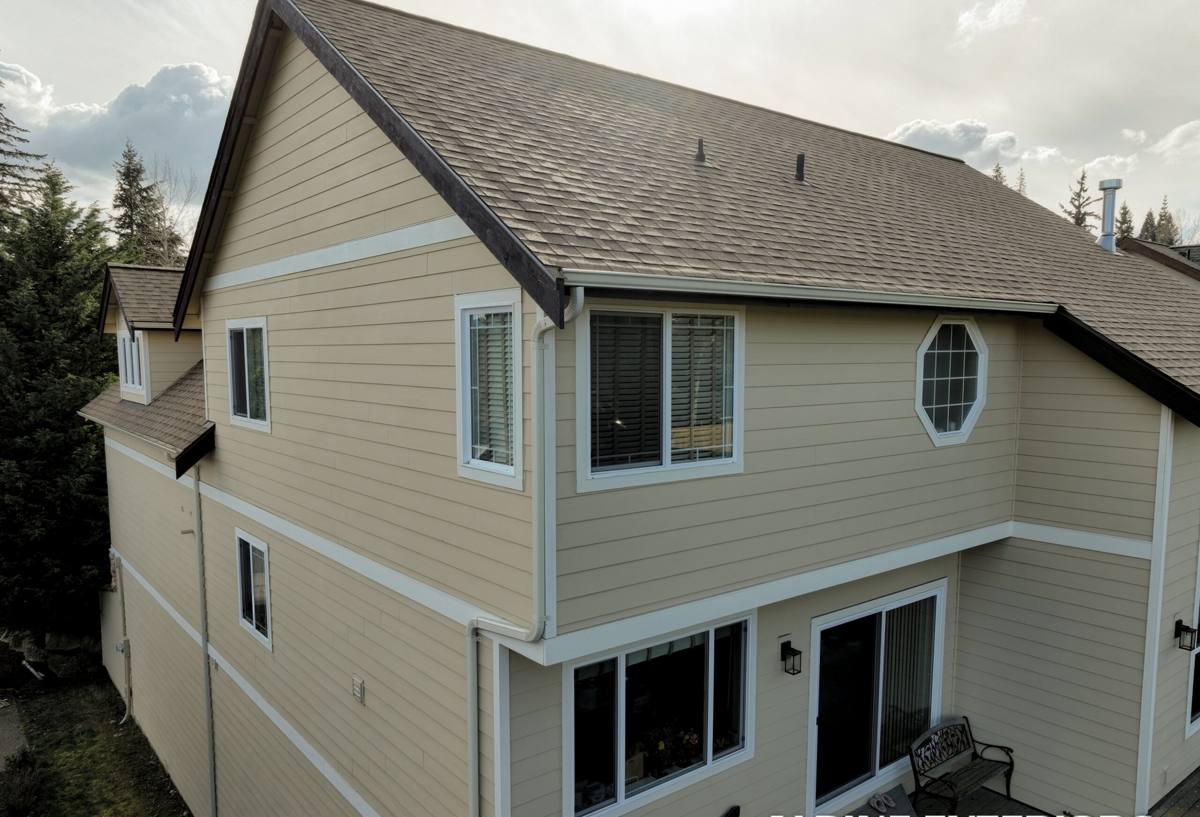
What Salt Air, Rain, and Moss Actually Do to a Wall
Salt Air and Fasteners
Airborne salt accelerates corrosion on anything metal — nail heads, flashing, trim fasteners, even the staples holding house wrap in place. When corrosion-prone fasteners are used this close to the water, rust stains bleed through paint and, worse, the fastener itself can weaken over time, loosening the panel it's supposed to hold.
Driving Rain and Water Intrusion
Wind off the Sound pushes rain into laps, joints, and butt seams instead of letting it run straight down and off the wall. A siding system that isn't detailed for wind-driven rain — proper laps, correctly flashed penetrations, a drainage gap behind the cladding — will eventually let water behind the siding, where it does the real damage: rot in sheathing, mold, and slow structural decay that isn't visible until it's expensive.
Moss and Trapped Moisture
Whatcom County's long wet season keeps shaded and north-facing walls damp for extended stretches, and moss will colonize any surface that stays wet long enough — siding, trim, even fasteners. Moss itself isn't just cosmetic; it holds moisture against the wall surface far longer than open air would, which is exactly the condition that rots wood-based products and degrades finishes not built for constant moisture exposure.
Why We Install Only James Hardie Fiber Cement
We made a deliberate decision as a company: we install James Hardie fiber cement siding and nothing else. Not vinyl, not LP SmartSide, not Cemplank or Allura, not primed spruce or cedar. That's not a marketing position — it's a standard we hold because of exactly the conditions described above.
Fiber cement is non-combustible and dimensionally stable — it doesn't swell, warp, or delaminate the way wood-based products can when they take on moisture repeatedly over a wet season. Hardie's ColorPlus factory-applied finish is baked on under controlled conditions, which gives it better adhesion and fade resistance than field-applied paint, and it comes with its own finish warranty separate from the substrate warranty. For homes exposed to salt air and long damp stretches, that combination — a moisture-stable core plus a factory finish designed to hold color and resist the elements — is why we standardized on it rather than offering multiple product lines.
We're not going to tell you vinyl or engineered wood siding are bad products in every application. They have real advantages elsewhere — vinyl's low upfront cost, LP's workability. But we've chosen not to install them here, in this climate, because the maintenance burden and moisture sensitivity trade-offs don't hold up the way we want a wall system to hold up on a house we've put our name on.
What a Correct Installation Actually Involves
Siding is a system, not a single layer of panels. A crew that cuts corners on what's underneath the siding can hang a beautiful-looking wall that still fails in five years. On a Puget-area home, we pay particular attention to:
Water Management Behind the Cladding
A weather-resistive barrier installed correctly — lapped the right direction, sealed at every penetration — combined with a drainage plane that lets any water that does get behind the siding find its way back out instead of sitting against the sheathing. This is the part of the job nobody sees once it's done, and it's the part that matters most in a wind-driven-rain climate.
Flashing and Penetrations
Every window, door, vent, and light fixture that penetrates the siding is a potential entry point for water. Correct flashing — head flashing above openings, proper kick-out flashing where rooflines meet walls, sealed penetrations at every fixture — is non-negotiable, not an upgrade.
Fastening and Clearances
Hardie specifies fastener type, spacing, and placement for a reason, and those specs are what keep the manufacturer's warranty valid. We also hold proper ground clearance and keep siding off of decks, patios, and roofing so moisture and debris — including moss spores — don't have a place to collect against the bottom edge of the wall.
Joints and Seams
Butt joints are where a lot of amateur installations fail first. Correctly treated and, where appropriate, flashed joints keep water from wicking into the panel edges, which is where fiber cement is most vulnerable if it's installed wrong.
Our Installation Process
- Assessment: We walk the home, check the condition of the existing wall assembly, and identify any moisture damage, rot, or drainage issues that need to be addressed before new siding goes on — covering a bad problem with new siding just hides it.
- Water management upgrade: We install or verify a proper weather-resistive barrier and drainage plane, and correct any flashing that isn't up to spec.
- Installation to manufacturer spec: Panels are cut, fastened, and lapped according to James Hardie's published installation guidelines, with attention to clearances at grade, decks, and roof lines.
- Trim and joint detailing: Trim, corners, and joints are finished and sealed correctly, since these are the highest-risk points for water intrusion.
- Final walkthrough: We inspect the completed work with you before considering the job done.
Comparing Siding Options for This Climate
Homeowners in the Puget area often ask us why we don't offer the lower-cost options other contractors install. Here's an honest comparison of how the major siding categories perform under salt air, driving rain, and prolonged moss-season moisture:
| Material | Moisture Behavior | Fire Resistance | Typical Maintenance |
|---|---|---|---|
| James Hardie fiber cement | Dimensionally stable; not wood-based, so it doesn't swell or rot from repeated wetting | Non-combustible | Periodic washing; ColorPlus finish reduces repainting needs |
| Vinyl | Doesn't rot, but can warp or crack with temperature swings and impact; seams and laps can allow water behind panels | Combustible, can soften/melt near heat sources | Low, but color can fade and isn't repaintable in the same way |
| LP SmartSide / engineered wood | Wood-based; sensitive to prolonged moisture exposure if seams, cuts, or finish are compromised | Combustible | Requires diligent caulking and finish maintenance to keep moisture out |
| Cedar / primed spruce | Natural wood; moisture and moss exposure require ongoing sealing and finish upkeep | Combustible | Highest — regular refinishing and moisture monitoring needed |
Why a Crew That Already Works This Area Matters
A contractor who mostly works drier inland jobs can still do competent general siding work, but they may not default to the detailing this stretch of coastline actually needs — the extra attention to drainage planes, the flashing at grade, the fastener choices that resist salt air corrosion. A crew that regularly works homes near Puget Sound has already seen what happens when those details get skipped, and builds them in as standard practice rather than an upsell.
Local familiarity also means a faster, more accurate estimate. We know the general moisture and exposure patterns that come with proximity to the water, which helps us flag likely problem areas — north walls, low grade clearance, deck-adjacent siding — during the initial walkthrough instead of discovering them mid-project.
Questions to Ask Before You Hire a Siding Contractor
- Do you install to the manufacturer's published specifications, including fastener type and spacing?
- What weather-resistive barrier and drainage plane do you use behind the siding?
- How do you flash windows, doors, and roof-to-wall intersections?
- What warranty covers the material, the finish, and your labor — and are they separate?
- Have you worked on homes in this specific area before, and can you speak to how you handle water management here?
- Will you address existing moisture or rot damage before installing new siding, or install over it?
Getting Started
If your Puget-area home has siding that's showing its age — moss buildup that keeps coming back, paint that won't hold, soft spots near the bottom edge — it's worth having it looked at before those issues turn into structural repairs. We're happy to walk the property, explain what we see, and put together a straightforward, no-pressure estimate for a James Hardie installation built for this climate. Use the form below to get started.