 Bellingham Exterior
 South Hill sits above the rest of Bellingham, and that elevation cuts both ways. The views are real, but so is the exposure. Homes up here catch wind and driving rain straight off Bellingham Bay, sit under mature tree canopy that keeps siding shaded and damp long after a storm passes, and — because much of South Hill's housing stock is older — often carry decades of prior repairs, patches, and paint jobs layered over the original wall assembly. Repairing siding correctly on a South Hill home means understanding all three of those things at once, not just matching a color and caulking a gap.
What Bellingham's Coastal Climate Does to Siding Over Time
Whatcom County doesn't get hurricanes or hailstorms. It gets something slower and, in some ways, harder on a building: near-constant moisture. Salt-laden air off the bay accelerates corrosion on fasteners and metal flashing. Driving rain — rain pushed sideways by wind rather than falling straight down — finds every gap in a butt joint, every under-caulked seam, and every spot where old paint has let go. And Bellingham's long, mild, overcast stretches mean siding that gets wet in October often doesn't fully dry out until spring.
On South Hill specifically, mature trees add another layer. Shade keeps siding from drying quickly after rain, and organic debris — needles, leaves, pollen — collects in horizontal laps and around trim, holding moisture against the wall longer than open, sun-exposed siding would experience. That combination is exactly what feeds moss and mildew growth, and it's why siding on shaded, older South Hill lots tends to show wear in different places than siding on a newer, open subdivision lot across town.
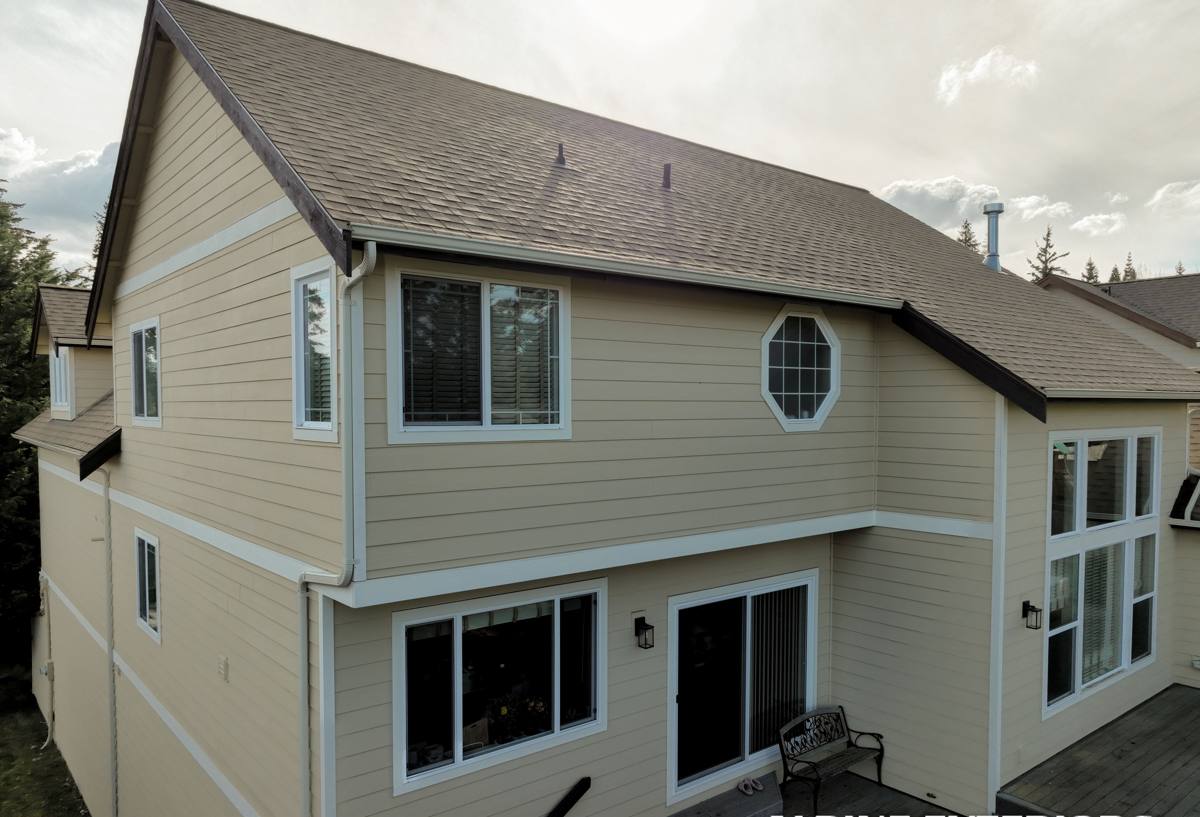
Signs a South Hill Home Needs Siding Repair
Not every flaw means a full re-side. Most of the calls we run on South Hill are legitimate repairs — a section of damaged siding, a failed transition detail, a chronically wet corner — not whole-house replacements. Here's what we look for, and what homeowners should look for between visits:
- Soft or spongy spots when you press on siding near the bottom edge of a wall, a sign moisture has gotten behind the material
- Paint that's bubbling, peeling, or alligatoring in a localized area rather than uniformly across the whole house
- Visible gaps at butt joints, corners, or window and door trim where caulk has shrunk, cracked, or fallen out
- Persistent moss or dark streaking that keeps coming back in the same spot no matter how often it's cleaned
- Cracked, split, or warped boards, especially on lower courses or anywhere gutters and downspouts discharge nearby
- Siding that feels loose, or fasteners that have backed out and left visible nail pops
- Interior signs — a musty smell, discolored drywall, or a soft spot on an exterior-facing wall — that trace back to an exterior breach
Any one of these is worth a look. Several at once, especially clustered on one elevation of the house, usually points to a specific failure — a flashing detail, a grading issue, a chronically shaded corner — rather than the siding material simply wearing out.
What a Correct Repair Actually Involves
A siding repair done right is not just cutting out a bad board and nailing in a new one. On an older South Hill home, that's often the fastest way to trap the same moisture problem behind a fresh coat of paint. Our repair process looks at the whole wall assembly, not just the visible surface:
Find the actual source
Damaged siding is usually a symptom. Before we replace anything, we trace the water path — is it a failed seal at a window, a missing kickout flashing, a gutter that's been overflowing onto the wall below, or just a joint that was never caulked correctly the first time? Replacing the board without fixing the source means the repair fails again on the same schedule.
Check what's underneath
Once boards come off, we look at the weather-resistive barrier and sheathing behind them. If moisture has been getting in for a while, that layer may need attention too — a repair that only addresses the visible siding while leaving compromised sheathing behind it isn't a real fix.
Match the material and reveal
On homes with older siding, matching board width, exposure (reveal), and profile matters for the repair to look intentional rather than patched. We take real measurements rather than guessing, and where an exact match isn't available, we plan the repair boundary — a corner, a trim line — so the transition reads as clean.
Re-flash and re-seal correctly
Every penetration, joint, and horizontal transition gets proper flashing and sealant, installed in the order that actually sheds water — not just caulked over the top as a cosmetic finish. This is the step that determines whether a repair lasts five years or twenty.
Repair or Replace: How We Make the Call
Homeowners often ask whether a damaged section means the whole house needs new siding. Usually it doesn't. But there are cases where patch repairs stop making financial sense. Here's roughly how we think about it on a South Hill property:
| What we find | What it usually means | Likely path |
|---|---|---|
| Isolated damage — one board, one corner, one water-entry point | Local failure, sound siding elsewhere | Targeted repair |
| Damage repeating in the same shaded, moss-prone spot | An ongoing moisture source, not random wear | Repair plus fixing the underlying cause (drainage, flashing, airflow) |
| Soft sheathing or rot found behind more than one area | Moisture has been getting in for years, likely house-wide | Broader repair or phased replacement |
| Siding sound but chronically repainted, patched, and caulked over decades | Material is at or near end of service life | Full replacement is usually the better long-term value |
| Single elevation failing while others are fine | Exposure-specific issue (weather side, shade, drainage) | Repair that elevation, monitor the rest |
The honest answer, most of the time, is that a well-built house with a real, localized problem just needs that problem fixed. We don't upsell a full re-side when a repair will hold — but we also won't patch over rot and call it done.
Why We Repair — and Rebuild — in James Hardie Fiber Cement
When a repair section needs new material, or when the damage is extensive enough that patching in the original product no longer makes sense, we install James Hardie fiber cement — full stop. We don't carry vinyl, LP SmartSide, or primed wood as repair or replacement options, because in a climate like Bellingham's, the material doing the repair matters as much as the workmanship.
Fiber cement doesn't feed moss and mildew growth the way wood-based products can on shaded, damp South Hill lots. It's non-combustible, dimensionally stable through the swings between soaked winter weeks and dry summer stretches, and Hardie's ColorPlus factory finish holds up under UV and salt air exposure without the repaint cycle that bare or site-primed products require. When we tie a repair into existing Hardie siding, or replace an older wood or composite section with Hardie boards, the new material is built for exactly the conditions that damaged the old material in the first place — not just a fresh version of the same vulnerability.
That standard also protects the invisible parts of the repair. Hardie's HZ5 product line is engineered for wet, freeze-prone climates, and its warranty structure is built around correct installation — which is why we install to Hardie's published specifications on fastener pattern, clearance, and flashing every time, not just on new full-house jobs.
Our Process for South Hill Repair Calls
Most repair jobs on South Hill follow the same sequence, adjusted for what we find once we open the wall up:
- On-site assessment. We look at the damaged area, the surrounding siding, drainage and grading near the wall, tree cover and shade patterns, and gutter performance during that visit.
- Diagnosis, not just a quote. Before we price the job, we identify what caused the damage — because a repair that ignores the cause is a repair we'll be back for.
- Written scope and cost factors. You get a clear explanation of what's being repaired, what material we're using, and why — including if we find something during the walk-through that changes the scope.
- Removal and inspection behind the siding. We don't skip this step even on small repairs, because it's the only way to know whether the problem is truly isolated.
- Correct rebuild. Weather-resistive barrier repaired as needed, proper flashing at every transition, Hardie fiber cement matched to reveal and profile, sealed and finished to spec.
- Final walk-through. We show you what was done and why, including anything worth keeping an eye on going forward — a downspout that needs cleaning more often, a branch worth trimming back for airflow.
Living with Moss Season: What Homeowners Can Do Between Visits
Bellingham's moss season runs long, and shaded South Hill properties see more of it than most. A repair holds longer when a few basic habits come with it:
- Keep gutters and downspouts clear so water discharges away from the wall instead of sheeting down the siding face
- Trim back branches and foliage that keep a wall in constant shade or in direct contact with siding
- Rinse visible moss and organic buildup off siding periodically rather than letting it establish and hold moisture against the surface
- Re-caulk visibly failed joints promptly — a small gap left over a wet Bellingham winter becomes a much bigger repair by spring
- Have siding checked after any period of unusually heavy or wind-driven rain, particularly on the side of the house that faces the weather
Why Local Experience on South Hill Matters
South Hill's mix of older homes, hillside exposure, and heavy tree cover creates repair conditions that differ block to block, sometimes wall to wall on the same house. A crew that has worked this neighborhood before recognizes the pattern faster — which corners tend to hold moisture, which original construction details are common on homes of a certain era, how far back a flashing failure usually traces. That experience shortens the diagnostic part of the job and reduces the chance of a repair that looks fine for a season and fails again the next winter.
It also means showing up with the right expectations about what an older South Hill home is built like, rather than treating every repair as a generic siding job. That's the difference between a patch and a repair that actually lasts through Whatcom County's wet stretch every year.
Get a Straightforward Look at Your Siding
If you're seeing soft spots, recurring moss, cracked boards, or a repair that's failed before, we'll come take a real look — not a sales pitch — and tell you honestly whether it's a targeted repair, a bigger fix, or something in between. Request a free, no-pressure estimate using the form below.