 Bellingham Exterior
 Composite Decking in South Hill: Built for What Bellingham's Climate Actually Does to a Deck
South Hill sits close enough to Bellingham Bay to catch salt-laden air off the water, and far enough up in elevation and tree cover to hold onto shade, damp, and moss longer than flatter parts of town. That combination is hard on outdoor structures. A deck here isn't just dealing with rain — it's dealing with rain that doesn't fully dry between storms, wood-eating moisture that sits under tree canopy, and a marine air layer that slowly corrodes anything metal that wasn't chosen with that in mind.
Composite decking exists largely to solve wood's weak points — rot, splintering, warping, repeated refinishing — but "composite" isn't one product, and installing it correctly in a climate like Whatcom County's takes more than following the same instructions you'd use in a dry inland state. We install composite decking in South Hill regularly enough to know which details actually matter here and which are just manufacturer boilerplate.
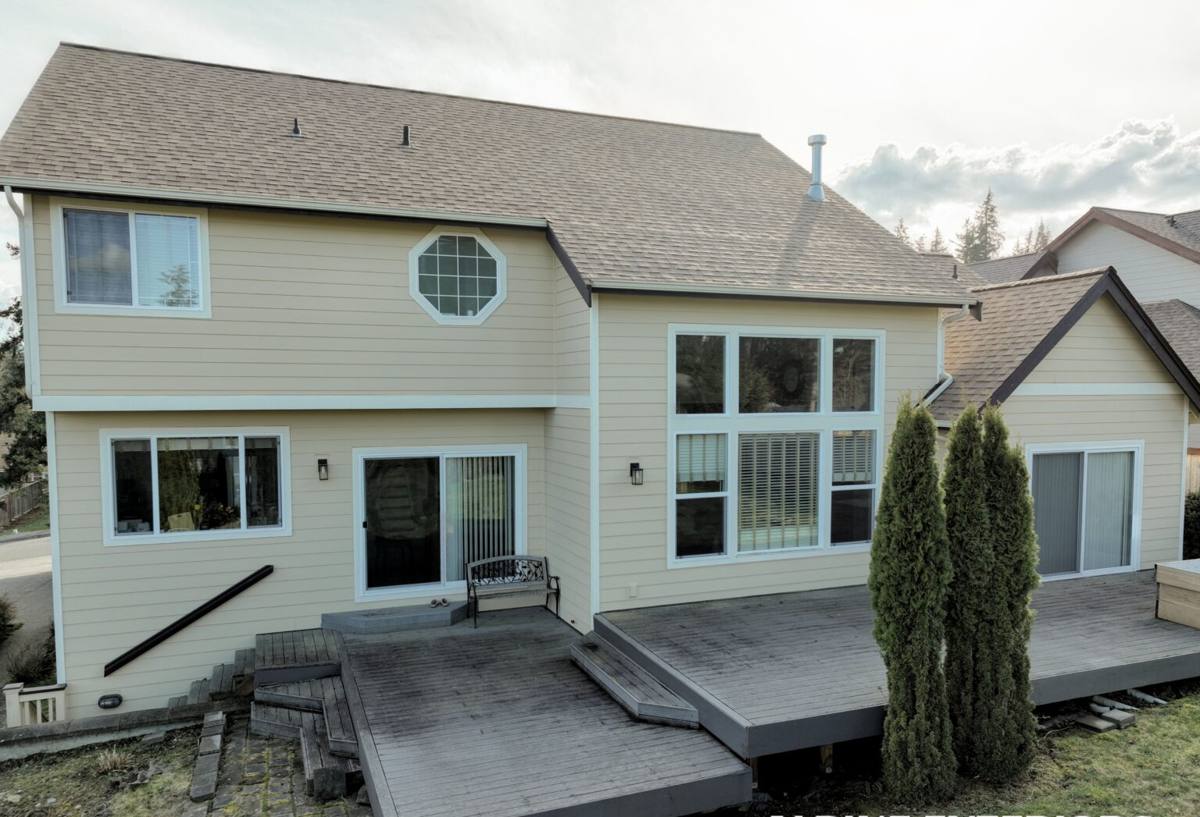
What South Hill's Terrain and Weather Demand From a Deck
A handful of local conditions shape how we approach every composite deck we build in this neighborhood:
- Extended shade and tree cover. Mature trees are part of what makes South Hill desirable, but shaded decking stays wet longer after every rain, which is exactly the condition moss and algae need to take hold.
- Salt-influenced air. Proximity to the bay means fasteners, brackets, and structural hardware corrode faster than they would further inland — a detail that's easy to overlook until a deck starts showing rust streaks a few years in.
- Slope and drainage. Many South Hill lots have grade changes that affect how water moves under and around a deck. Poor drainage planning here doesn't just wet the decking surface — it can pool against the house foundation or ledger board.
- A genuinely long wet season. Bellingham's rainy stretch runs long, which means any gap in flashing, ventilation, or fastening shows up as a problem faster than it would in a climate with more dry months to recover in.
None of this means composite decking is a poor fit for South Hill — the opposite is usually true, since composite resists the rot and splintering that this exact climate causes in untreated wood. It means the installation has to account for these conditions rather than treat them as an afterthought.
What a Correct Composite Deck Installation Actually Involves
The Structure Underneath Matters as Much as the Boards on Top
Composite decking is only as good as the frame it sits on. In a damp climate, that frame needs proper joist spacing for the specific composite product being used (composite generally needs tighter joist spacing than wood, and spacing requirements vary by manufacturer and board profile), joist tape or another moisture barrier on top of the framing to slow water intrusion into the wood structure below, and airflow underneath the deck so moisture doesn't stay trapped against the joists.
Ledger Board and Flashing
Where the deck attaches to the house is the single most common source of long-term water damage on any deck, composite or wood. Correct flashing at the ledger board — installed so water sheds away from the house rather than behind the siding — is not optional in a climate that gets driving rain for months at a stretch.
Fasteners and Hardware
Given the salt air this area sees, we use fasteners and structural hardware rated for coastal or marine-adjacent exposure rather than standard-grade hardware. It costs a little more up front and prevents the rust staining and hardware failure that shows up years later on decks built with the cheaper option.
Hidden Fastener Systems
Most quality composite boards are designed for hidden fastener clips rather than face-screwing. Done right, this gives a clean surface with no screw heads to collect water or grime — a real advantage during a long moss season, since fewer surface penetrations means fewer spots for organic growth to establish.
Composite vs. Wood vs. PVC Decking
Homeowners in South Hill often ask us to weigh composite against the alternatives given the climate. Here's an honest comparison based on how each performs in this specific setting:
| Factor | Wood (Cedar/Pressure-Treated) | Composite | PVC/Capped Polymer |
|---|---|---|---|
| Moisture resistance | Lower — prone to rot, cupping, and splinters over time in a wet climate | High — engineered specifically to resist moisture damage | Highest — fully synthetic, no wood fiber to absorb water |
| Moss/algae resistance | Low in shaded, damp spots without regular cleaning | Moderate to high depending on capping quality | High — smooth, non-porous surface |
| Maintenance | Annual sealing/staining recommended | Periodic washing, no sealing or staining | Minimal — occasional washing |
| Upfront cost | Lowest | Mid-range | Highest |
| Typical warranty structure | Manufacturer warranty on lumber grade only | Fade and stain warranties from manufacturer, often 25+ years | Longest warranties, often lifetime residential |
| Feel underfoot / appearance | Natural wood grain, warms and ages with the wood | Wood-look, wide range of colors and grain patterns | Can look slightly more uniform/synthetic depending on brand |
We don't push every customer toward composite. If budget is the priority and someone is willing to keep up with annual maintenance, cedar can still be the right call. Our job is to lay out the real trade-offs for this climate specifically, not steer everyone to the highest-margin product.
Our Process, Start to Finish
- Site assessment. We look at slope, drainage paths, shade exposure, and the condition of the existing structure (if we're replacing an old deck) before quoting anything.
- Structural check. Ledger board condition, existing footings, and framing are evaluated — a composite surface on a compromised frame is a short-term fix, not a real one.
- Flashing and moisture barrier work. Proper flashing at the house connection and a moisture barrier across the joists go in before a single composite board is laid.
- Framing to spec. Joist spacing is set to match the composite product's engineering requirements, not a generic standard.
- Composite installation. Boards go down with hidden fastener systems where the product supports it, with attention to expansion gaps and board orientation for drainage.
- Railing, stairs, and finish details. Matched to the decking system and installed with the same corrosion-resistant hardware standard.
- Final walkthrough. We check drainage under the finished deck and walk the homeowner through what maintenance (if any) the specific product needs.
Problems We Commonly Fix From Other Installations
A fair share of our composite decking work in South Hill is repair or replacement of decks that were installed without this climate in mind. The recurring issues we see:
- No ventilation gap under the decking, leading to trapped moisture and premature joist rot even though the composite surface still looks fine.
- Standard-grade fasteners that have rusted and stained the boards around them.
- Missing or incorrect ledger flashing, causing water damage to the house framing behind the deck attachment point.
- Joist spacing that doesn't match the composite manufacturer's requirements, leading to boards that flex, sag, or show stress lines over time.
- Decking laid directly over old, failing structures without addressing what's underneath.
Composite decking has a reputation for being low-maintenance, and it generally is — but that reputation assumes the installation was done correctly in the first place. A poor install under a good product still fails.
Maintenance Through Bellingham's Moss Season
Composite decking cuts maintenance dramatically compared to wood, but "low-maintenance" isn't "no-maintenance," especially with a moss season as long as this region's. A simple seasonal routine keeps a composite deck looking and performing the way it should:
- Sweep debris (leaves, needles, seed pods) off the deck regularly — organic buildup in shaded corners is what gives moss a foothold.
- Wash the surface with a soft-bristle broom and mild soap and water a couple of times a year, more often in heavily shaded areas.
- Avoid pressure washing at close range or high pressure — it can damage the capping layer on some composite products.
- Keep gutters and downspouts near the deck clear so runoff isn't dumping extra water onto the surface or framing.
- Trim back overhanging branches where possible to reduce shade and speed up drying time after rain.
- Check underneath the deck periodically for standing water or debris blocking airflow.
Why Hiring a Crew That Already Works South Hill Matters
Composite decking installation isn't neighborhood-specific in theory — the building science is the building science. In practice, a crew that regularly works South Hill's sloped lots, tree-heavy yards, and access constraints moves faster and makes fewer assumptions than one seeing the neighborhood for the first time. We already know to check for the drainage patterns typical of hillside lots in this area, to plan around limited driveway or street access on some of these properties, and to expect the shade conditions that make moss resistance a real factor rather than a marketing line.
Familiarity with Whatcom County permitting and inspection expectations also keeps a project moving instead of stalling on paperwork. None of that replaces sound installation practices, but it does mean fewer surprises for the homeowner and a project that accounts for the realities of the site from day one rather than treating South Hill like generic Bellingham.
If you're weighing a new composite deck or replacing one that hasn't held up, we're glad to take a look and give you a straight assessment — no pressure, no upsell, just what your specific property actually needs. Use the form below to request a free estimate.