 Bellingham Exterior
 Storm Damage Roofing Built for Sudden Valley's Terrain
Sudden Valley sits back from the open coast, tucked against Lake Whatcom and surrounded by tall conifers, which changes how storm damage shows up on a roof compared to a home out in the open. Homes here take less direct salt spray than waterfront properties along Bellingham Bay, but they deal with something just as damaging over time: heavy tree canopy that drops limbs and needle debris in every windstorm, a lake-effect microclimate that holds moisture in the air longer than surrounding areas, and driving rain that gets pushed sideways off the water during winter systems. Add Whatcom County's long, wet moss season, and you've got a roof that's rarely dry enough, long enough, to shed water and debris the way it's designed to.
Storm damage repair in this kind of setting isn't just about patching what's obviously broken. A missed puncture under a moss mat, or a lifted shingle tab that's been quietly letting wind-driven rain under the flashing for a few weeks, can turn into a rotten deck board by the time anyone notices a stain on the ceiling. This page covers what storm damage actually looks like on a Sudden Valley roof, what a correct repair involves, and how we handle the job from the first call to the final walkthrough.
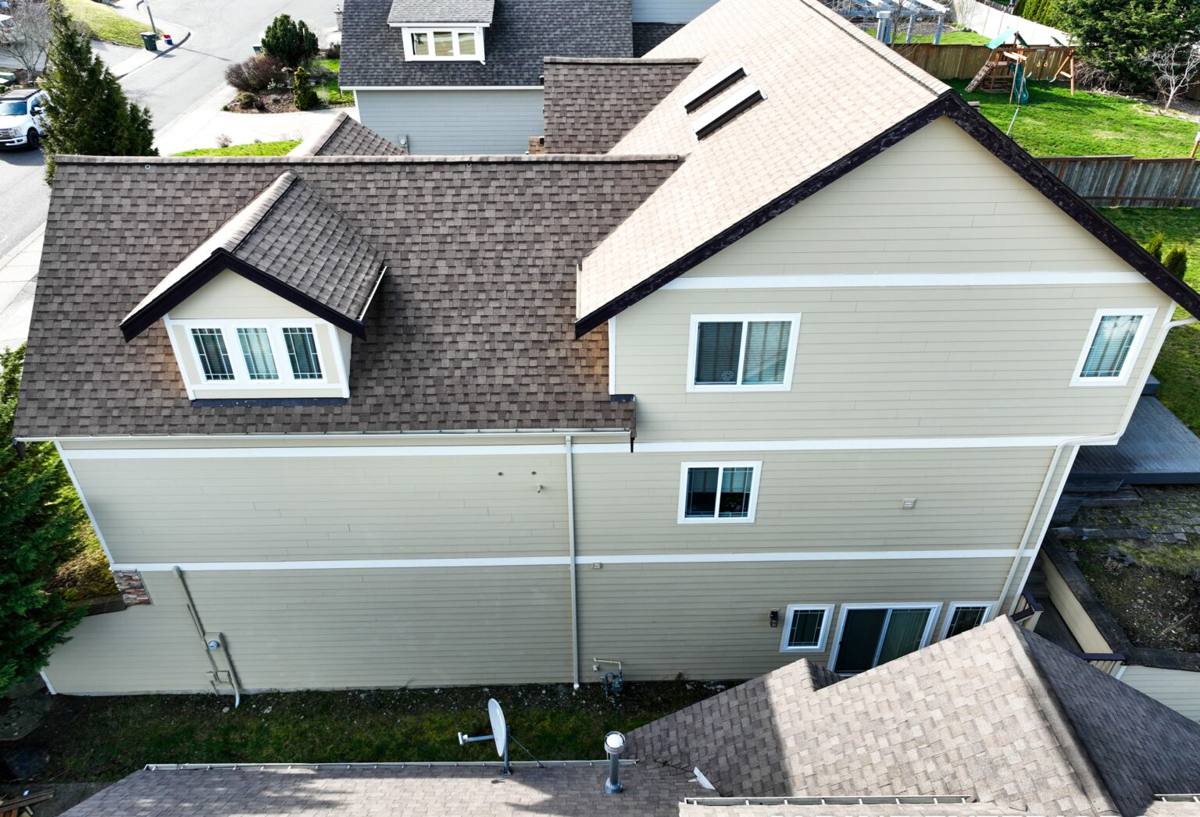
What Counts as Storm Damage on a Wooded, Lakeside Roof
Wind and Wind-Driven Rain
Whatcom County storms typically bring sustained wind out of the south or southwest, and Sudden Valley's tree lines funnel gusts in ways that can lift shingle tabs, crease ridge caps, and drive rain up and under lap joints that would stay dry in a calmer setting. This kind of damage is often invisible from the ground — you won't see a hole, you'll see a water stain weeks later.
Tree Limb and Debris Impact
This is the damage type that sets Sudden Valley apart from a lot of in-town Bellingham roofs. Mature conifers shed limbs in every serious windstorm, and even a glancing hit can crack a shingle, punch through underlayment, or knock a chunk out of a ridge vent. Smaller debris — needles, cones, twigs — piles up in valleys and behind chimneys, holding moisture against the roof deck long after the storm has passed.
Moss and Long-Term Moisture Damage
Storms don't just cause impact damage — they saturate moss mats that have been building for months, and that extra weight and moisture load can be what finally pushes a marginal shingle or flashing seal past its breaking point. A roof that's been quietly losing granules under a moss colony for a couple of seasons is far more vulnerable during a bad storm than a clean one.
Hail and Debris Bruising
Hail is less common here than in other parts of the country, but it does happen, and even a modest event can bruise asphalt shingles in a way that isn't visible until the granules start to wash off months later.
What a Correct Storm Damage Repair Actually Involves
A quick patch job hides a problem instead of solving it. A correct repair traces the damage back to its source and checks everything the damage could have affected before it's covered back up.
Full Inspection, Not a Spot Check
We inspect the whole roof plane the damage is on, not just the spot that was reported. One cracked shingle from a falling limb is often accompanied by lifted tabs nearby that got stressed by the same gust, or displaced fasteners a few feet away.
Decking and Underlayment Check
If water has been getting in for any length of time, the plywood or OSB decking underneath needs to be checked for soft spots, delamination, or rot — not just the shingles above it. Repairing shingles over compromised decking is a short-term fix that fails again in the next storm.
Flashing and Penetration Review
Storm damage frequently shows up first at flashing — around chimneys, skylights, vent pipes, and roof-to-wall transitions — because these are the places wind-driven rain finds an opening. We check these points even when the visible damage is elsewhere on the roof.
Matching Materials Correctly
Patch repairs need to match the existing roofing material in type, weight, and, where possible, color and age so the repair sheds water the same way the surrounding roof does. Mismatched or incompatible patch materials can create a new weak point instead of fixing the old one.
Our Process, Start to Finish
- Initial call and triage. We ask what happened and when, and whether there's active leaking, so we can prioritize accordingly.
- Emergency mitigation, if needed. Active leaks or exposed decking get tarped or temporarily sealed to stop further water intrusion before the full repair is scheduled.
- On-site inspection and documentation. We walk the roof, photograph the damage, and note anything that affects decking, flashing, or ventilation — documentation you can also use if you're filing an insurance claim.
- Written repair plan and estimate. You get a clear explanation of what's damaged, what needs to be repaired versus replaced, and an honest cost range before any work starts.
- Repair work. We fix the actual cause of the leak or damage — decking, underlayment, flashing, and roofing material — not just the visible symptom.
- Final walkthrough. We show you what was done and what to watch for going forward, especially if moss or debris buildup was a contributing factor.
Repair or Replace? What Actually Drives That Decision
Not every storm-damaged roof needs full replacement, and not every roof is worth repairing. The right call depends on a handful of factors working together, not any single one.
| Factor | Favors Repair | Favors Replacement |
|---|---|---|
| Extent of damage | Isolated to one area or plane | Spread across multiple planes or the whole roof |
| Roof age | Well within expected service life | Already near or past typical lifespan |
| Decking condition | Solid, dry, no rot | Soft spots, delamination, or rot present |
| Underlying moss/moisture history | Minimal prior moss or water staining | Long-term moss colonization or recurring leaks |
| Material availability | Matching shingles/materials still available | Discontinued material, poor match likely |
We'll tell you honestly which side of that table your roof falls on. A repair-worthy roof doesn't need a sales pitch for a full replacement, and a roof past its useful life doesn't need another round of patches that won't hold.
Insurance Claims and Documentation
Most homeowner policies cover sudden storm damage — a fallen limb, wind uplift, hail — differently than they cover gradual wear like long-term moss deterioration. That distinction matters for a claim, and it's part of why thorough documentation at the inspection stage is worth doing right. We provide clear photos and a written description of the damage that you can submit with your claim. We don't handle the claim itself or negotiate with your adjuster, but we'll answer questions about the roof's condition honestly if your insurer needs clarification.
Reducing Repeat Storm Damage
Given the tree cover and moisture that Sudden Valley roofs deal with year-round, a few maintenance habits go a long way toward reducing how much damage the next storm actually causes:
- Keep gutters and downspouts clear of needles and debris so storm rain has somewhere to go
- Have overhanging limbs trimmed back before they become a wind-storm liability, not after
- Address moss buildup before it saturates and adds weight during a storm
- Check attic ventilation periodically — trapped moisture accelerates decking and shingle deterioration
- Have the roof inspected after any storm with sustained high winds, even if nothing looks obviously wrong from the ground
None of these prevent every storm from causing damage, but together they reduce how often a storm turns into an emergency repair instead of routine maintenance.
Why It Matters That We Already Work in Sudden Valley
A crew that only sees Sudden Valley roofs occasionally is working from a generic playbook. A crew that works the community regularly knows what these roofs are actually up against — the tree debris patterns after a windstorm, the way moss builds differently on a shaded, lake-adjacent lot than it does on an open one, and the access and scheduling considerations that come with working in a community association setting. That familiarity means less guesswork during the inspection and a repair plan that accounts for conditions specific to the area, not just the damage in front of us.
We also know that storm damage repair often needs to happen quickly, before a temporary tarp or a small leak becomes a bigger problem during the next system to roll through Whatcom County. Being an established local crew means we can usually respond faster than a contractor coming from outside the area.
Get a Straight Answer on Your Roof
If a recent storm left you with a leak, missing shingles, or debris damage on your Sudden Valley roof, we'll come take an honest look and tell you plainly what's going on and what it'll take to fix it — no pressure, no upsell. Reach out using the form below for a free estimate.