 Bellingham Exterior
 Board & Batten Siding in York: Built for What Bellingham Bay Throws at a House
Homes in and around York sit close enough to Bellingham Bay and the broader Whatcom County coastline that siding here does a different job than siding fifty miles inland. Salt-laden air moves off the water and settles on exterior surfaces year-round. Driving rain, pushed sideways by wind off the Strait, finds every gap in a wall assembly that would stay dry in a calmer climate. And for a good chunk of the year, low sun angles and constant damp keep north- and west-facing walls shaded and wet long enough for moss and algae to take hold. None of that is unique to one street or subdivision — it's the baseline for this part of Whatcom County — but it's exactly the combination that decides whether a board and batten job looks sharp in year twelve or needs paint and patching by year five.
Board and batten is a strong look for this area. The vertical lines read well against the region's mix of craftsman, farmhouse, and modern coastal architecture, and the style has real history in Pacific Northwest building. But the style only holds up if the material underneath it is chosen and installed with this climate in mind — not the climate of wherever a product was originally engineered for.
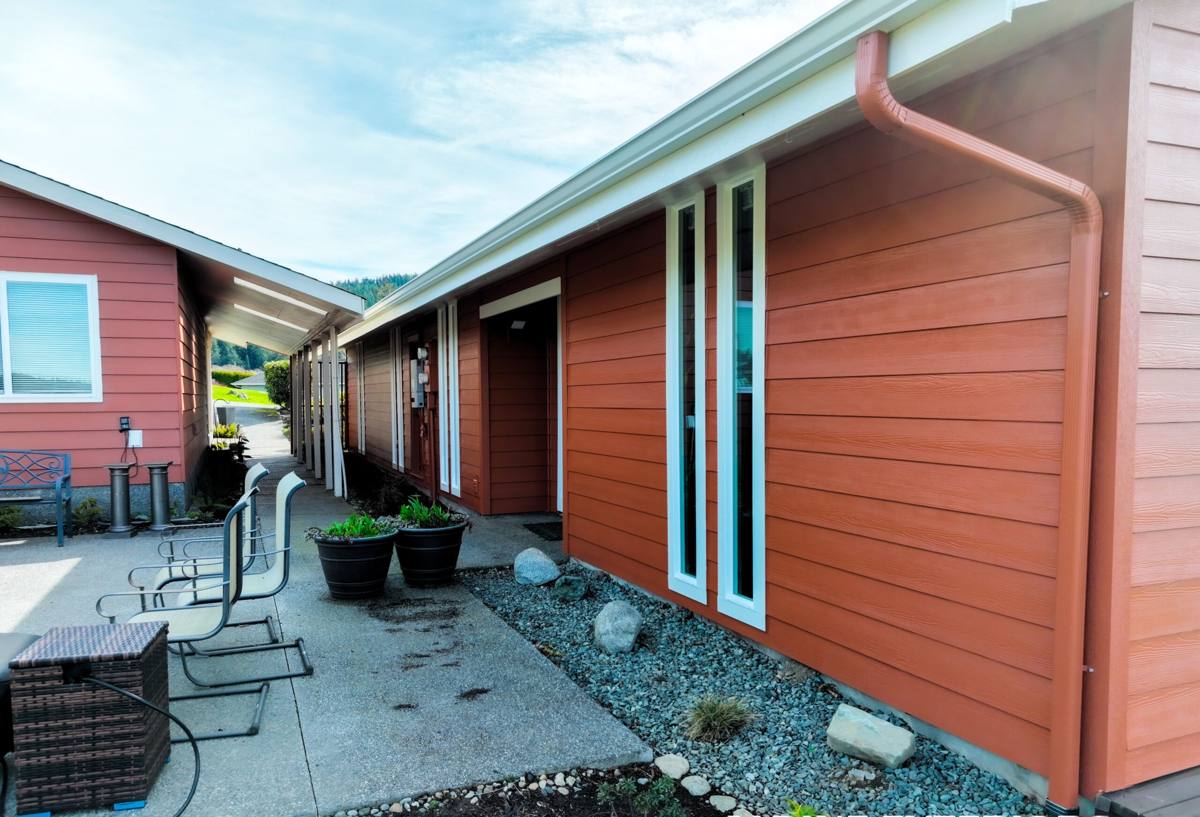
What Board and Batten Siding Actually Is
Board and batten is a two-layer siding pattern: wide vertical boards (or panels) installed first, then narrower battens fastened over the seams between them. The result is a rhythm of raised vertical lines and shadow gaps that reads as more architectural than flat lap siding. It can cover a whole house or be used as an accent — gables, dormers, entry walls, or a mix with horizontal siding on the lower story.
The pattern is simple. The material behind it is where the decisions that matter actually get made.
Why the Material Choice Matters More on Board and Batten
Board and batten has more seams, more fastener penetrations, and more vertical joints than lap siding. Every batten strip is a place where water can be pushed by wind-driven rain, and every seam is a place where a weak substrate shows its age first. In a climate with regular driving rain and constant salt exposure, a board and batten system built from a moisture-sensitive material is working against itself from day one.
What a Correct Board and Batten Job Involves
Substrate and Moisture Barrier
Before any siding goes up, the wall needs a continuous, correctly lapped weather-resistive barrier and properly integrated flashing at every window, door, and penetration. This step matters more here than almost anywhere else in Washington — wind-driven rain off the bay will find any shortcut in the water management plane, and it will find it repeatedly, not just in one bad storm.
Board Layout and Batten Spacing
Boards need consistent spacing and battens sized and placed so water sheds cleanly instead of pooling behind the strip. Batten spacing that looks fine on paper can trap moisture if the underlying panel isn't rated for the exposure or if the gap behind the batten isn't accounted for in the installation.
Fastening
Fastener type, spacing, and depth all affect how the assembly performs over time, especially with salt air accelerating corrosion on the wrong hardware. Fasteners need to be rated for coastal exposure, not just whatever's on the truck.
Painting and Finish
On a factory-finished product, this step is largely eliminated — the finish is baked on before the material ever reaches the site. On a field-painted product, every cut edge, fastener head, and seam needs to be sealed and coated correctly, and that finish starts degrading from day one under UV and salt exposure.
Why We Install James Hardie for Board and Batten — and Nothing Else
We install James Hardie fiber cement exclusively. For board and batten specifically, that means Hardie panel products designed for vertical batten applications, finished with the ColorPlus factory finish system. We don't install LP SmartSide, vinyl, Cemplank, Allura, primed spruce, or cedar board and batten, and in a climate like this one, the reasoning isn't abstract — it's specific to what salt air, driving rain, and a long moss season do to each of those materials over years, not just in the showroom.
| Material | How It Handles This Climate |
|---|---|
| James Hardie fiber cement | Non-combustible, engineered for moisture and swings in humidity, factory ColorPlus finish resists fading and holds up to UV and salt air without repainting on the usual cycle |
| Vinyl | Can warp or become brittle with temperature swings and UV exposure over time; seams and battens in a vinyl board and batten system are a common point of water intrusion if not detailed precisely |
| LP SmartSide (engineered wood) | Wood-based core is vulnerable if the factory coating is compromised at a cut edge or fastener; sustained damp conditions like ours put real pressure on any wood-based product's edge sealing |
| Cedar / primed spruce | Attractive material, but real wood requires ongoing maintenance — refinishing, caulking, and vigilance against rot — that only intensifies in a wet, salt-air climate |
None of these are bad products in every context. LP SmartSide and cedar both have real strengths, and vinyl has its place on a budget-driven job. Our position is narrower than "these products fail" — it's that for board and batten siding on homes exposed to Bellingham Bay's salt air and rain, we don't think they hold their appearance and performance as reliably as fiber cement does, and we're not willing to install something we don't believe in for this climate. James Hardie's HZ5 product line is specifically engineered for climates like the Pacific Northwest's, and the ColorPlus finish carries its own separate warranty against fading and chipping — backed by a company, not a can of paint from the job site.
Our Process for a York Board and Batten Project
- On-site assessment — we look at wall exposure, existing moisture damage, window and door flashing condition, and how much of the assembly needs to come off versus be built on properly.
- Scope and product selection — we walk through Hardie panel and batten options, colors, and where board and batten fits best on the specific house — full elevation, accent gable, or mixed with lap siding.
- Removal and substrate prep — old siding comes off, sheathing is checked for rot or water damage, and a continuous weather-resistive barrier goes on correctly lapped and flashed.
- Installation — boards, battens, and trim go on to Hardie's fastening and spacing specs, with attention to every seam, corner, and penetration.
- Final walkthrough — we go over the finished work with the homeowner before calling the job done.
Maintenance: What Board and Batten Actually Needs Here
- Rinse siding annually to clear salt residue, pollen, and early moss or algae growth before it takes hold
- Check caulking at trim, window, and door joints every year or two — sealant is the first thing to give in constant damp conditions
- Keep gutters clear and downspouts directed away from walls; a lot of siding damage starts as roof runoff, not rain itself
- Trim back vegetation and tree cover that keeps a wall shaded and damp longer than it needs to be
- Watch north- and west-facing elevations first — they're usually the last to dry out and the first to show moss
With Hardie's factory finish, this is closer to occasional upkeep than a maintenance schedule. That's a meaningful difference from field-painted or wood siding, where the finish itself is a recurring job.
What Affects Cost on a Board and Batten Project
| Factor | Why It Matters |
|---|---|
| Full elevation vs. accent use | Board and batten on an entire house costs more than using it as a gable or entry accent over lap siding |
| Substrate condition | Rot or water damage found once old siding comes off adds repair scope before new siding can go on |
| Trim and detail work | Corners, window surrounds, and transitions between board and batten and other siding styles take more labor than a flat run of panel |
| Height and access | Second-story and steep-site homes, common around Bellingham's hillier lots, add scaffolding and staging time |
| Color and finish selection | Factory ColorPlus finishes vary in cost by line, but eliminate the recurring cost of repainting |
We give real numbers after seeing the actual wall condition and scope — not a blanket per-square-foot figure that ignores what's actually going on behind the old siding.
Why Hiring a Crew That Already Works in York Matters
A siding crew that regularly works this part of Whatcom County has already seen what salt air, wind-driven rain, and moss do to a wall assembly over a decade or more — not in theory, but on houses down the street from each other. That translates into better calls on flashing details, fastener selection, and where a home's specific exposure to weather off the bay needs extra attention. It also means a crew that isn't learning the region's building codes and permit process on your job. For a style like board and batten, where the number of seams and joints raises the stakes on correct installation, that local experience is worth more than a lower bid from a crew unfamiliar with what this coastline does to a house.
If you're considering board and batten siding for a home in the York area, we're glad to take a look and walk through what it would actually take on your specific house. The estimate is free, there's no pressure, and you'll get a straight answer about scope and cost before anything is decided.