 Bellingham Exterior
 Why Barkley Roofs Face a Different Set of Demands
Barkley sits close enough to Bellingham Bay that homes here deal with a combination most inland neighborhoods don't: salt-laced air moving off the water, long stretches of driving rain through fall and winter, and a growing season for moss and moisture-loving growth that can run most of the year. None of that is unique to any one house in the area — it's the baseline every roof in this part of Whatcom County has to handle. A metal roof that's specified and installed correctly for this environment will outperform almost anything else on the market. One that's installed generically, using the same details a crew would use in a drier inland climate, tends to show problems early — usually at the fasteners, the flashing, or wherever moisture has a chance to sit.
This page is specifically about metal roofing for homes in and around Barkley. If you're comparing materials or just trying to understand what a correct installation looks like in this climate, the details below are the ones that actually matter here.
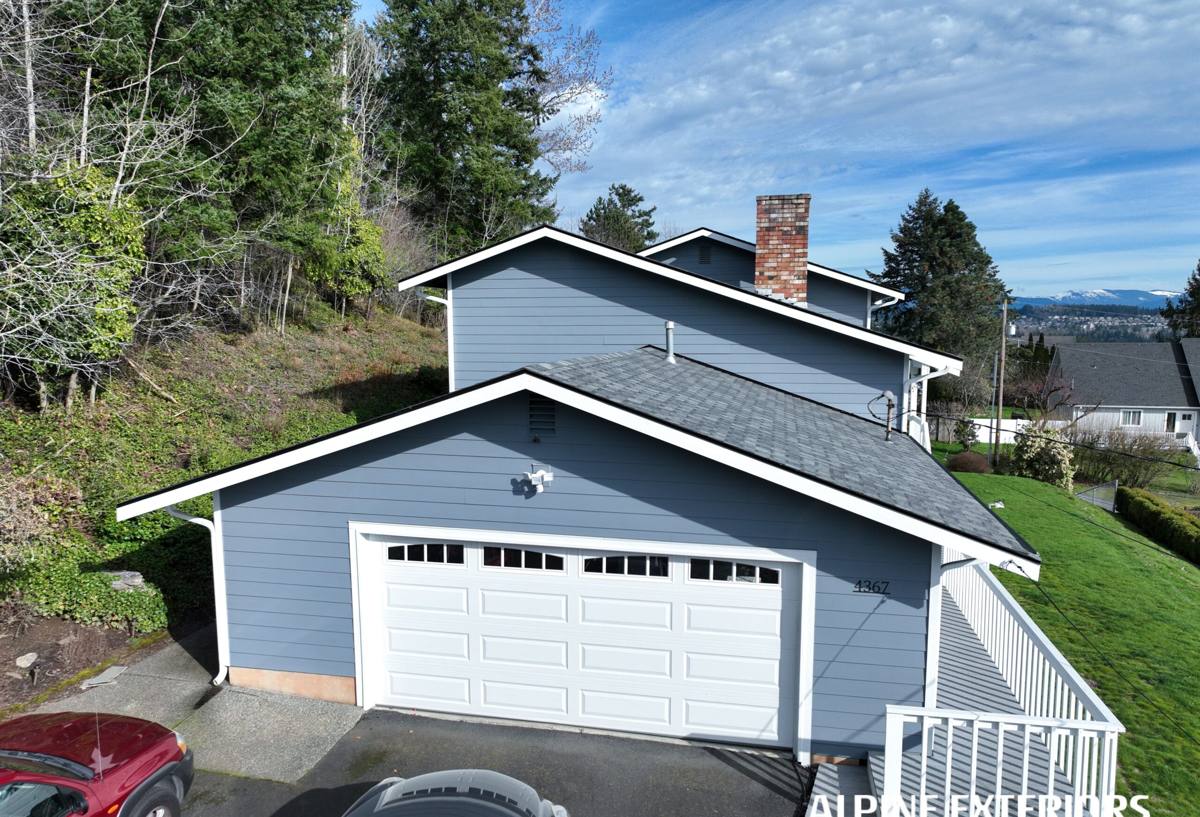
What Salt Air, Rain, and Moss Actually Do to a Roof Over Time
Salt Air and Corrosion
Airborne salt doesn't need to be blowing hard to do damage — it settles on roofing surfaces and fasteners over months and years, and it accelerates corrosion on anything not rated for a coastal or near-coastal environment. This matters most at exposed screw heads, cut edges, and any place two dissimilar metals touch each other. A fastener or flashing detail that would last decades in a dry inland town can start rusting or staining within a few years this close to the water.
Moss and Trapped Moisture
Bellingham's mild, wet climate is close to ideal for moss growth, and metal roofing isn't immune to it — moss and organic debris can still collect in valleys, around penetrations, and anywhere water doesn't shed cleanly. The issue isn't usually the moss itself; it's what happens underneath it. Moss holds moisture against the panel surface far longer than open air would, and over years that constant damp contact can degrade coatings and encourage corrosion at seams and fastener points.
Wind-Driven Rain
Rain here doesn't always fall straight down. Wind off the bay can push it sideways and under laps, seams, and flashing that would be fine in calmer conditions. This is why underlayment selection and flashing detail matter as much as the panel itself — a roof can have excellent metal on top and still leak if the water management underneath it wasn't built for wind-driven conditions.
Metal Roofing Materials and Finishes That Hold Up Locally
Not every metal roofing product performs the same way in a marine climate. The panel profile, the base metal, and the coating all affect how the roof ages near salt air and constant moisture.
| Option | How It Performs in Barkley's Climate | Best Fit |
|---|---|---|
| Standing seam (steel or aluminum) | Concealed fasteners mean fewer penetration points for water and salt air to attack; strong performance against wind-driven rain | Most Barkley homes, especially those closer to the bay |
| Exposed-fastener metal panels | Lower upfront cost, but fastener gaskets and washers wear faster in salt air and need periodic checking | Budget-conscious projects, outbuildings, garages |
| Aluminum panels | Naturally corrosion-resistant, does not rust; a strong choice for properties nearest the water | Coastal-adjacent lots, homes with high salt exposure |
| Steel panels with a marine-grade coating | Good durability and cost balance when the coating system is rated for coastal use | Most residential re-roofs in Barkley and Bellingham generally |
Coating quality matters as much as the base metal. A well-formulated paint or coating system resists chalking and fading from UV exposure while also standing up to the salt content in the air. We steer homeowners toward panels and coatings with a proven coastal track record rather than the cheapest option on a spec sheet — the difference shows up in year eight or ten, not on installation day.
What a Correct Metal Roof Installation Actually Involves
A metal roof is only as good as what's underneath it and how it's detailed at the edges. The panels get the attention, but most of the leaks and early failures we see trace back to a handful of details that are easy to shortcut.
- Underlayment: A synthetic or self-adhered underlayment rated for high-moisture climates, not a minimal-code product, gives the roof a real second line of defense against wind-driven rain.
- Flashing at every transition: Valleys, chimneys, vents, skylights, and wall intersections need properly formed and sealed flashing — this is where most roof leaks actually originate, on any roof type.
- Fastener selection: Fasteners and washers rated for coastal exposure, matched to the panel metal to avoid galvanic corrosion between dissimilar metals.
- Panel layout for water flow: Correct overlap and seam direction so water is always shedding downhill, especially in valleys and low-slope sections where moss and debris tend to collect.
- Ventilation: Proper intake and exhaust airflow in the attic to prevent condensation from forming on the underside of the metal, which is a common cause of hidden deck damage.
Skipping any one of these doesn't usually cause an immediate problem. It shows up two, five, or ten years later, as a slow leak, a corroded fastener, or a soft spot in the deck that could have been avoided with the right materials and layout from the start.
Our Process for Barkley Metal Roofing Projects
We keep the process straightforward and give you real information at each stage rather than surprises.
- On-site inspection: We look at the existing roof, deck condition, ventilation, and any trouble spots — moss buildup, staining, soft decking — before recommending anything.
- Honest tear-off vs. overlay assessment: Metal can sometimes go over an existing roof, but we'll tell you plainly when a tear-off is the better long-term call for your deck and structure.
- Written estimate: Panel type, underlayment, flashing approach, and price laid out clearly, with the reasoning behind each choice for your specific roof and exposure.
- Deck prep and repair: Any soft, rotted, or water-damaged decking gets replaced before a single panel goes on — metal over a compromised deck just hides the problem.
- Installation: Underlayment, flashing, and panels installed in sequence with attention to the details that matter in this climate, not just the parts that are visible from the ground.
- Cleanup and walkthrough: Site cleaned, debris and old materials hauled off, and a walkthrough so you understand what was done and what to expect from the roof going forward.
Maintenance That Actually Matters for a Barkley Metal Roof
Metal roofing is genuinely low-maintenance compared to other materials, but "low-maintenance" isn't the same as "no maintenance" in this climate. A little attention once or twice a year goes a long way.
- Clear leaves, needles, and debris from valleys and around penetrations before fall rains set in
- Rinse off moss and organic growth with a gentle wash rather than scraping or pressure-washing the coating
- Check gutters and downspouts so water isn't backing up against roof edges
- Have flashing points and fastener condition checked periodically, especially on homes with more direct exposure to salt air
- Watch for any coating chalking, fading, or staining and address it before it becomes a corrosion issue
- After major windstorms, do a quick visual check for lifted panels or displaced flashing
What Metal Roofing Costs in Barkley — and What Drives the Price
Exact pricing depends on your roof's size, pitch, complexity, and the panel system you choose, but the factors below are what typically move a metal roofing estimate up or down.
| Factor | Why It Affects Cost |
|---|---|
| Panel system (exposed fastener vs. standing seam) | Standing seam costs more upfront but reduces long-term maintenance and fastener-related issues near salt air |
| Roof complexity | More valleys, dormers, and penetrations mean more flashing work and labor time |
| Tear-off vs. overlay | Removing an old roof and repairing the deck adds cost but is often the right call for long-term performance |
| Metal type and coating | Aluminum and marine-grade coatings cost more than standard steel but hold up better this close to the bay |
| Roof pitch and access | Steeper or harder-to-access roofs take longer and require more safety setup |
Metal roofing typically costs more upfront than asphalt shingles, but it's a longer-lived system — the comparison should be made over the full lifespan of the roof, not just the installation invoice. We'll walk through the real numbers for your specific roof during the estimate rather than quoting a generic range that doesn't reflect your home.
Why Hiring a Crew That Already Works in Barkley Matters
A metal roof installed by a crew unfamiliar with this specific stretch of Whatcom County can look identical to one built for it — until the salt air and rain start doing their work. The difference is in the underlayment spec, the fastener choice, the flashing detail at every valley and penetration, and knowing which panel systems actually hold up here versus which ones just perform well in a showroom. We work on homes throughout Bellingham, including Barkley, and we build every metal roof to handle the conditions this area actually sees — not a generic national spec.
If you're weighing metal roofing for a Barkley home, we're happy to take a look and give you a straight answer about what your roof needs. Reach out for a free, no-pressure estimate using the form below.