 Bellingham Exterior
 Deck Repair in Fairhaven: What the Local Climate Demands
A deck in Fairhaven sits closer to Bellingham Bay than most other neighborhoods in the city, and that location shapes how quickly it ages. Salt-tinged marine air, rain that comes in sideways more often than it falls straight down, and a moss season that can stretch across most of the year all work on a deck differently than they work on a house forty miles inland. We work throughout Whatcom County, but Fairhaven decks are consistently among the ones we see showing climate-related wear the earliest, especially on properties close to the water or shaded by mature trees.
Deck repair done right in this neighborhood isn't just about swapping out a few boards that look bad. It's about understanding which parts of the structure are actually under the most stress from this specific combination of salt, moisture, and shade, and fixing those parts correctly instead of just addressing what's visible from the yard.
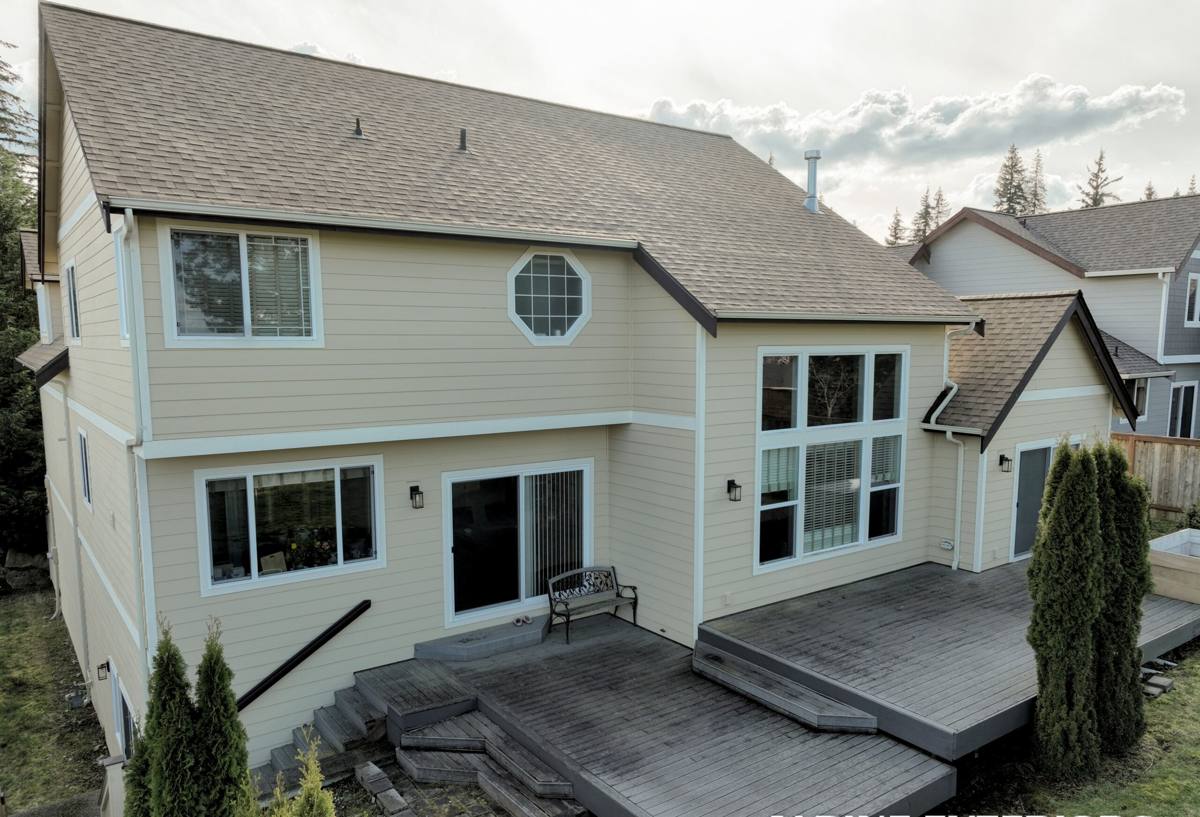
What Salt Air, Driving Rain, and Moss Do to a Deck Over Time
Corrosion at the Fasteners
Every deck depends on hundreds of fasteners: joist hangers, structural screws, bolts holding ledger boards and posts in place. Marine air carries enough salt that standard hardware corrodes faster here than it does inland. Corrosion at a fastener rarely announces itself. It shows up years later as rust streaking down a board, a hanger that's lost its grip, or a screw head that shears off when someone tries to remove it. By the time it's visible, the fastener has often already lost real holding strength.
Wind-Driven Rain and Hidden Moisture Intrusion
Fairhaven's exposure to open water means rain doesn't just fall on a deck, it gets pushed into it. Wind-driven rain finds its way behind ledger boards, into post bases, and under decking where boards meet a house wall. Those are exactly the spots where rot starts, and they're also the spots a homeowner is least likely to check because they're hidden by design. A deck that looks fine on top can have a soft, moisture-damaged ledger connection underneath.
A Long Moss and Algae Season
Mild temperatures, consistent dampness, and tree cover common on Fairhaven's older residential lots add up to extended moss and algae growth on horizontal surfaces. Beyond being a slip hazard, moss and algae hold moisture against decking boards long after a storm has passed, which accelerates rot in wood and can degrade the surface layer of some composite products if it's left to build up season after season.
Freeze-Thaw Stress on Footings and Posts
Whatcom County doesn't see extreme winters, but it does see repeated freeze-thaw cycling through the wet season. Water that's worked its way into a crack in a post base or a footing expands when it freezes, widening that crack a little more each cycle. Over several seasons, that slow mechanical stress can loosen a post base or crack a footing that looked structurally sound the year before.
Signs Your Fairhaven Deck Needs Repair, Not Just Cleaning
Some deck problems are cosmetic and some are structural, and the two get confused more often than they should. A pressure wash can make a tired-looking deck look presentable again without addressing anything underneath. Here's what actually points to a repair need:
- Soft or spongy decking boards, especially near the house or along the perimeter
- Visible gaps or separation where the deck meets the ledger board on the house
- Rust staining running from screw heads or joist hangers
- A railing that flexes or wobbles noticeably when pushed
- Stairs that feel less solid than they used to, or treads with visible give
- Moss or algae that returns within weeks of cleaning, particularly on shaded boards
- Cracking or checking in support posts, especially near the base
- Any post base sitting in standing water or visibly deteriorated concrete
Any one of these on its own might be minor. Several together, or anything involving the ledger connection or structural posts, usually means it's time for an actual inspection rather than another round of cleaning.
What a Correct Deck Repair Actually Involves
Structural Components First
Before anything cosmetic gets touched, a correct repair starts with the parts of the deck that hold everything up: the ledger board attachment to the house, the posts, the footings, and the joists. This is also where flashing gets checked. A ledger board without proper flashing is one of the most common sources of hidden rot on older decks, because it lets water track directly into the house wall and the deck framing at the same time. If we find compromised framing, undersized or corroded hardware, or a footing that's shifted, that gets addressed before we spend any time on the surface.
Decking Boards and Fasteners
Once the structure underneath is sound, we look at what's actually failing on the surface: individual boards that are cracked, cupped, or soft, and fasteners that are corroded or backing out. In this climate, we use fasteners rated for the exposure the deck actually gets, not just the minimum spec, because the cost difference between standard and corrosion-resistant hardware is small compared to what it costs to redo the work in a few years.
Railings and Code Compliance
Railings take a lot of abuse from weather and use, and a wobbly railing is a safety issue, not just a cosmetic one. When we repair railings, we also check that the height, baluster spacing, and attachment method meet current Whatcom County building code, since older decks were sometimes built to standards that have since changed. A repair is a natural point to bring a railing up to current code rather than just reattaching what's there.
Repair or Replace? Weighing the Factors
Not every deck problem calls for a full rebuild, and not every deck is worth patching indefinitely. The honest answer usually comes down to how much of the structure is still sound versus how much has been compromised by moisture over time.
| Factor | Points Toward Repair | Points Toward Replacement |
|---|---|---|
| Framing and posts | Solid, no significant rot or corrosion | Widespread rot, corroded connectors, or shifted footings |
| Ledger board | Properly flashed, attached correctly | Improperly flashed or showing water damage into the house wall |
| Decking surface | Isolated bad boards among otherwise sound decking | Most boards cupped, cracked, or soft throughout |
| Age of structure | Newer build with a localized problem | Old deck nearing the end of its practical service life |
| Design and layout | Layout and size still work for the household | Deck no longer fits how the space is used |
In many cases the honest recommendation for a Fairhaven deck with sound framing is a targeted repair: replace the damaged boards, correct the ledger flashing, upgrade fasteners, and secure the railings. When the framing itself has been compromised by years of hidden moisture, patching the surface only delays a bigger problem and can end up costing more over time than doing the structural work once, correctly.
Material Considerations When We Repair
Matching or Upgrading Decking Material
When we replace decking boards, the choice is usually between matching the existing wood decking or transitioning sections to a composite product. Both are legitimate choices, and the right call depends on the deck, the budget, and how much upkeep the homeowner wants going forward.
Why We're Careful About Which Wood Products We Repair With
Standard untreated or lightly treated softwood decking is more vulnerable in this climate than in drier parts of the state, simply because it spends more of the year damp. When we do repair with wood, we use decking rated for ground contact and exterior exposure, and we're upfront that wood decking in a marine, moss-prone environment needs more regular maintenance, sealing, and cleaning than composite alternatives. That's not a knock on wood decking as a product; it's a maintenance trade-off worth knowing before deciding.
Where Composite Fits
Composite decking generally handles sustained moisture and moss exposure with less upkeep than wood, which is a real advantage in a neighborhood like Fairhaven. The trade-off is upfront cost and the fact that composite boards still need airflow underneath and correct fastening to perform as intended; a composite deck installed without attention to drainage and ventilation can trap moisture just as easily as a poorly built wood deck. We treat the installation details as seriously as the material choice, because either product can fail early if it's installed without accounting for how water actually moves through the structure.
Our Deck Repair Process
1. On-Site Inspection
We start by physically checking the ledger connection, posts, footings, and framing, not just walking the surface and looking at board condition. Soft spots get probed, hardware gets checked for corrosion, and we look specifically at flashing where the deck meets the house.
2. A Written, Specific Scope
You get a scope that spells out exactly what's being repaired, what materials and fasteners are being used, and why, not a vague line item for "deck repair." If we find something during the inspection that changes the scope, we explain it before any work moves forward.
3. Structural Repair Before Cosmetic Work
Any framing, post, footing, or ledger issues get corrected first. We don't install new decking boards over a structure that still has an unresolved problem underneath it.
4. Decking, Fasteners, and Railings
Damaged boards get replaced with material matched to the rest of the deck or transitioned to composite where that makes sense, using fasteners rated for this climate's salt and moisture exposure. Railings are secured and brought up to current code requirements.
5. Final Walkthrough
We walk the finished repair with you, point out what was done and why, and flag anything worth keeping an eye on going forward, like a shaded section that will need more frequent moss cleaning than the rest of the deck.
Why a Local Fairhaven Crew Matters
A crew that works this part of Whatcom County regularly knows which details actually matter here: where ledger flashing tends to fail on homes near the bay, which wall orientations stay damp longest, and how much moss buildup is normal versus a sign of a bigger drainage problem. That kind of familiarity comes from repeated exposure to real Fairhaven decks over time, not from a generic checklist. It shows up in small decisions on repair day, like paying extra attention to a north-facing section that never fully dries out, that a crew unfamiliar with the neighborhood might not think twice about.
Fairhaven's proximity to Bellingham Bay, its mature tree cover, and its mix of older and newer housing stock mean no two decks in the neighborhood are dealing with quite the same combination of exposure. A repair approach that accounts for that instead of applying the same fix everywhere tends to hold up better, and cost less to maintain, over the years that follow.
If your Fairhaven deck has soft boards, a wobbly railing, recurring moss, or you're just not sure whether it needs repair or something bigger, we're glad to take a look and give you an honest read. Reach out using the form below to schedule a free, no-pressure estimate.
```