 Bellingham Exterior
 Fiber Cement Siding Built for Ferndale's Exterior Walls
Ferndale homes sit close enough to the water and to open, low-lying farmland that their exteriors take a specific combination of punishment: salt-tinged marine air, rain that comes in sideways more often than straight down, and a moss season that can stretch across most of the year on shaded walls. Fiber cement siding is one of the few wall materials that stands up to all three at once without asking for constant upkeep in return. That's why it's the only siding system we install on homes in Ferndale and across Whatcom County.
This page covers what fiber cement siding actually is, what it needs to do on a Ferndale home specifically, how we install it correctly, and what the process looks like from first estimate to final walkthrough.
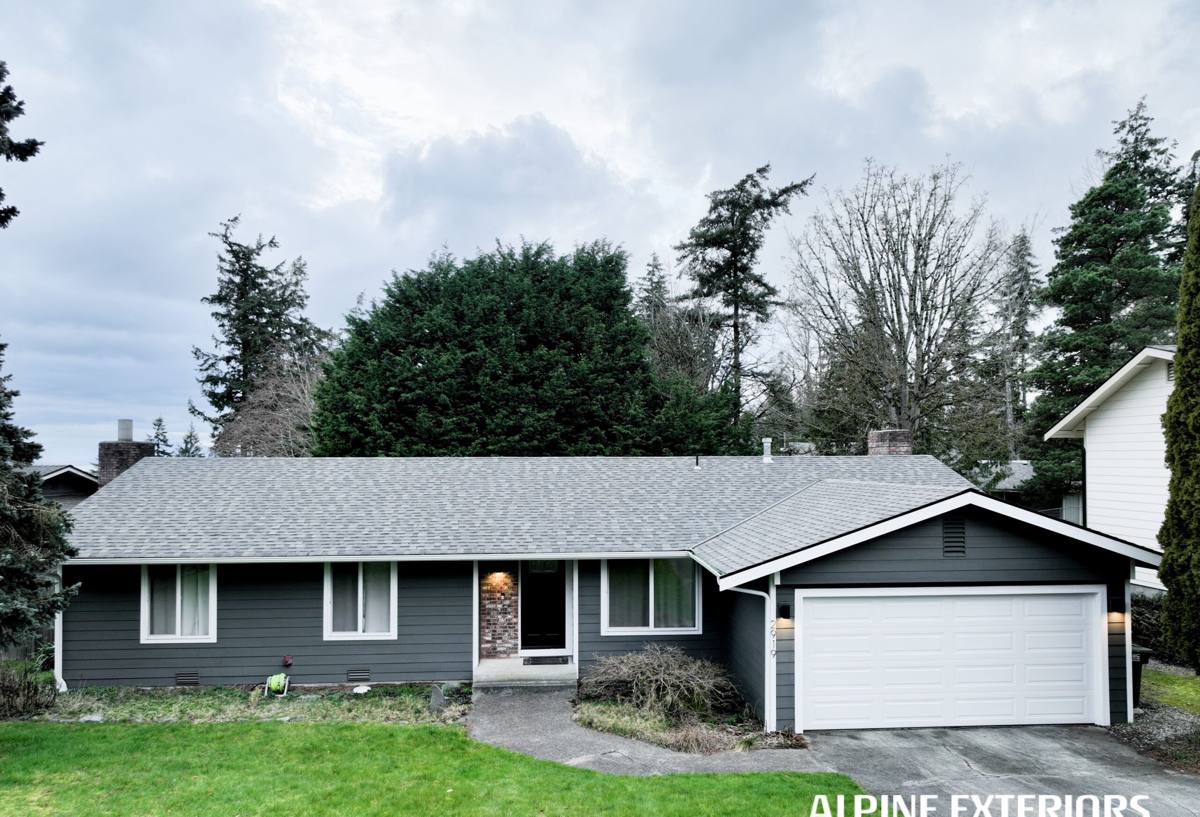
What Fiber Cement Siding Is
Fiber cement siding is a composite of cellulose fiber, sand, and portland cement, formed into planks or panels and cured into a rigid, dense material. It's not wood, and it's not plastic. It doesn't expand and contract with moisture the way engineered wood products do, and it doesn't soften, crack, or fade the way vinyl does under UV and temperature swings. We install James Hardie's fiber cement line exclusively, which means every job in Ferndale uses the same engineered product system rather than a mix of whatever happens to be cheapest that month.
Why We Don't Mix in Other Products
We used to offer a broader range of siding options. We narrowed that down after seeing, repeatedly, what actually holds up in this specific climate versus what looks fine in a showroom and starts failing within a few wet seasons on the wall. LP SmartSide, vinyl, Cemplank, Allura, primed spruce, and cedar all have a place in the market, and plenty of homeowners are happy with them elsewhere. We made a professional call that in Whatcom County's sustained moisture and salt exposure, standardizing on one system we fully trust beats offering a menu of options with different long-term risk profiles.
What Ferndale's Climate Asks of a Siding System
Salt Air
Even homes set back from the immediate shoreline pick up a steady flow of salt-laden air moving through this part of the county. Salt accelerates corrosion in fasteners and trim hardware and can degrade lower-grade finishes faster than you'd see further inland. Fiber cement's factory finish and corrosion-resistant fastening details are built around that exposure rather than ignoring it.
Wind-Driven Rain
Rain here rarely falls straight down. Wind pushes it sideways into lap joints, trim intersections, and anywhere a wall assembly has a seam. That's a different and more demanding load than an annual rainfall total suggests, and it's a big part of why porous or dimensionally unstable siding materials tend to fail from the side rather than from the top.
A Long Moss Season
Mild temperatures, consistent moisture, and plenty of shaded, tree-lined lots add up to a moss and mildew season that runs long in Whatcom County. Fiber cement's dense, non-porous composition gives moss and mildew far less to grab onto than wood-based or slightly porous siding products, which matters most on north-facing walls and anywhere a home sits under tree cover.
The Hardie Product System We Install
| Feature | What It Is | Why It Matters in Ferndale |
|---|---|---|
| HZ5 formulation | Hardie's engineered mix for high-moisture, freeze-thaw climates | Matches the sustained wet-season exposure of coastal Whatcom County better than warmer-climate formulations |
| ColorPlus finish | Factory-baked color coating applied under controlled conditions | Resists fading and moisture intrusion far longer than paint applied on site after installation |
| Non-combustible core | Cement-based composition that doesn't feed a fire | Matters for household safety and can factor into insurance underwriting |
| Dimensional stability | Minimal expansion or contraction with moisture changes | Reduces the cupping, swelling, and warping seen in wet-season-heavy engineered wood siding |
| Transferable warranty | Manufacturer warranty that follows correct installation | Protects the investment for the current owner and adds value if the home sells |
What a Correct Fiber Cement Installation Involves
Fiber cement siding performs the way it's designed to only when it's installed to spec. That's not a minor caveat — it's the difference between a wall system that lasts decades and one that develops problems within a few years despite using the right material. On every Ferndale job, correct installation means:
- Proper clearance between the bottom edge of the siding and grade, decks, patios, and roof lines, so water isn't wicking up into the board
- Correct fastener type, spacing, and placement, since salt air makes fastener corrosion resistance non-negotiable
- Lapped and sealed joints detailed to shed wind-driven rain rather than trap it
- House wrap and flashing integrated with the siding, not just installed underneath and hoped for the best
- Caulking and sealant used only where the manufacturer specifies it, not as a substitute for proper flashing
- Field-cut edges sealed or capped so raw, unfinished material isn't left exposed to the weather
Cutting corners on any of these steps is one of the more common reasons a good product develops a bad reputation. We treat installation detail with the same seriousness as the material spec itself, because on a Ferndale wall, the two are inseparable.
Our Fiber Cement Siding Process in Ferndale
1. On-Site Assessment
We walk the property in person before quoting anything. That means looking at existing siding condition, wall orientation and sun/shade exposure, trim complexity, and any signs of moisture already tracking behind the current wall assembly.
2. Tear-Off and Substrate Check
Where a full tear-off is the right call, removing the old siding also reveals what's actually happening underneath — sheathing condition, house wrap integrity, and any framing that's taken on moisture damage over time. We address what we find rather than sealing problems in behind new siding.
3. Weather Barrier and Flashing
House wrap, flashing at windows, doors, and roof intersections, and any needed sheathing repair get handled before a single piece of Hardie siding goes up. This step is where most long-term moisture problems are prevented or created.
4. Installation to Spec
Fastening pattern, clearances, joint lapping, and trim details all follow Hardie's published specifications for the HZ5 product line, not a generalized approach borrowed from a different climate zone.
5. Final Walkthrough
We go over the finished job with the homeowner, point out anything worth knowing for future maintenance, and confirm the warranty registration is in order.
Repair or Full Replacement?
Not every fiber cement siding issue in Ferndale requires a full re-side. Storm-damaged sections, a cracked board, or trim that's failed around an opening can often be repaired and matched into existing Hardie siding without touching the rest of the wall. But when moisture has been tracking behind the assembly for a while, or the existing siding is an older, non-Hardie product nearing the end of its service life, patching it usually just delays a larger job. We'll give you a straight answer on which situation you're in rather than defaulting to whichever option happens to be more profitable for us.
Cost Factors for Fiber Cement Siding in Ferndale
| Factor | What It Affects | Why It Matters Here |
|---|---|---|
| Home size and wall complexity | Total material and labor | More corners, dormers, and trim mean more joints exposed to wind-driven rain |
| Tear-off vs. install over existing wall | Labor scope and access to substrate | Tear-off exposes hidden moisture damage that's common under older siding in this climate |
| Substrate repair needs | Cost before new siding can go on | Trapped moisture behind failing siding can rot sheathing and framing over time |
| Trim and ColorPlus selection | Material cost and finish longevity | Factory-applied finishes hold up longer against salt air and UV than field-painted trim |
| Site access and staging | Labor time and equipment needs | Larger or tree-shaded lots can add setup time and complicate material staging |
Exact pricing depends on the specific home, which is why we give real estimates after an in-person walkthrough instead of a number off a generic price sheet.
Signs Your Ferndale Home May Need New Fiber Cement Siding
- Moss or dark staining that returns quickly after cleaning, especially on shaded or north-facing walls
- Soft or spongy siding, particularly near the base of the wall or around window and door trim
- Peeling paint, bubbling, or visible warping on existing siding boards
- Cracked, chipped, or missing sections following storms or high-wind events
- Visible gaps at seams, corners, or trim joints where wind-driven rain can track in
- Rising energy bills that may point to a wall assembly no longer sealing the way it should
Why a Crew That Already Works Ferndale Matters
A crew that installs fiber cement siding across Whatcom County day in and day out sees how salt air, wind-driven rain, and a long moss season actually behave on real walls over a full year, not just how the product performs on a manufacturer's spec sheet. That experience shows up in practical decisions on install day: which wall orientations need extra flashing attention, how much clearance really matters near grade on a low-lying Ferndale lot, and which trim details are worth the extra time so a homeowner isn't dealing with a callback two winters later. Ferndale's mix of coastal exposure and open, lower terrain isn't identical to every other town in the county, and a crew with local installation experience accounts for that instead of applying the same generic approach everywhere.
If your Ferndale home needs new fiber cement siding, a repair, or an honest second opinion on what's happening behind an aging wall, we're glad to take a look. Reach out using the form below to schedule a free, no-pressure estimate.