 Bellingham Exterior
 Why Decks in Happy Valley Take More Punishment Than People Expect
Happy Valley sits close enough to Bellingham Bay that salt-tinged air reaches every deck in the neighborhood, whether it's a hundred yards from the water or a mile inland on a breezy day. Salt air speeds up corrosion in fasteners, brackets, and any exposed metal hardware, which is often the first thing to fail on an otherwise sound deck. Layer on the driving rain that comes through Whatcom County most of the year — often at an angle, not straight down — and water finds its way into joints, ledger connections, and end grain that a drier climate would never stress the same way.
Then there's moss season, which in this part of Washington isn't really a season so much as most of the calendar. Moss and algae hold moisture against wood and decking surfaces long after a storm has passed, keeping boards damp for days at a time. That constant damp-dry cycle is what actually breaks decks down — not one big storm, but years of slow saturation in the same low spots, shaded corners, and north-facing sections that never quite dry out.
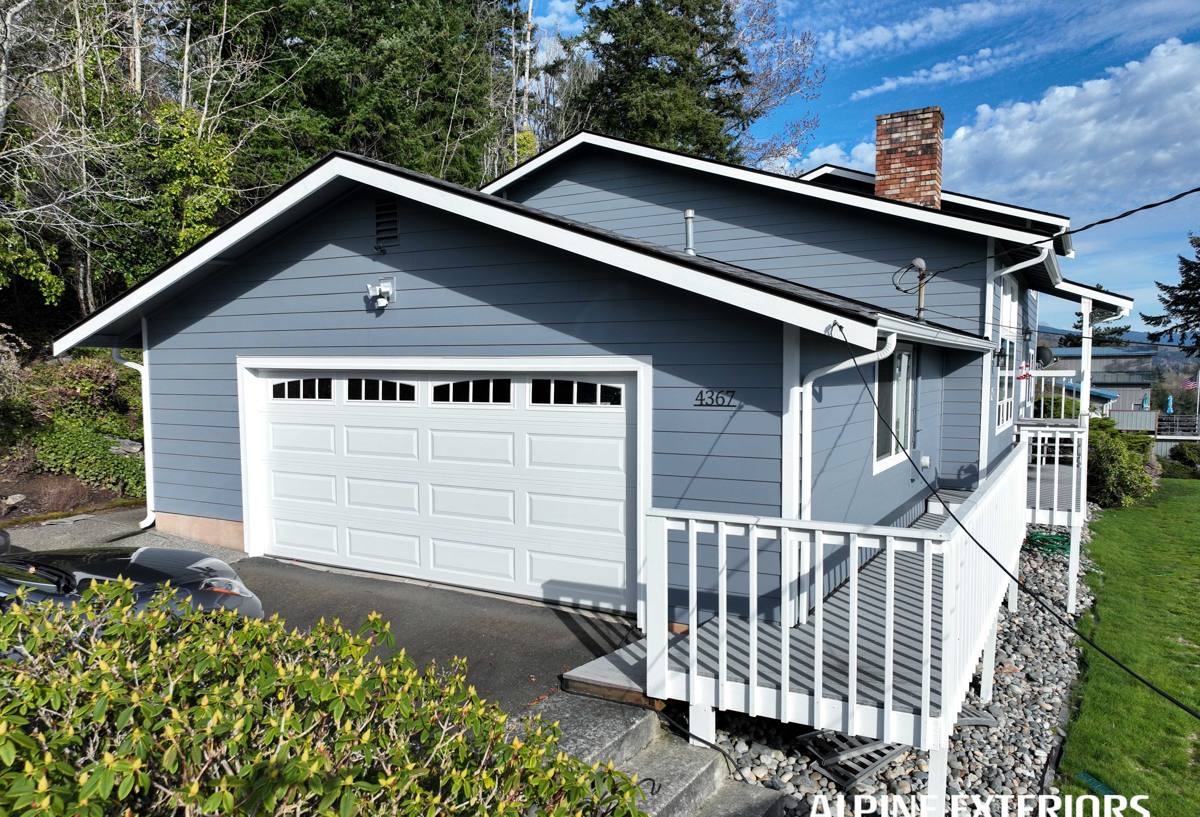
Signs a Happy Valley Deck Needs Repair Now, Not Later
Deck problems in this climate rarely show up as one dramatic failure. They show up as small signals that are easy to write off until they aren't. Worth checking for on a walk around your own deck:
- Soft or spongy spots when you press on decking boards, especially near the house or in shaded areas
- Rust streaks running down from screws, bolts, or metal brackets
- Railings or stair rails that flex or wobble when you lean on them
- A visible gap or dark staining where the deck meets the house (the ledger board connection)
- Thick moss or black-green staining that doesn't scrub off easily
- Fastener heads that have popped up above the board surface
- Stairs that bounce or feel less solid than the main deck surface
- A musty smell coming from underneath the deck
Any one of these on its own might just mean routine maintenance. Two or three together, especially near the ledger or support posts, usually means something structural needs a closer look.
What Actually Fails Under a Bellingham-Area Deck
Ledger Board and Flashing
The ledger is the board that attaches the deck to the house, and it's the single most important connection on the whole structure — it's also the spot where a lot of decks in this region eventually fail. If the ledger was installed without proper flashing, or if the flashing has degraded, water works its way behind it and rots both the ledger and the house rim joist behind it. This is not a cosmetic fix. A compromised ledger connection is a safety issue, and it's one of the first things we check on any repair call.
Fasteners and Hardware
Galvanized coatings on screws, joist hangers, and bolts break down faster near salt air, and once corrosion starts it weakens the connection long before it's visible from the top of the deck. We see this most often on older decks built before stainless or coated fasteners were standard practice in coastal Washington.
Framing and Joists
Joists that stay damp under a deck with poor airflow or clogged drainage will soften and lose strength over time, particularly at the ends where they meet the beam or ledger. This kind of damage is often hidden until a board above it starts to feel soft.
Decking Boards
Wood decking cups, splits, and checks as it absorbs and releases moisture through repeated wet Whatcom County winters. Composite boards handle moisture better but aren't immune — moss and organic debris trapped in grooved or textured surfaces can still stain and, in some cases, degrade the board's surface layer over years.
Railings and Stairs
Railing posts are notorious weak points because they're often through-bolted into rim joists that are also the most exposed to weather. A wobbly railing is frequently a sign of a rotted post base, not just a loose bolt.
Repair or Replace? Weighing the Real Factors
Not every deck problem means starting over, but not every deck is worth patching either. The right call usually comes down to how much of the structure is still sound versus how much has been compromised by moisture over time.
| Factor | Leans Toward Repair | Leans Toward Replacement |
|---|---|---|
| Ledger board condition | Solid, properly flashed | Soft, rotted, or missing flashing |
| Framing/joists | Isolated soft spots | Widespread softness or sagging |
| Decking surface | Scattered board issues | Most boards cupped, splitting, or gray throughout |
| Age of structure | Under 15-20 years | Original build decades old |
| Railings/stairs | A few loose connections | Multiple wobbly posts or failed footings |
| Homeowner goals | Extend life, control cost | Wanting a different layout, size, or material |
A straightforward board swap or railing fix is usually a modest, well-defined cost. Ledger, framing, or footing repairs cost more because they involve opening up the structure, but they're still far less than a full tear-off and rebuild. We'll always tell you honestly when a repair no longer makes financial sense compared to replacement — patching a deck that's structurally tired just to save money short-term usually costs more over a few years.
How We Approach a Deck Repair
- Full inspection first. We check the ledger connection, framing, posts, footings, railings, and decking surface — not just the spot you called about, since damage in this climate tends to travel.
- Straight explanation of what we find. You'll know what's failing, why, and what your real options are before any work starts.
- Address the structure before the surface. Rotted framing, a bad ledger connection, or a failing footing gets fixed before we touch decking or railings — cosmetic repairs over a weak structure don't hold up.
- Correct flashing and fastener choices. Any ledger or framing work gets proper flashing and corrosion-resistant hardware suited to this climate, not whatever was cheapest at the time of original construction.
- Match materials where it counts. Board replacements are matched for size and, where possible, appearance so repairs don't look like an obvious patch job.
- Clean up and check drainage. We clear debris and moss buildup from under the deck and around footings so water has somewhere to go instead of sitting against the wood.
Material Choices That Make Sense for This Climate
Wood decking is affordable and repairable in sections, which is genuinely useful when you're dealing with isolated damage rather than a whole-deck problem. The trade-off is maintenance: wood needs regular cleaning, moss removal, and resealing to hold up against the wet stretches typical of Whatcom County, and skipping that upkeep is what leads to the rot we get called about most.
Composite decking costs more upfront but resists moisture absorption and doesn't need staining or sealing, which appeals to homeowners who want to spend less time on deck maintenance. It's not maintenance-free, though — moss and algae still grow on composite surfaces in shaded, damp spots, and it still needs periodic cleaning to stay looking good and to keep organic growth from staining the surface long-term.
For structural framing and ledger repairs, we lean toward pressure-treated lumber rated for ground or moisture contact, paired with stainless or high-grade coated fasteners, regardless of what decking material sits on top. That combination is where the real durability comes from — the framing you never see matters more to a deck's lifespan than the boards you walk on.
Moss and Drainage: The Ongoing Local Battle
Even a well-repaired deck in this part of Bellingham will grow moss again if drainage and airflow underneath aren't addressed. Decks built low to the ground, or in shaded yards common in established neighborhoods like Happy Valley, are especially prone to trapping moisture underneath where it never fully dries between rains. Part of a proper repair is making sure water has a clear path away from the structure and that there's enough clearance underneath for air to move. We'll point out drainage or grading issues we notice, even if they're outside the immediate repair scope, because ignoring them just means calling us back for the same problem in a few years.
Why Hiring a Crew That Already Works in Happy Valley Matters
Deck problems here follow patterns tied directly to this specific climate — the ledger failures, the salt-air fastener corrosion, the moss-driven moisture retention. A crew that regularly works decks around Bellingham and Whatcom County has already seen how these issues develop locally and knows where to check first, rather than treating every deck like a generic repair job. That local pattern recognition saves time during inspection and helps catch problems before they turn into safety issues, not just cosmetic ones.
It also means straightforward answers about permits, typical repair scope, and what's realistic for your specific deck's age and exposure, based on decks we've actually worked on nearby rather than general guidance that doesn't account for this region's weather.
Get a Straight Answer About Your Deck
If your deck in Happy Valley has soft spots, a wobbly railing, or just doesn't feel as solid as it used to, it's worth a look before another wet season adds to the damage. We offer free, no-pressure estimates — we'll tell you plainly what needs fixing, what can wait, and what your realistic options are. Use the form below to get started.