 Bellingham Exterior
 Why Barkley Homes Wear Differently Than You'd Expect
Barkley is one of Bellingham's newer, more consistently built neighborhoods, and that can create a false sense of security about siding. Homeowners often assume that because a house was built in the last two or three decades, the exterior cladding is holding up fine. In our experience walking Barkley properties, the age of the home matters less than the material choice and the original installation quality. A lot of houses in this part of Bellingham went up with vinyl or with wood-based composite sidings that were common in their build era, and both categories struggle with the specific combination of conditions this part of Whatcom County delivers: proximity to Bellingham Bay's salt-laden air, long stretches of driving rain off the Salish Sea, and a moss season that can run from late fall well into spring.
None of that means Barkley is a harsh climate in the way, say, a coastal exposed bluff is. It's a moderate marine climate. But "moderate" in western Washington still means sustained moisture exposure for months at a time, and siding systems that aren't built for that will show it — usually through swelling, staining, or soft spots long before the rest of the house looks like it needs work.
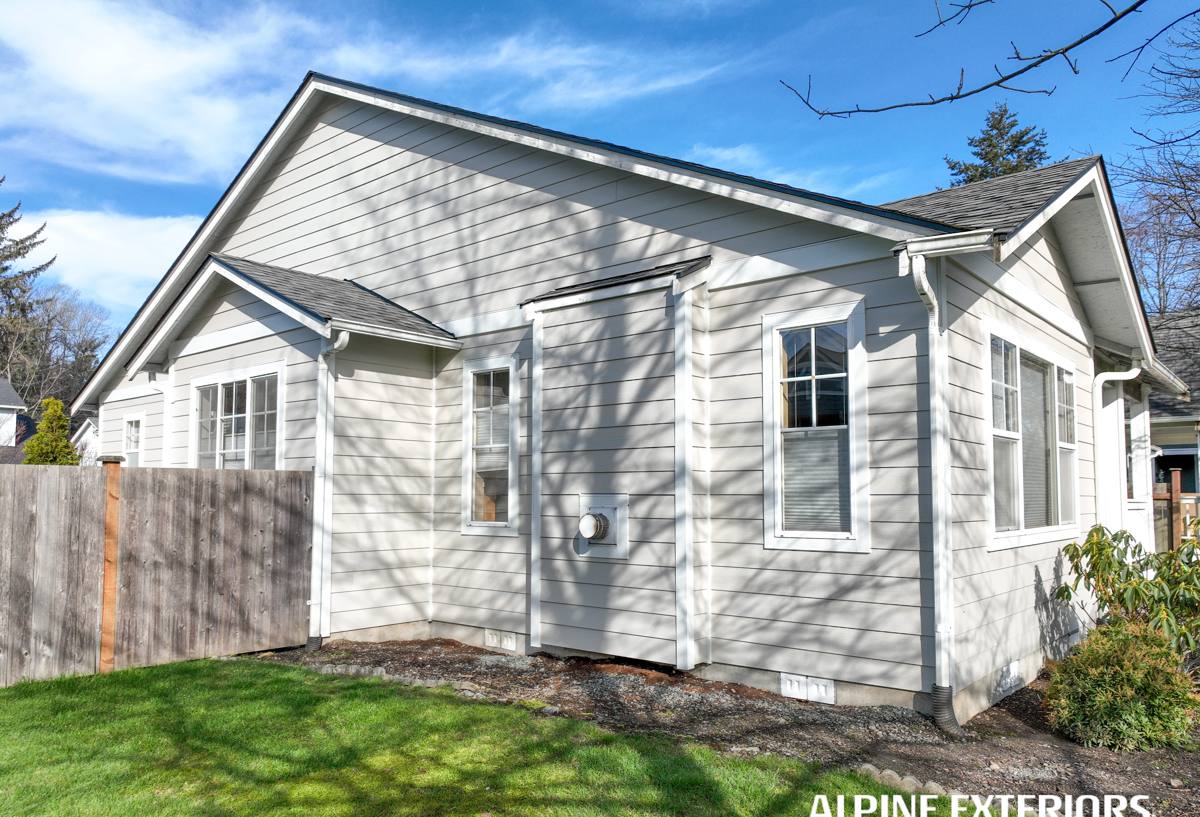
What Salt Air, Rain, and Moss Actually Do to Siding
Salt Air
Bellingham sits directly on Bellingham Bay, and Barkley, while set back from the water, still sits within the reach of salt-carrying air moving inland off the Sound. Salt air accelerates corrosion on fasteners and metal flashing, and it degrades certain paint and coating systems faster than inland exposure would. Siding that isn't factory-finished with a coating designed for this kind of exposure tends to chalk, fade, or lose adhesion at the surface years ahead of schedule.
Driving Rain
Whatcom County doesn't get the heaviest rainfall totals in the state, but it gets a lot of wind-driven rain — moisture pushed sideways against walls rather than falling straight down. That matters enormously for siding, because wind-driven rain finds every seam, lap joint, and butt joint that wasn't detailed correctly. Materials that absorb water at their edges, or installations with tight, un-vented joints, trap moisture instead of shedding it.
Moss Season
From roughly October through April, north-facing walls, areas under tree canopy, and anything shaded by a neighboring structure in Barkley can stay damp for days at a time. That's exactly the environment moss and algae need to establish. Once organic growth gets a foothold on siding, it holds moisture against the surface around the clock, which speeds up whatever damage process is already underway underneath.
The Local Reality: What We See on Barkley Tear-Offs
When we pull old siding off homes in this neighborhood, the failure patterns are consistent enough to plan around:
- Swelling and delamination at butt joints and bottom courses on wood-based composite siding, especially on north and west elevations
- Vinyl siding that has warped or bowed from thermal cycling, with gaps opening up at the laps that let wind-driven rain behind the panel
- Fastener corrosion where staples or the wrong-gauge nails were used instead of proper corrosion-resistant fasteners
- Moss and algae staining concentrated on shaded walls, sometimes masking soft sheathing underneath
- House wrap or building paper that was torn, stapled through repeatedly, or never lapped correctly during the original build
That last point is important: a siding replacement is rarely just a siding replacement. It's an opportunity to inspect and correct the water-management layer behind the cladding, which is often where the real long-term protection comes from.
What a Correct Siding Replacement Involves
A proper job in this climate is a sequence, not a single step, and skipping any part of it shortens the life of everything installed after it.
1. Full Tear-Off and Sheathing Inspection
We remove the existing siding down to the sheathing and inspect for rot, soft spots, or prior water intrusion — particularly around window and door openings, at wall penetrations, and along the bottom plate. Any damaged sheathing gets replaced before anything else happens.
2. Water-Resistive Barrier and Flashing
A new, correctly lapped weather-resistive barrier goes on next, with flashing integrated at every window, door, and penetration so water is directed out and down rather than into the wall assembly. In a driving-rain climate, this layer is doing as much long-term work as the siding itself.
3. Furring or Rainscreen Detailing Where Appropriate
Depending on the wall assembly and exposure, we evaluate whether a vented rainscreen gap makes sense to let any incidental moisture drain and the wall assembly dry rather than stay saturated — especially valuable on shaded, moss-prone elevations.
4. Siding Installation to Manufacturer Spec
Correct fastener type and spacing, correct nailing lines, proper joint treatment, and correct clearances at grade, roofing, and trim. Manufacturer installation instructions exist because they're what the warranty is actually based on — deviations are the single most common reason a siding job fails early.
5. Trim, Caulking, and Final Detailing
Corner boards, trim, and caulking get finished last, using products compatible with the siding system so the whole exterior moves and weathers as one assembly rather than as mismatched parts aging at different rates.
Why We Install James Hardie Fiber Cement, Not Vinyl or Wood Composites
We've made a deliberate decision to install only James Hardie fiber cement siding, and we don't install vinyl, LP SmartSide, Cemplank, Allura, primed spruce, or cedar. That's not a marketing position — it's a standard we hold because of what we've seen in the field, including plenty of Barkley homes.
Vinyl has real advantages: it's inexpensive, low-maintenance in mild conditions, and easy to source. But in this climate it warps and bows with thermal cycling, its seams are a permanent weak point against wind-driven rain, and it doesn't hold up structurally the way a rigid product does over 20-plus years of Whatcom County weather.
Wood-based composite sidings and primed wood products can look excellent when new, but they're moisture-sensitive by nature. Cut edges, fastener holes, and butt joints all need diligent field sealing, and in a climate with this much sustained dampness, that margin for error is thin. Cedar is a genuinely beautiful, time-tested material, but it demands a maintenance commitment — refinishing, sealing, moisture monitoring — that most homeowners don't want to sign up for indefinitely, especially on a home surrounded by moss-favoring shade.
James Hardie fiber cement is non-combustible, dimensionally stable in wet-dry cycling, and finished at the factory with a ColorPlus coating engineered to hold color and resist the fading that salt air accelerates on field-applied paint. Hardie's HZ5 product line is specifically engineered for the kind of cold, wet climate zones the Pacific Northwest falls into. It carries a strong transferable warranty, which matters to future resale in a neighborhood like Barkley where homes do change hands. Installed to spec, it's the product we're confident standing behind for the long haul in this exact climate.
Comparing Siding Options for a Barkley Home
| Factor | Vinyl | Wood/Composite | James Hardie Fiber Cement |
|---|---|---|---|
| Moisture behavior in driving rain | Seams vulnerable to wind-driven water | Absorbs moisture at cut edges/joints | Dimensionally stable, doesn't absorb like wood |
| Salt-air finish durability | Can chalk/fade over time | Field-applied paint fades faster | Factory ColorPlus finish engineered for UV/salt exposure |
| Moss/algae resistance | Moderate; traps moisture behind panels if warped | Prone to staining and softening under growth | Resists moisture intrusion; surface can be cleaned without damaging substrate |
| Fire resistance | Combustible | Combustible | Non-combustible |
| Maintenance commitment | Low, but limited repair options | Ongoing sealing/refinishing needed | Low; occasional wash and caulk check |
| Warranty | Varies by manufacturer | Varies, often shorter | Long-term, transferable |
What Barkley Homeowners Should Check Before Hiring Anyone
- Do they carry current Washington State contractor licensing and adequate liability insurance?
- Will they inspect and, if needed, replace sheathing before installing new siding — not just cover over what's there?
- Do they follow the manufacturer's published installation instructions for fastener type, spacing, and clearances?
- Do they address flashing at windows, doors, and penetrations as part of the job, not as an afterthought?
- Can they explain, specifically, how their approach accounts for wind-driven rain and shaded, moss-prone walls?
- Do they provide a written scope of work rather than a verbal estimate?
A siding crew that primarily works other parts of the county, or mostly does drier-climate regions, may not think about rainscreen detailing or moss-prone shaded elevations the same way a crew that regularly works Bellingham neighborhoods does. Local, repeated experience with this exact microclimate shows up in the details — where flashing gets prioritized, which elevations get extra attention, and how joints get treated.
Timeline and What to Expect
Most single-family siding replacements in the Barkley area take one to three weeks depending on home size, the condition of the sheathing once it's exposed, and weather windows — western Washington's wetter months can slow exterior work, so scheduling around drier stretches when possible helps keep a project moving. We'll walk you through tear-off, any sheathing repair, water-resistive barrier and flashing work, siding installation, and final trim before we consider a job finished, and we'll flag anything unexpected we find once the old siding comes off before proceeding.
If your Barkley home's siding is showing staining, soft spots, warping, or you're simply planning ahead of a needed replacement, we're glad to take a look and give you a straightforward, no-pressure estimate — use the form below to get started.