 Bellingham Exterior
 Windows Built for Life Around Lake Whatcom
Sudden Valley sits tucked against Lake Whatcom's shoreline and forest, which is exactly what makes it such a desirable place to live — and exactly what makes its homes harder on windows than a typical subdivision. Heavy tree cover keeps humidity high and sun exposure low in a lot of yards, lake-effect moisture lingers in the air longer than it does a few miles into town, and homes with a water view often carry larger expanses of glass that were never built with today's energy standards in mind. Add in the driving rain that comes through Whatcom County most winters, plus the long moss season that coats anything shaded or damp, and it's easy to see why older windows in this neighborhood tend to fail sooner than the manufacturer's brochure promised.
Energy-efficient window replacement here isn't just about a lower power bill, though that's real. It's about stopping moisture intrusion before it reaches your framing, cutting down on condensation and mildew inside the house, and getting glass and hardware that can actually stand up to a Pacific Northwest lake climate for the long haul.
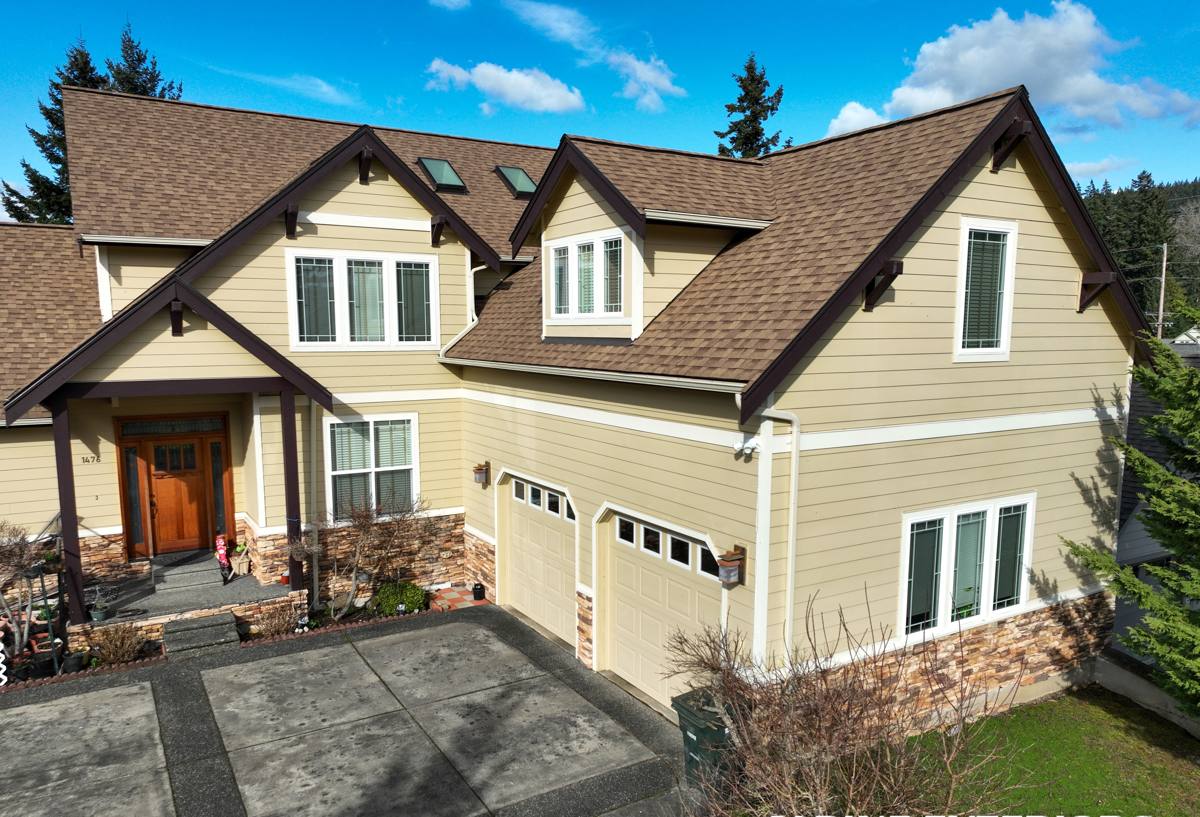
What This Climate Actually Does to Windows
Moisture Finds the Weak Point
Wood-framed and poorly flashed windows are the first to show trouble in a place like Sudden Valley. Constant dampness works its way into any gap in the sealant or flashing, and once water gets behind the trim, it doesn't dry out quickly under a tree canopy. That's how you end up with soft sills, peeling paint, and — eventually — rot that isn't visible until you're already replacing framing, not just glass.
Moss and Algae Aren't Just Cosmetic
A long moss season does more than stain a window sill green. Moss and algae hold moisture against wood and vinyl surfaces, which accelerates decay and breaks down sealants faster than direct rain alone would. Windows on the shaded, north-facing side of a Sudden Valley home — often the side facing the trees rather than the lake — tend to show this wear first.
Temperature Swings and Seal Failure
Lake-cooled mornings followed by afternoon sun put real stress on the seals between panes of glass. Once a seal fails, you get fogging or condensation trapped between the panes — a sign the insulating gas fill is gone and the window's efficiency has quietly dropped, even if it still looks fine from across the room.
What "Energy-Efficient" Actually Means
It's a phrase that gets used loosely, so it's worth being specific. A genuinely energy-efficient window replacement involves a few measurable factors working together, not just a sticker on the glass.
- U-factor — how well the window resists heat transfer; lower is better for our climate.
- Solar Heat Gain Coefficient (SHGC) — how much solar heat passes through the glass, which matters more on lake-facing walls with direct exposure.
- Low-E coatings — a microscopically thin coating that reflects heat while still letting light through.
- Gas fills — argon or krypton between panes, which insulates better than plain air but only if the seal holds.
- Frame material — affects both insulation value and how the window holds up to constant moisture.
None of these numbers matter much if the installation itself is sloppy. A high-performance window installed with gaps around the frame or poor flashing will underperform a mid-grade window installed correctly — this is where a lot of the real efficiency gain (or loss) actually happens.
Frame Material Comparison for a Lake and Forest Climate
| Frame Material | Moisture Resistance | Maintenance | Typical Fit for Sudden Valley |
|---|---|---|---|
| Vinyl | Good — won't rot, minimal upkeep | Low | Solid all-around choice for most homes |
| Fiberglass | Very good — dimensionally stable in temperature swings | Low | Strong option for larger lake-facing openings |
| Wood | Poor without diligent upkeep in constant moisture | High | Only where the look is a priority and upkeep is planned for |
| Wood-clad (wood interior, clad exterior) | Good on the exterior face; interior still vulnerable | Moderate | Works if interior moisture is controlled |
| Aluminum | Fair — prone to condensation without a thermal break | Low | Less common here due to heat loss unless thermally broken |
We don't push one material on every job. A home a stone's throw from the water with big picture windows has different needs than a shaded cabin-style home tucked back in the trees, and we'll walk through the trade-offs for your specific exposure before recommending anything.
Signs Your Current Windows Are Working Against You
Most homeowners don't replace windows because they woke up and decided to — they replace them because something started bothering them. Here's what we hear most often from Sudden Valley homeowners, and what it usually means.
- Fogging or a foggy ring between the panes of glass — the seal has failed and the insulating gas is gone.
- Noticeable drafts near the frame, even with the window fully latched.
- Condensation forming on the inside of the glass regularly, especially in winter.
- Windows that are difficult to open, close, or lock — often a sign the frame has swelled or shifted.
- Soft, discolored, or spongy wood at the sill or bottom corners of the frame.
- Visible moss or dark staining building up in the corners or tracks.
- A noticeably colder spot near the window compared to the rest of the room.
- A jump in heating costs that isn't explained by anything else in the house.
Any one of these on its own isn't necessarily an emergency, but a few of them together usually means the window is past the point where caulk and weatherstripping will fix it.
What a Correct Installation Actually Involves
It Starts With the Water Path, Not the Glass
The glass and frame get all the attention, but the part that determines whether a window lasts is the flashing and sealing detail around it — how water that hits the wall is directed away from the opening instead of into it. In a climate with this much driving rain, a rushed flashing job is the single most common reason a "new" window starts leaking within a few years.
Sill Pans and Proper Sealing
A correctly installed window includes a sloped sill pan or equivalent drainage detail so any water that does get past the exterior seal has somewhere to go besides your wall framing. Backer rod and sealant get used at the right joints — not just caulk smeared around the trim as an afterthought.
Insulating the Gap, Not Just the Frame
The small gap between the window frame and the rough opening needs to be insulated properly — not overpacked with expanding foam that can bow the frame, and not left open where cold air and moisture can move freely behind the trim.
Matching the Install to Your Siding
How a window ties into your existing siding matters as much as the window itself. We pay attention to how the new unit integrates with what's already on the wall so you're not left with a gap, a mismatched reveal, or a spot where water can collect against the siding.
How We Approach a Sudden Valley Window Project
- On-site assessment — we look at each window's exposure, current condition, and whether the issue is the glass, the frame, the flashing, or all three.
- Straight talk on options — full replacement isn't always necessary; sometimes repair or resealing buys real years, and we'll say so.
- Product selection based on exposure — lake-facing walls, shaded tree-line walls, and upper-story windows often call for different specs, not a one-size answer.
- Careful removal — protecting existing siding, trim, and landscaping during the swap.
- Correct flashing and sealing — the step that actually determines whether the window performs for the next twenty years.
- Final check and walkthrough — operation, locks, and seals confirmed before we call the job done.
Working Inside a Private Community
Sudden Valley is a private, gated residential community with its own roads and its own set of expectations for contractors working there. A crew that's already familiar with getting equipment in and out, respecting the neighborhood, and working around the typical layout of homes in the area gets your project done with less friction than a crew learning the community for the first time on your dime. We've done work in and around this neighborhood and know how to move a job along without disrupting your street or your neighbors.
If your community association has design or exterior-change guidelines, it's worth checking those before ordering materials — we're happy to work from whatever specifications apply to your property.
What Drives the Cost
There's no honest flat rate for window replacement — too much depends on the specifics of your home. What we can do is walk through the factors that actually move the number.
| Factor | Why It Matters |
|---|---|
| Number and size of windows | Larger lake-facing units and picture windows cost more than standard bedroom-sized openings. |
| Frame material | Vinyl is typically the most budget-friendly; fiberglass and wood-clad cost more upfront but can offer longer service life in wet climates. |
| Glass package | Double-pane with Low-E coating versus triple-pane changes both the cost and the efficiency gain. |
| Condition behind the window | Hidden rot or water damage found during removal adds work that a quote can't always predict in advance. |
| Access and site conditions | Sloped lots, upper-story windows, and limited driveway access near the lake can affect labor time. |
We'd rather give you real ranges based on what we actually find at your home than a number pulled out of the air over the phone.
Get a Straight Answer for Your Home
If your windows are fogging, drafting, sticking, or just looking worn down from another wet Whatcom County winter, it's worth having someone look at them before you decide whether you need a full replacement or just targeted repairs. We'll walk your home, tell you honestly what we see, and give you a clear estimate with no pressure attached — use the form below to get started.