 Bellingham Exterior
 Why Birchwood Siding Wears Differently Than You'd Expect
Birchwood is a settled, tree-shaded residential neighborhood, and that's exactly why its siding takes more punishment than homeowners usually assume. Mature tree canopy keeps yards cool in summer, but it also keeps siding damp longer after every rain, cuts off the afternoon sun that would otherwise dry out north- and east-facing walls, and drops organic debris into gutters and wall assemblies where it holds moisture against the cladding. Add Bellingham's marine influence — salt-tinged air drifting in off Bellingham Bay, driving rain that comes in sideways during winter storms, and a moss season that can run from October well into spring — and you get a slow, steady erosion of anything that isn't built and installed to handle it.
None of this is dramatic. It rarely shows up as a sudden failure. Instead it shows up as a decade of paint that won't hold, boards that swell and split at the seams, and moss lines creeping up from the ground or down from the eaves. By the time it's visible, the siding has usually been losing the fight for years.
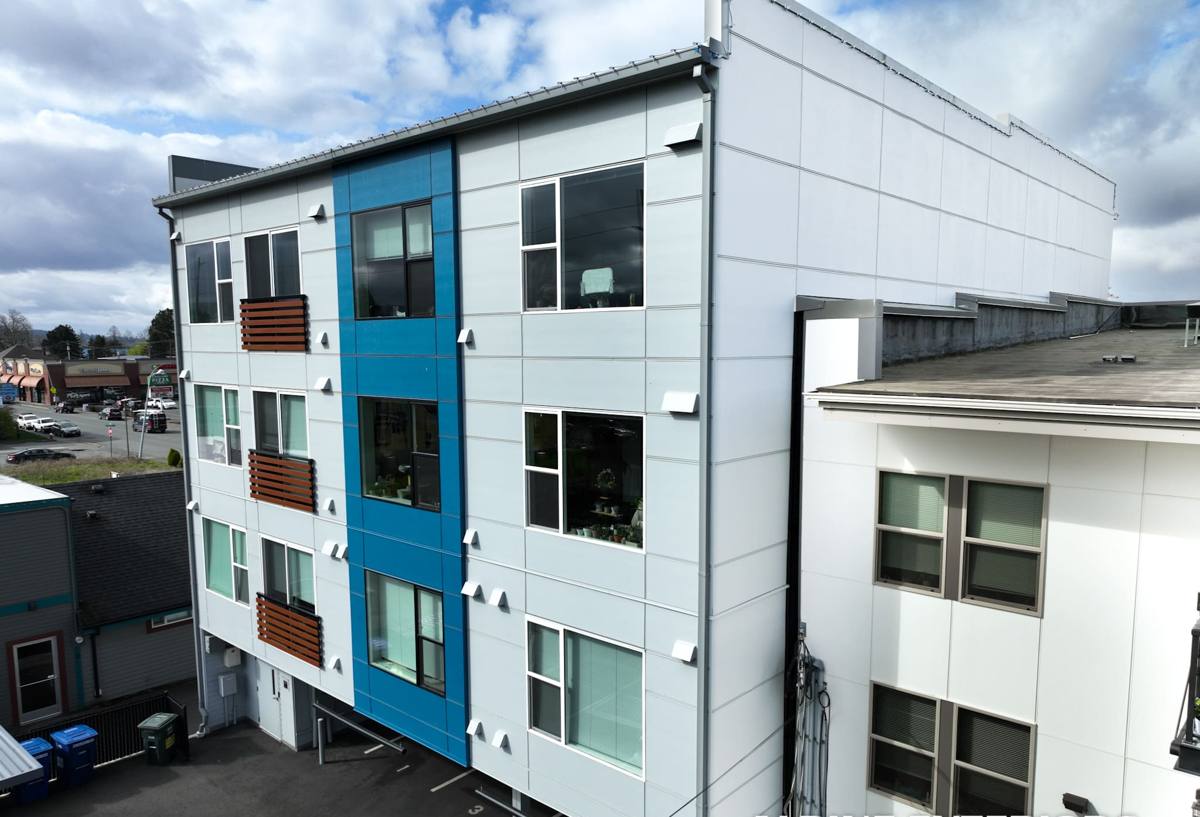
What Whatcom County's Climate Actually Does to Siding
Salt Air
Homes in and around Bellingham sit close enough to the Salish Sea that airborne salt is a real factor, not a coastal-town cliché. Salt accelerates corrosion on exposed fasteners and metal flashing, and it interacts with paint films in ways that shorten repaint cycles compared to inland homes.
Driving Rain
Whatcom County gets a lot of rain, but the bigger issue for siding is wind-driven rain — storms that push water sideways into wall assemblies rather than letting it run straight down. That kind of weather finds every gap in flawed flashing, exposed end grain, or caulk that's been asked to do a job it was never designed for.
Moss and Organic Growth
Shade, moisture, and mild temperatures are a perfect combination for moss, algae, and mildew. On siding that can absorb moisture — wood, some engineered wood products, and poorly sealed cut edges — that growth isn't just cosmetic. It holds water against the substrate and keeps the material from ever fully drying between rain events.
Signs a Birchwood Home Needs Siding Replacement, Not Another Repair
Spot repairs make sense when the damage is isolated and the rest of the siding is sound. Replacement becomes the right call when the problems are systemic — spread across multiple walls, tied to the material itself, or rooted in something behind the siding that patching won't fix. Signs worth taking seriously include:
- Paint that fails within two or three years of a repaint, especially on north- and east-facing walls
- Soft, swollen, or crumbling spots when you press on the siding, particularly near the bottom courses and around windows
- Persistent moss or dark streaking that comes back within a season of cleaning
- Visible gaps, cupping, or separation at butt joints and panel seams
- Cracking or splitting that runs with the grain, common on aging wood-based products
- Rising utility bills or noticeably drafty rooms, which can point to moisture-compromised sheathing behind the cladding
- Siding that's original to a home built more than 20-25 years ago and has never been fully replaced
What a Correct Siding Replacement Actually Involves
Siding replacement is often treated as a cosmetic upgrade, but the material you see is only half the job. The other half — the parts you don't see once the work is done — determines whether the new siding lasts 10 years or 40.
Tear-Off and Substrate Inspection
Full removal of the old siding is the only way to find out what's actually happening underneath. In a wet, shaded neighborhood like Birchwood, it's common to find soft sheathing, rusted fasteners, or water staining around window and door openings that wasn't visible from outside. Any of that needs to be repaired or replaced before new siding goes on — installing new cladding over compromised sheathing just hides the problem for another few years.
Weather-Resistive Barrier and Flashing
A correctly installed weather-resistive barrier, properly lapped and taped, is what actually keeps wind-driven rain out of the wall assembly. Flashing at windows, doors, and roof-to-wall intersections has to be detailed so water sheds outward at every layer, not just caulked and hoped for. This is the step that separates a siding job that holds up through Whatcom County winters from one that starts failing behind the scenes almost immediately.
Proper Clearances and Fastening
Siding needs the right ground clearance, the right gap at roof lines and decks, and fasteners driven to the manufacturer's spec — not just close enough. In a climate with this much sustained moisture, sloppy clearances are one of the most common causes of early rot and moss buildup at the bottom courses.
Trim, Caulking, and Paint or Finish
The finish work is what homeowners notice, but it should be the last five percent of the effort, not the whole job. Correct trim details and a factory-applied finish — rather than field-applied paint that has to be reapplied every few years — go a long way toward keeping maintenance manageable.
Why We Install Only James Hardie Fiber Cement Siding
We don't install vinyl, LP SmartSide, Cemplank, Allura, or primed cedar or spruce siding. That's a deliberate standard, not a limitation of what we're capable of installing. Every one of those products has legitimate uses and reasonable arguments in its favor — vinyl is inexpensive and low-maintenance in mild climates, engineered wood products install quickly, cedar has a look some homeowners specifically want. But in a climate defined by prolonged dampness, salt air, and moss pressure, the trade-offs stack up against them.
Vinyl expands and contracts with temperature swings, can warp or crack in impact, and doesn't hold paint if a homeowner wants to change color down the road. Engineered wood products are sensitive to installation quality and moisture exposure at cut edges — get either wrong in a wet climate and the material can swell or deteriorate well before its expected lifespan. Cedar is a beautiful, genuinely traditional Pacific Northwest material, but it demands a maintenance schedule — refinishing, caulking, moisture monitoring — that most homeowners underestimate when they choose it, and that schedule only gets more demanding under heavy tree cover and moss pressure.
James Hardie fiber cement is non-combustible, dimensionally stable, and engineered specifically for climates like this one. It doesn't swell, rot, or feed moss and algae growth the way wood-based products can, and it holds its factory finish far longer than field-applied paint. That combination of durability and low maintenance is why it's the only product we put our name behind.
Hardie Product Lines Built for This Climate
James Hardie makes climate-engineered product lines, and the versions manufactured for the Pacific Northwest (Hardie's HZ5 formulation) are formulated for our wetter, milder weather specifically — different from the versions built for hot, arid, or freeze-heavy regions. That regional engineering matters more in a place with Bellingham's rain and moss exposure than in most parts of the country.
Hardie's ColorPlus finish is baked on at the factory under controlled conditions, which gives it better fade and wear resistance than paint applied on-site, and it comes with its own finish warranty separate from the product warranty. For Birchwood homes dealing with salt air and shade, that factory finish is one of the most practical advantages of the system — fewer repaint cycles, less time fighting moss stains and mildew streaking on a field-applied coat.
Homeowners can choose from lap siding in several exposure widths, shingle-style panels for accent areas, and trim boards that match — all designed to work together as one system rather than mismatched components from different manufacturers.
What Drives the Cost of a Siding Replacement
Every home is different, so we won't quote a number without seeing the house, but the factors that move a project's cost up or down are consistent. Understanding them helps you evaluate any estimate you receive, from us or anyone else.
| Factor | Why It Matters |
|---|---|
| Home size and wall area | More square footage means more material and labor, the largest single driver of cost |
| Condition of existing sheathing | Rot or water damage found during tear-off requires repair before new siding can go on |
| Number of stories and access | Second-story and steep-lot work requires more scaffolding and safety setup, adding labor time |
| Architectural detail | Dormers, bump-outs, and multiple roof lines add cutting, flashing, and trim work |
| Siding profile and accent choices | Mixing lap siding with shingle-style accent panels adds material and labor over a single profile |
| Trim and window/door detail work | More openings mean more flashing and trim work per square foot of wall |
How Our Process Works
We start with an on-site look at the home, not just a photo estimate, because the condition of the sheathing and the home's specific exposure to weather and moss pressure aren't things you can fully judge from the street. From there:
- We walk the exterior with you and point out what we're seeing — problem areas, likely sheathing condition, and anything that'll affect scope
- We provide a written estimate that spells out the product line, finish, and scope, so there's no ambiguity about what's included
- Once scheduled, we tear off the old siding, inspect and repair sheathing as needed, and install a properly detailed weather barrier and flashing system
- We install the James Hardie siding and trim to manufacturer spec, including fastening, clearances, and joint treatment
- We walk the finished job with you before we consider it complete
Why Working With a Crew That Knows Birchwood Matters
A siding contractor who works across a wide territory sees a house once and moves on. A crew that regularly works in Birchwood and the surrounding Bellingham neighborhoods has a working sense of which walls take the worst weather, where moss pressure tends to concentrate under mature tree cover, and how the local building department handles permitting and inspection for exterior work. That familiarity shows up in small decisions during the job — how flashing gets detailed at a tricky roof intersection, where extra attention to ground clearance is worth it — that a first-time-in-the-neighborhood crew is more likely to miss.
It also means we're not guessing about what holds up here. We've seen what ten and twenty years of Whatcom County weather does to different products and different installation choices, and that experience shapes every recommendation we make.
Get a Straight Answer About Your Siding
If you're seeing early paint failure, soft spots, or persistent moss on your Birchwood home's siding, it's worth having someone look at it before the problem spreads further behind the walls. We offer free, no-pressure estimates — we'll tell you honestly whether you're looking at repair or replacement, walk you through what correct installation involves, and give you a straightforward, written scope and price. Use the form below to get started.