 Bellingham Exterior
 Windows Built for the Blaine Area's Climate
Homes in and around Blaine sit close to open water, which means they take a different kind of weathering than homes further inland. Salt-laden air off the Salish Sea works on aluminum hardware, fasteners, and unprotected wood trim year-round. Driving rain off winter storms tests every seal and flashing detail a window has. And the long stretch of grey, damp months that Whatcom County is known for keeps moss and algae growing on anything that stays wet too long — including window sills, sashes, and the trim around them. None of this is dramatic on its own, but it adds up faster here than it does in drier parts of the state, and it shows up first in the windows.
We install custom windows across the Blaine area with that reality in mind. That means paying close attention to water management, choosing materials that hold up to salt exposure without a lot of upkeep, and being honest with homeowners about what a given product or installation approach will actually require from them over the next 10 to 20 years.
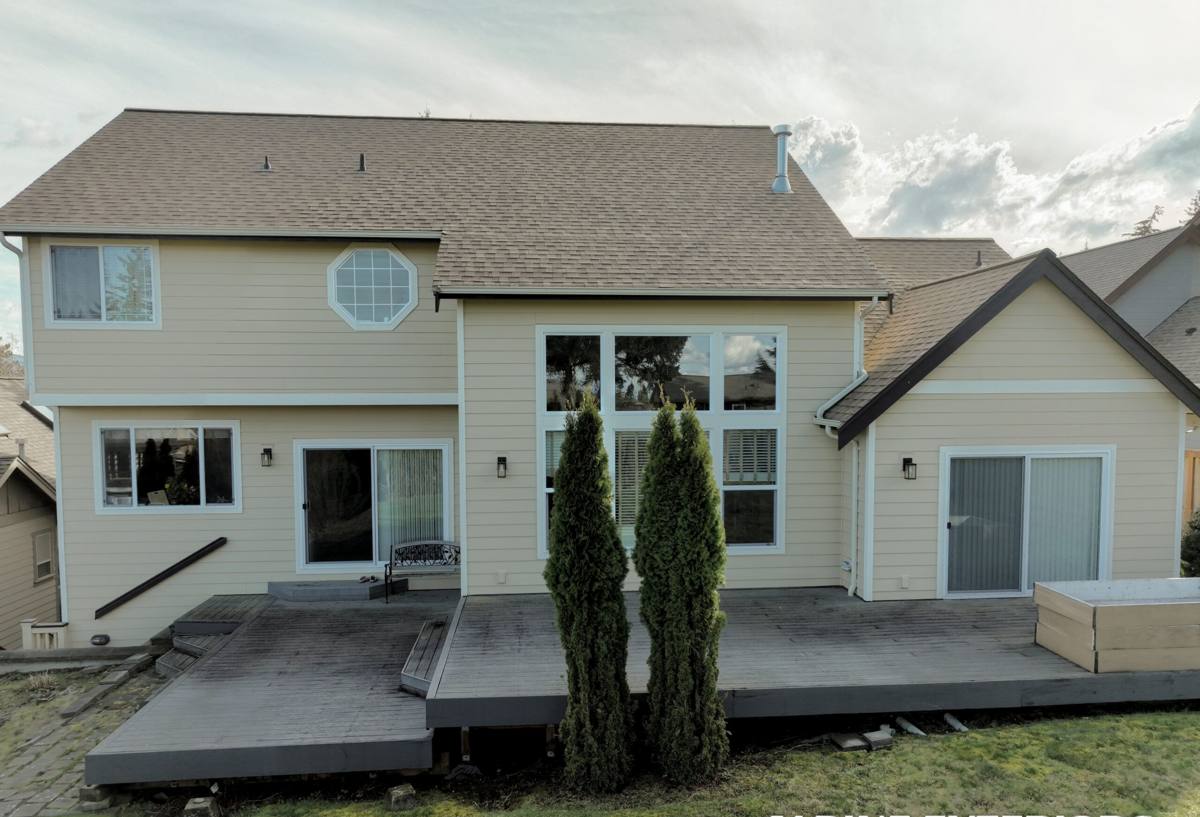
What "Custom" Actually Means Here
Custom-sized, not just custom-ordered
A lot of homes in this area, especially older ones, were not built to today's standard window openings. Settling, past remodels, and non-standard framing from decades ago mean an off-the-shelf replacement window often doesn't fit cleanly. Custom sizing means the window is built to the actual opening — not the closest available stock size with shims and extra caulk making up the difference. That difference matters most in a wet climate, because gaps and improvised fills are exactly where water finds its way in.
Matching the look of the house
Custom also covers grid patterns, sightlines, and trim profiles. On older Blaine-area homes, we try to match the original window's proportions and divided-lite pattern rather than defaulting to whatever the manufacturer ships standard. On additions or full remodels, custom sizing gives more freedom to change the window layout — larger openings, different configurations — without being boxed in by stock dimensions.
Signs Your Current Windows Are Working Against You
Most homeowners don't replace windows on a schedule — they replace them when something starts going wrong. In this climate, the warning signs tend to show up as a slow accumulation rather than one obvious failure. Worth checking for:
- Fogging or a permanent haze between panes — the seal on the insulated glass unit has failed and moisture is trapped inside
- Soft or discolored wood at the sill or the bottom corners of the frame, often the first place rot starts
- Visible moss or dark streaking building up on the sill or exterior trim faster than it can be cleaned off
- Drafts you can feel with a hand near the frame on a windy day, especially during winter storms off the water
- Windows that are difficult to open, close, or lock — swollen wood or warped vinyl frames are common culprits
- Visible daylight or gaps around the frame from outside, particularly at the corners
Any one of these on its own might just need a repair. Several of them together, especially on windows original to an older home, usually mean it's time to talk about replacement.
Frame Material Options for a Salt-Air, High-Moisture Area
There's no single "best" window material — the right choice depends on the house, the budget, and how much upkeep the homeowner wants to take on. Here's how the common options compare for a coastal Whatcom County property:
| Material | How it handles this climate | Maintenance | Typical trade-off |
|---|---|---|---|
| Vinyl | Doesn't rot or corrode; performs well against salt air and moisture | Low — occasional cleaning | Fewer color and profile options, can't be repainted |
| Fiberglass | Very stable in temperature swings and moisture; strong resistance to warping | Low | Higher upfront cost than vinyl |
| Aluminum-clad wood | Exterior clad face resists weather; interior keeps a wood look | Moderate — clad exterior is low-care, but any exposed wood or sealant joints need periodic checks | More installation-sensitive; failure points if sealant details aren't done right |
| Bare wood | Attractive, traditional look, but most vulnerable to the sustained damp and salt exposure in this area | High — regular painting/sealing | Shortest service life here without consistent upkeep |
We don't push one material on every job. For a lot of Blaine-area homes, vinyl or fiberglass makes sense simply because they hold up with the least intervention. For homes where the look of real wood on the interior matters — historic homes, for example — a well-detailed aluminum-clad wood window can work well, but it depends on getting the installation and sealant details right the first time, because repairs to a clad wood frame are more involved than repairs to vinyl or fiberglass.
How We Handle Water Management on Every Install
Flashing comes before the window
The window itself is only part of what keeps water out. How the opening is flashed and integrated with the house's weather-resistive barrier does most of the real work. We flash the sill pan first, lap the housewrap correctly over the flanges, and make sure water that does get behind the cladding has a path back out rather than into the wall framing. This is the step that gets rushed on quick jobs, and it's the step that determines whether a window leaks in year one or year fifteen.
Sealant is a detail, not a fix-all
Caulk and sealant have a role, but they're not a substitute for correct flashing, and we're deliberate about where we do and don't seal. Sealing every gap solid can actually trap moisture that gets in from elsewhere, with nowhere to escape. A correctly installed window uses sealant at the right joints and leaves drainage paths open where they're supposed to be open — that balance matters more in a wet climate than in a dry one.
Sill design and slope
We check that the sill sheds water away from the house rather than pooling against the frame, and that any trim or stool below the window doesn't create a shelf where standing water and moss can build up. It's a small detail that has an outsized effect on how much moss and staining shows up over the following winters.
Our Process, Start to Finish
- On-site assessment — we look at the existing openings, framing condition, and any signs of past water intrusion before quoting anything
- Measurement and ordering — openings are measured precisely so the windows are built to fit, not force-fit on install day
- Removal — old windows come out carefully, and we check the framing underneath for hidden rot or damage before anything new goes in
- Flashing and sill prep — this is done to spec every time, not shortcut to save an hour
- Installation and shimming — windows are set plumb, level, and square, then properly fastened per the manufacturer's requirements
- Insulation and sealing — gaps are filled with appropriate low-expansion foam or insulation, and sealant is applied at the correct joints only
- Interior and exterior trim — finished to match the house
- Walkthrough and cleanup — every window is opened, closed, and locked in front of the homeowner before we consider the job done
If hidden rot or framing damage turns up once the old window is out, we stop and talk to the homeowner before proceeding rather than covering it up and moving on. In this climate, hidden damage behind an old window is common enough that we plan for the possibility rather than treat it as a surprise.
What Affects the Cost
Every project is different, but the same handful of factors drive most of the cost variation on custom window jobs in this area:
| Factor | Why it matters |
|---|---|
| Frame material | Vinyl is typically the most budget-friendly; fiberglass and clad wood cost more upfront |
| Number and size of openings | Larger or non-standard openings take more time and material to fit correctly |
| Condition of existing framing | Rot or water damage found during removal adds repair work before the new window goes in |
| Glass package | Upgraded Low-E coatings, gas fills, or tempered glass (required in some locations) add cost |
| Trim and finish work | Matching existing interior trim or custom exterior trim profiles takes additional labor |
| Access and site conditions | Second-story or hard-to-reach windows take longer and may require additional equipment |
We'd rather walk a homeowner through these factors on-site and give a real number for their house than quote a generic per-window price that doesn't hold up once the actual job starts.
Living With Custom Windows in a Moss-Season Climate
A well-installed window still needs some basic upkeep to get its full service life in this climate. None of it is complicated, but skipping it lets moss, staining, and hardware wear build up faster than they should:
- Rinse sills and tracks a couple of times a year to clear out dirt and organic buildup before it turns into moss
- Keep gutters and downspouts clear so runoff isn't sheeting directly down over window heads
- Check weep holes on vinyl and fiberglass frames periodically to make sure they're not clogged with debris
- Lubricate locks and hinges annually, since salt air accelerates hardware wear
- Look at exterior sealant joints once a year and flag any cracking or separation early, before water gets behind it
- Repaint or reseal any exposed wood trim on the schedule the manufacturer recommends, not just when it looks bad
Why a Crew That Already Works the Blaine Area Matters
Window installation done well is mostly about details that don't show up in a sales brochure — flashing sequence, sealant placement, sill slope, how the window ties into the specific wall assembly of an older Whatcom County home versus a newer one. A crew that regularly works this stretch of coastline has already seen how these homes behave through a few winters of driving rain and salt air, and adjusts accordingly instead of treating every job like it's in a different climate. We're not interested in cutting corners that save an hour on install day and cost a homeowner a rot repair five years later. We'd rather do the flashing right the first time.
If you're weighing repair versus replacement, or just want a straight answer about what your current windows need, we're happy to take a look. Reach out for a free, no-pressure estimate using the form below — we'll walk the property, answer your questions, and give you a real number, not a sales pitch.