 Bellingham Exterior
 Board & Batten Siding for Sunnyland Homes
Sunnyland is one of Bellingham's older, more established residential neighborhoods — a mix of mid-century homes, later infill, and mature trees that shade a good share of the housing stock for most of the day. That combination shows up in a lot of the siding calls we get from the area. Homeowners like board and batten for the way it reads on these homes: the vertical lines suit both an older bungalow getting a refresh and a newer build going up on an infill lot. But board and batten is a joint pattern before it's a look, and every seam between a board and its batten is a place water can try to work its way behind the wall. In a neighborhood with as much shade and tree cover as Sunnyland, and a climate that gives siding salt air, wind-driven rain, and a moss season that runs most of the year, how those joints are built matters as much as which brand goes on the invoice.
We install James Hardie fiber cement board and batten exclusively, and on a shaded neighborhood like this one, we build the fastening pattern, batten clearance, and flashing details around what a low-sun, tree-covered wall actually goes through over a couple of decades — not around what looks fine walking away from the job.
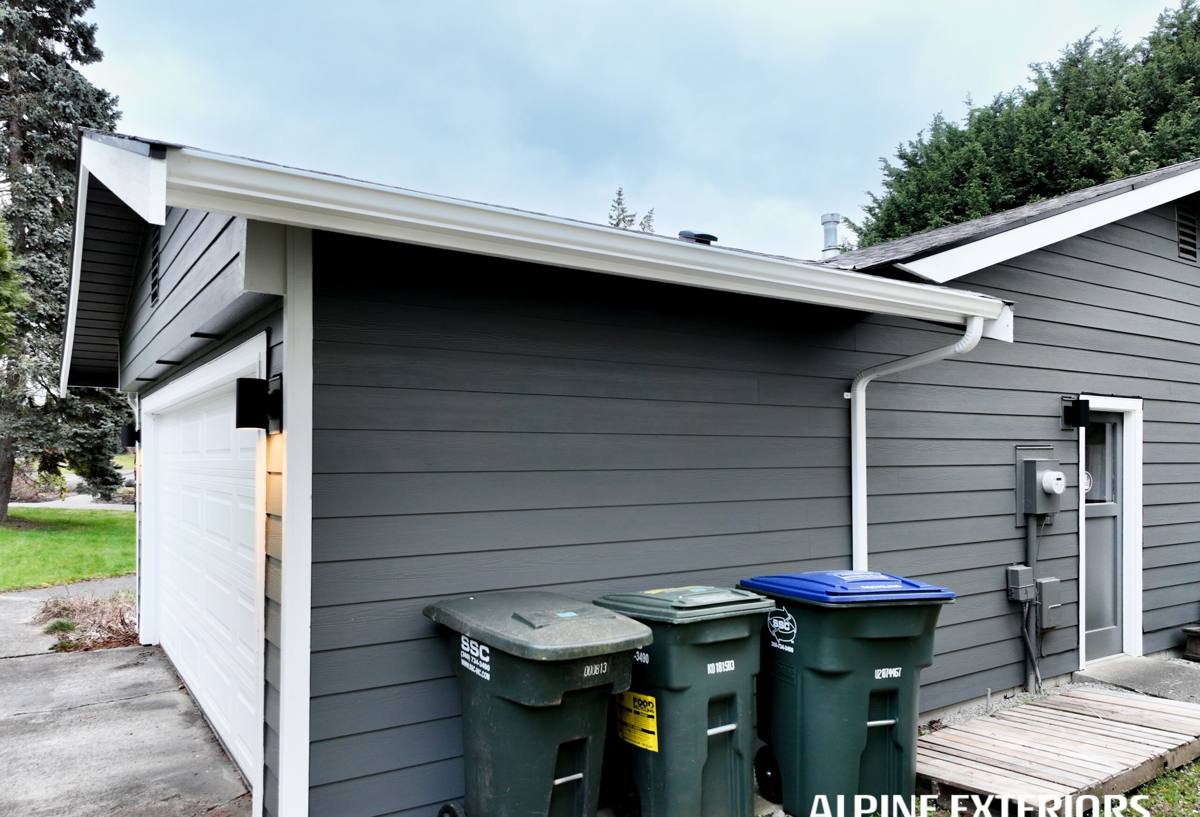
What Sunnyland's Setting Does to a Vertical Siding Wall
Tree Cover Stretches the Moss Season
A lot of Sunnyland's charm comes from its mature trees, but shade is exactly what moss and algae need to establish and hold on. Walls that stay damp longer because they rarely see direct sun — north-facing walls, walls tucked behind landscaping, walls under a tree canopy — go through a longer wet cycle than an open, sun-exposed wall across town. On board and batten, that matters more than on most profiles, because the batten seams are where trapped moisture shows up first as staining, then as substrate softening if it's ignored long enough.
Salt Air Reaches Inland Neighborhoods Too
Sunnyland isn't waterfront, but Whatcom County's marine air doesn't stop at the shoreline. Salt-laden air off Bellingham Bay moves across the whole area, and it's steadily corrosive to exposed metal. Board and batten uses more fasteners per square foot than standard lap siding because both the boards and the battens need to be secured, so fastener spec — corrosion resistance, correct size, correct spacing — carries real weight on this profile even a few miles inland.
Driving Rain and Close-Set Lots
When Bellingham's fall and winter storms push rain in sideways, narrower, tree-lined lots like a lot of Sunnyland's can funnel wind in ways that concentrate driving rain against certain walls and corners more than others. A batten that's caulked tight instead of properly lapped and back-vented becomes the path that wind-driven rain uses to get behind the siding rather than off of it.
Why the Batten Joint Is the Point That Fails First
Board and batten amplifies whatever weaknesses a siding material already has, simply because it has more seams and more exposed edge than a lap profile covering the same wall. That's part of why we don't offer LP SmartSide, vinyl, Cemplank, Allura, primed spruce, or cedar board and batten. Those are legitimate products, and other contractors install them competently — but on a profile with this many joints, in a neighborhood where shade keeps walls damp longer than average, we standardized on one fiber cement system we trust to hold up at the seam, not just on the flat.
| Material | Behavior at Batten Seams | Performance in Shaded, Damp Conditions | Realistic Lifespan |
|---|---|---|---|
| James Hardie fiber cement | Dimensionally stable; doesn't swell or cup at the joint | Factory finish resists moss and holds color under shade | 30+ years with proper install |
| LP SmartSide (engineered wood) | Cut edges and fastener holes are more moisture-sensitive | Shaded exposure adds upkeep at edge sealing | 15-25 years, climate-dependent |
| Vinyl | Seams less rigid; can gap or warp at battens | Doesn't rot, but traps moisture issues out of sight | 20-30 years, variable |
| Cedar | Absorbs moisture at every seam without regular sealing | Shade slows drying, shortens the sealing interval | 15-25 years with consistent upkeep |
Fiber cement's core doesn't expand and contract with moisture the way wood-based products do, which is the property that matters most on a wall built entirely out of vertical seams and shaded from the sun most of the day. The factory-applied ColorPlus finish also means field priming is limited to cut edges, not the whole board face — a real advantage on shaded walls where a field-applied finish has less sun exposure to help it cure and hold up.
What a Correct Install Requires on an Older Sunnyland Home
A fair number of Sunnyland homes are carrying original or previously replaced siding that's decades old, which changes what "correct installation" involves compared to new construction. Before board and batten goes up, the wall underneath needs an honest look, not an assumption:
Checking What's Behind the Existing Siding
Older sheathing can be uneven, and any wood-based layer underneath may have taken on moisture over the years, especially on the shadier sides of the house. Board and batten installed over a wall with hidden rot or inadequate drainage just buries the same problem under new material — it doesn't fix it.
Rainscreen and Drainage Gap
A drainage gap behind the siding lets any moisture that gets past the surface dry out instead of sitting against the wall. On a shaded lot where walls already take longer to dry naturally, this detail does more work than it would on a sun-exposed wall.
Batten Clearance, Not Caulk
Battens need the clearance Hardie's installation spec calls for so the wall can shed water, rather than being caulked tight against the board, which traps it instead.
Flashing at Windows and Trim
Older homes often have window and door trim that wasn't detailed to current flashing standards. Re-siding is the point where that gets corrected — flashed and lapped properly so water sheds away from the opening instead of running behind the new siding.
Our Process for a Sunnyland Board & Batten Project
- Walkthrough and assessment — we look at each wall's orientation, shade exposure, and the condition of what's underneath the existing siding before we plan anything.
- Planning the details before install day — batten spacing, corner treatment, and how the siding meets windows, trim, and rooflines get worked out on paper first, not improvised in the field.
- Tear-off and prep — old siding comes off, the wall assembly gets checked and repaired where needed, and the weather-resistive barrier goes on correctly lapped before any new material touches the wall.
- Installation to manufacturer spec — fastener pattern, batten clearance, and flashing follow James Hardie's published requirements for this climate zone, which is also what keeps the manufacturer's warranty intact.
- Final walkthrough — we walk the finished job with you and cover what little maintenance board and batten actually needs, so you know what a healthy wall looks like going forward.
Checklist: Before You Sign a Board & Batten Contract
- Ask specifically how the contractor handles drainage gaps and batten clearance — vague answers are a warning sign on this profile
- Confirm what happens if rot or moisture damage is found once the old siding comes off
- Ask how window and door trim will be flashed, not just how the siding will look around them
- Get the fastener spec in writing, not just "corrosion-resistant" as a general claim
- Ask whether the crew has installed board and batten specifically, not just lap siding, in shaded or wooded settings
- Confirm the installer's familiarity with James Hardie's published spec for this climate zone, since a generic national install standard isn't the same thing
Maintenance: What to Expect After Installation
A correctly installed James Hardie board and batten wall doesn't ask for much. There's no recurring sealing or repainting cycle the way there is with cedar, and the factory finish is built to hold color without the touch-ups a field-painted wall needs. What we do recommend, especially on a shaded Sunnyland lot, is an occasional rinse-down of walls that stay damp longest and a periodic look at trim and flashing lines after major storms — not because the material is fragile, but because catching a clogged gutter or a piece of storm debris against the wall early is easier than dealing with what it causes later.
Why Hire a Crew That Already Works Sunnyland
Board and batten rewards experience with a specific setting more than most siding profiles do, because its failure points are subtle and slow to show up. A crew that's installed this profile on Sunnyland's shaded, tree-lined streets has already seen which walls need extra drainage attention because of the canopy overhead, what an older sheathing layer in this neighborhood is likely to look like once the old siding comes off, and where the standard install spec needs adjusting for a lot that almost never sees direct afternoon sun. That judgment doesn't show up on a spec sheet — it's the difference between a wall that still looks and performs the same in fifteen years and one that's showing seam staining by year five.
If you're weighing board and batten for a home in Sunnyland, we're glad to walk the property, talk through what your specific walls need given their shade and exposure, and give you a straightforward, no-pressure estimate. There's a form below — reach out and we'll set up a time to take a look.