 Bellingham Exterior
 Why Ferndale Decks Take a Different Kind of Beating
Ferndale sits close enough to the water that homes here deal with a steady dose of salt-laced marine air on top of everything else Whatcom County weather throws at a deck. That combination matters more than most homeowners realize until they're standing on a deck that's cupping, graying unevenly, or growing a slick layer of moss they can't keep ahead of. Salt air accelerates corrosion on fasteners and hardware. Driving rain off the Strait finds every gap in a poorly built substructure. And our long, wet moss season turns any horizontal surface that doesn't drain and dry quickly into a green, slippery liability by late winter.
None of this means a deck in Ferndale is doomed — it means the materials and the build have to be chosen and installed with this specific climate in mind, not a generic set of national building assumptions.
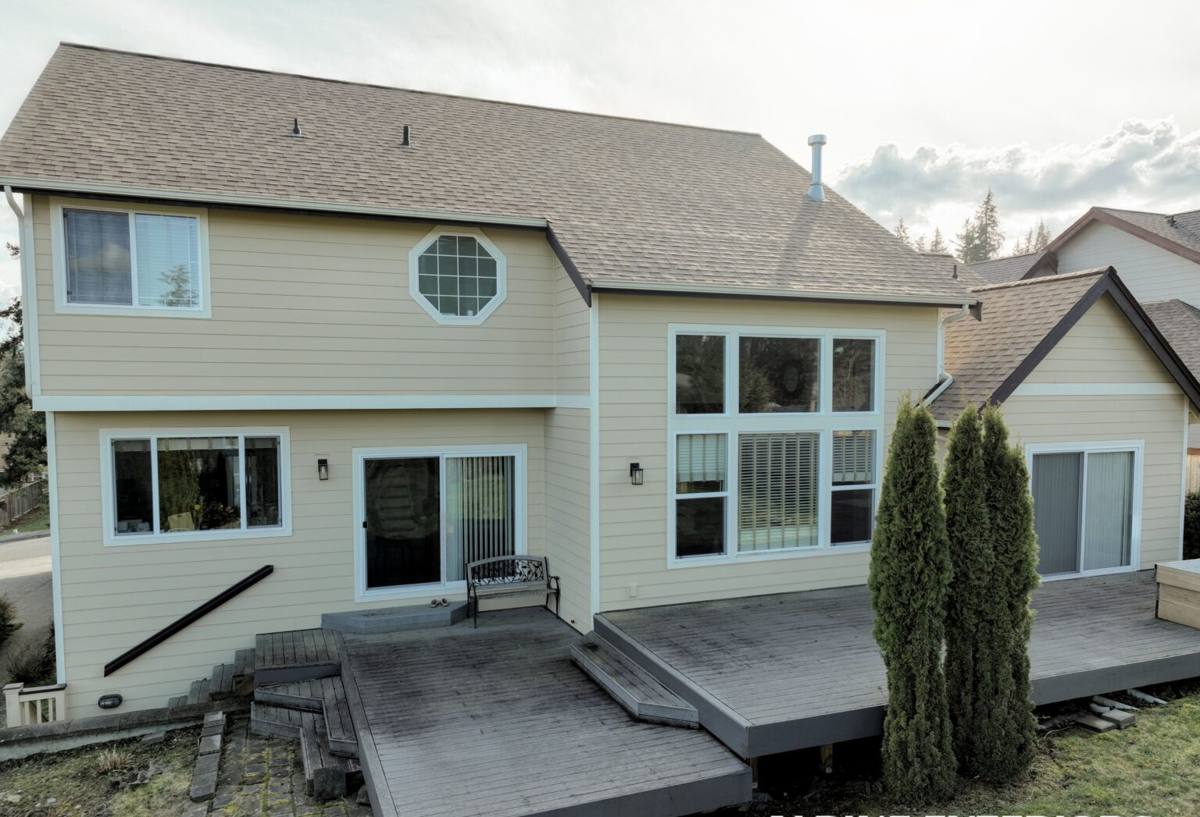
What Composite Decking Actually Solves — and What It Doesn't
Composite decking is a blend of wood fiber and polymer, usually wrapped in a protective cap layer. Done right, it eliminates the two biggest headaches wood decking has in this climate: it doesn't need annual staining or sealing, and it resists the rot and splintering that damp, shaded Pacific Northwest decks are prone to. For a lot of Ferndale homeowners, that's the whole appeal — a deck that still looks decent in year eight without a weekend spent on their knees with a sander and a can of stain.
What composite decking doesn't do is make the substructure or the installation irrelevant. Composite boards still expand and contract with temperature and moisture. They still need airflow underneath to shed the moisture our climate throws at them. And they still trap moss and organic debris in the grooves and gaps just like any other decking material if the gaps aren't sized and maintained correctly. A composite deck installed poorly will still fail — it'll just fail differently than a wood one does.
Capped vs. Uncapped Boards
Most composite decking sold today is "capped" — a polymer shell surrounds the wood-plastic core on some or all sides. Fully capped boards handle our wet season noticeably better than partially capped or uncapped composite, which can wick moisture at cut ends and exposed edges. In a climate as consistently damp as ours, we treat cap coverage as a real factor in board selection, not a marketing detail.
What a Correct Installation Involves
Substructure and Drainage
The framing underneath a composite deck matters as much as the boards on top. Joist spacing has to match the manufacturer's specification for the board profile being used — composite boards need tighter joist spacing than solid wood in most cases, especially on diagonal or picture-frame layouts. We also grade and ventilate the space under the deck so water has somewhere to go instead of sitting against the framing, which is where rot starts even under a "waterproof" deck surface.
Fastening and Board Spacing
Composite boards need consistent gapping between boards to allow for expansion and to let water and debris drain through rather than pool. Too tight, and boards can buckle or cup during a warm stretch; too wide, and you get a trap for moss, needles, and grit that never fully dries out. We use hidden fastener systems designed for the specific board profile rather than generic deck screws, which reduces surface penetration points where moisture and salt-air corrosion can start.
Ledger Flashing Where the Deck Meets the House
Any deck attached to the house needs proper flashing at the ledger board — this is one of the most common failure points we find on older decks in this area, composite or wood. Water gets behind an unflashed or poorly flashed ledger and rots the rim joist or sheathing from the inside, long before anything looks wrong on the surface.
Our Process, Start to Finish
We keep the process straightforward because most of the work that determines how a deck holds up happens before a single board goes down.
- On-site assessment of the existing structure (or the build site, for new decks), including any ledger, footing, or drainage issues.
- A layout and material plan based on how the space is actually used, not just square footage.
- Removal of the old deck surface if we're rebuilding on an existing footprint, with an honest look at what's underneath before we cover it back up.
- Framing and, where needed, footing or post repair, built to current code for this jurisdiction.
- Composite decking installation with manufacturer-specified fastening and spacing.
- Railing, stairs, and trim work to close it out.
- A final walkthrough so you know what maintenance, if any, the deck actually needs going forward.
Composite vs. Wood vs. PVC — What Fits a Ferndale Deck
There's no single "best" decking material for every home — it depends on budget, how much upkeep you want to do, and how the deck sits relative to sun, shade, and drainage. Here's how the three most common options stack up for a climate like ours.
| Factor | Wood | Composite | PVC |
|---|---|---|---|
| Upfront cost | Lowest | Mid-range | Highest |
| Annual maintenance | Staining/sealing needed | Periodic washing only | Periodic washing only |
| Moisture resistance | Depends on species & sealing | Good with capped boards | Excellent |
| Moss/algae resistance | Poor without upkeep | Moderate — still needs cleaning | Moderate — still needs cleaning |
| Typical lifespan | 10–20 years with upkeep | 25–30+ years | 25–30+ years |
| Look/feel | Natural wood grain | Wood-like, more color options | Uniform, less wood-like |
For most Ferndale homeowners weighing upfront cost against long-term upkeep in a wet, moss-prone climate, composite lands in the middle — a meaningful step up from wood maintenance without the higher price and more synthetic feel of full PVC.
Maintenance Composite Decking Still Needs Here
"Low-maintenance" doesn't mean "no maintenance," especially in a climate that grows moss on north-facing roofs, fences, and decks for a good chunk of the year. A composite deck in Ferndale still needs:
- Periodic washing to clear pollen, moss spores, and organic buildup before they take hold in board grooves
- Clearing leaves and debris out from between boards and off ledger flashing before the wet season sets in
- Keeping gutters and downspouts near the deck functioning so runoff isn't dumping directly onto or under it
- An occasional check of railing hardware and fasteners for corrosion, especially closer to open water
- Trimming back vegetation that shades the deck and keeps it from drying out between rain events
Skip this and even a well-installed composite deck will develop the same slick moss film that plagues wood decks — it just takes longer to get there.
Mistakes We See on Older and DIY Decks Around Whatcom County
A lot of the repair calls we get aren't from bad decking material — they're from installation shortcuts that don't show up until years later. The most common: joist spacing sized for wood instead of the composite board actually installed, which leads to sagging and board deflection. Missing or minimal ledger flashing, which lets water into the house framing behind the deck. Standard deck screws instead of a fastening system rated for the board profile, leaving visible fastener heads that corrode faster in salt air. And tight or uneven board spacing that turns into a moss trap within a season or two. Each of these is fixable, but it's cheaper to build it right the first time than to open up a deck and correct it later.
Why a Crew That Already Works Ferndale Matters
Building codes, setback rules, and permitting requirements vary by jurisdiction, and Whatcom County's requirements aren't identical to Bellingham's or a neighboring county's. A crew that already works this area knows what the local permitting process actually requires before the project starts, not after an inspection gets flagged. Just as important, we've seen how homes in this specific area — close to the water, exposed to marine air, and dealing with our particular rain-and-moss cycle — actually hold up over time, not just how a spec sheet says a product should perform. That local track record shapes real decisions: which fastening systems we trust here, how much drainage slope we build in, and where we add extra flashing attention because we've seen what happens when it's skipped.
Planning a Composite Deck in Ferndale — What to Check Before You Sign a Contract
- Does the quote specify joist spacing, or just "standard framing"?
- Is ledger flashing explicitly included in the scope of work?
- What fastening system is being used, and is it rated for the specific board profile?
- Are cap coverage and board warranty terms spelled out, not just "composite decking"?
- Is drainage and under-deck ventilation addressed, or is the deck just being laid over the existing grade?
- Does the contractor pull the required local permit, or leave that on you?
A contractor who can answer these clearly before you sign is a good sign they've thought through the climate this deck actually has to survive — not just the sale.
If you're planning a new composite deck or replacing a tired wood one in Ferndale, we're glad to take a look and give you a straightforward, no-pressure estimate — use the form below to get started.