 Bellingham Exterior
 Edgemoor's Setting Is Tough on an Ordinary Roof
Edgemoor sits close to Bellingham Bay, tucked under mature evergreen canopy on wooded, bluff-adjacent lots. That setting is a big part of what makes the neighborhood desirable, and it's also exactly what wears out a roof faster than average. Salt-laden air drifts in off the water and slowly attacks exposed metal fasteners, flashing, and any coating that isn't built for a marine environment. Heavy tree cover means shade, needle drop, and moisture that lingers on the roof deck long after a storm has passed. And Whatcom County's wet season isn't just rain — it's weeks of low-intensity, driving rain that finds every weak seam, nail pop, and undersized flashing detail an ordinary roof has.
Put those three things together — salt air, driving rain, and a long moss season — and you get a roofing environment that's genuinely harder on a home than most inland Bellingham neighborhoods. Asphalt shingles in particular struggle here: moss gets a foothold in the granule surface, roots into the mat, and lifts shingle edges just enough for wind-driven rain to work underneath. We see this pattern often enough in Edgemoor that it shapes how we recommend roofing for the area.
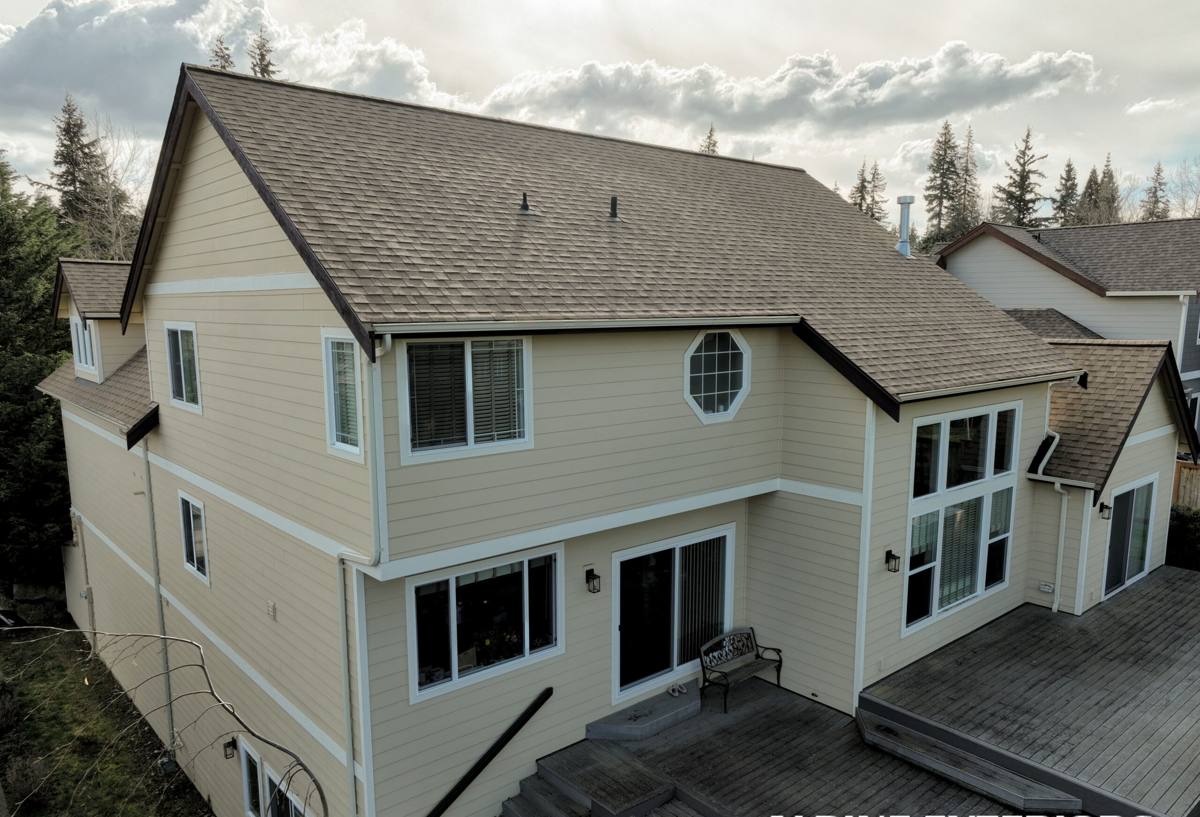
Why More Edgemoor Homeowners Are Choosing Metal
Metal roofing isn't the right fit for every home or every budget, but for the conditions Edgemoor deals with, it solves several problems at once. It sheds water fast instead of absorbing it, so there's less standing moisture for moss and algae to colonize. It has no organic mat for moss roots to grip, which means moss that does land on the roof stays on the surface and rinses off far more easily than it does on shingles. And a properly installed, correctly coated metal system is built to handle decades of coastal exposure without the granule loss, curling, and cracking that shortens the life of asphalt near the water.
There's also a practical maintenance argument. Homeowners in this neighborhood tend to have tall, shaded roofs that aren't easy or safe to get on every year for moss treatment and gutter clearing. A metal roof reduces how often that maintenance is truly necessary, without eliminating it — we're honest with clients that no roof under a full tree canopy is maintenance-free.
Panel Types and Finishes: What Actually Works Here
Standing Seam
Standing seam panels use raised, interlocking seams with fasteners hidden underneath, rather than exposed through the panel face. For a coastal, tree-covered property like most of Edgemoor, this matters: every exposed fastener is a future point of corrosion and a potential leak path once the sealant washer ages. Standing seam removes most of those exposed penetrations from the field of the roof, which is a meaningful advantage in a salt-air environment.
Exposed-Fastener Panels
Exposed-fastener (screw-down) panels cost less up front and are a reasonable option on secondary structures like detached garages or sheds. On a primary residence this close to the bay, though, we're straightforward with clients about the trade-off: the exposed screws and washers need periodic inspection and eventual replacement, and that's an added maintenance line item that standing seam avoids.
| Factor | Standing Seam | Exposed-Fastener |
|---|---|---|
| Fasteners | Concealed clips | Exposed screws through panel |
| Coastal durability | Higher — fewer failure points | Moderate — washers age and need service |
| Upfront cost | Higher | Lower |
| Best use | Primary residence, main roof | Outbuildings, secondary roofs |
What a Correct Metal Roof Installation Includes
Underlayment and Ice Protection
Metal panels are only as good as what's underneath them. We install a high-temperature, self-adhering underlayment at eaves, valleys, and any low-slope transitions, with synthetic underlayment across the field. This matters more in a shaded, moisture-heavy neighborhood like Edgemoor, where the roof deck stays damp longer between rain events.
Flashing and Penetrations
Every chimney, skylight, vent pipe, and wall transition is a potential leak point, and it's usually where a rushed metal roofing job fails first. We custom-fabricate and hand-fit flashing at these details rather than relying on generic trim, because driving, wind-blown rain off the bay finds gaps that would never leak in a calmer inland setting.
Fastening and Wind Considerations
Bluff-adjacent lots and open exposures toward the water can see stronger, more sustained wind than sheltered inland properties. Panel fastening schedules and clip spacing get adjusted for that exposure, not just pulled from a generic spec sheet.
Salt Air, Rain, and Moss: Long-Term Care
Coastal Corrosion Protection
Not every metal roofing product is built for salt exposure. We steer clients toward coatings and metal types with proven coastal performance and avoid combinations of dissimilar metals that can cause galvanic corrosion where flashing, fasteners, and panels meet. This is a professional standard we hold to, not a knock on any single manufacturer — some finish systems simply aren't rated for marine environments, and using them near the bay sets a homeowner up for early coating failure.
Moss Under Tree Cover
Even a metal roof under heavy Douglas fir and cedar canopy will collect needle litter and see moss attempt to establish in valleys, around penetrations, and anywhere debris sits long enough to hold moisture. The fix isn't aggressive pressure washing, which can damage finishes and void warranties — it's periodic gentle rinsing, keeping valleys and gutters clear, and trimming back branches that overhang the roofline where practical.
Our Process, Start to Finish
- On-site assessment — we walk the roof and attic, check deck condition, ventilation, and existing flashing, and look at how the specific lot's tree cover and exposure will affect the system.
- System recommendation — panel type, gauge, and finish selected for the home's exposure and budget, explained in plain terms with honest trade-offs.
- Written estimate — clear scope, materials, and pricing before any work is scheduled.
- Tear-off and deck prep — old roofing removed, deck inspected and repaired as needed, underlayment installed.
- Panel installation and flashing — panels set, seams and flashing detailed by hand at every penetration and transition.
- Final walkthrough — site cleanup, magnetic sweep for debris, and a walkthrough of the finished roof with the homeowner.
Why Local Experience in Edgemoor Matters
A crew that regularly works Edgemoor already understands the practical realities of the neighborhood: narrow or sloped driveways that limit staging and material delivery, mature trees that require careful rigging and protection during tear-off, and City of Bellingham permitting requirements that apply to reroofing projects. That familiarity shows up in fewer surprises during the job — knowing in advance how to stage equipment on a tight, wooded lot, or how to protect landscaping near the bluff edge, isn't something a crew figures out for the first time on your roof.
It also shows up after the job is done. A contractor who's installed multiple roofs in the same few square miles has a track record they can stand behind locally, and a reason to make sure the work holds up — because word travels fast in a tight-knit neighborhood like this one.
Cost Factors to Expect
Metal roofing costs more upfront than asphalt shingles, but the gap narrows when you account for lifespan and reduced maintenance. Exact numbers depend on roof size, pitch, complexity, and access, but the general factors that move the price are consistent from job to job.
| Factor | Effect on Cost |
|---|---|
| Panel type (standing seam vs. exposed-fastener) | Standing seam typically costs more per square |
| Roof pitch and complexity | Steep or heavily cut-up roofs take more labor and material |
| Tree and access constraints | Limited staging or rigging around mature trees adds time |
| Deck condition | Rot or damage found at tear-off requires repair before install |
| Coating and gauge | Heavier gauge and marine-grade finishes cost more but last longer near the bay |
Checklist: Is Your Roof Ready for a Metal Upgrade?
- Shingles curling, cracking, or losing granules, especially on the shaded side of the roof
- Moss visibly established in the shingle mat, not just sitting on the surface
- Rusting or corroding flashing, vents, or fasteners
- Frequent moss treatment or roof cleaning that's stopped keeping up with regrowth
- Visible sagging, staining, or moisture in the attic below the roof deck
- A roof original to a home built more than 20-25 years ago in this climate
If any of that sounds familiar, or you're simply planning ahead for a home near the bay, we're glad to take a look. Fill out the form below for a free, no-pressure estimate — we'll walk the roof, answer your questions honestly, and give you a clear picture of what a correctly built metal roof would take for your specific property.