 Bellingham Exterior
 A Local Page for One Specific Job: New-Construction Windows in Sudden Valley
Sudden Valley sits along Lake Whatcom in a heavily wooded, lake-influenced pocket of Whatcom County, and it's still an active building area — new homes going up on undeveloped lots, older cabins being replaced with full-time residences, additions and rebuilds on lake-view lots. All of that means one thing for windows: a lot of them are going in during framing, not being swapped into an existing wall years later. That's a different job with different stakes, and it's the one this page is about.
"New-construction" windows are installed with a nailing fin (or flush-fin) flange that gets integrated into the wall's weather-resistive barrier (WRB) before siding and trim go on. "Replacement" windows go into an opening that already has finished siding around it, using a different flange or a pocket-fit approach. The materials, the sequencing, the flashing detail, even the warranty terms can differ between the two. If you're building or rebuilding in Sudden Valley, you want a crew that treats this as its own trade skill — not a generic "window guy" who mostly does retrofits.
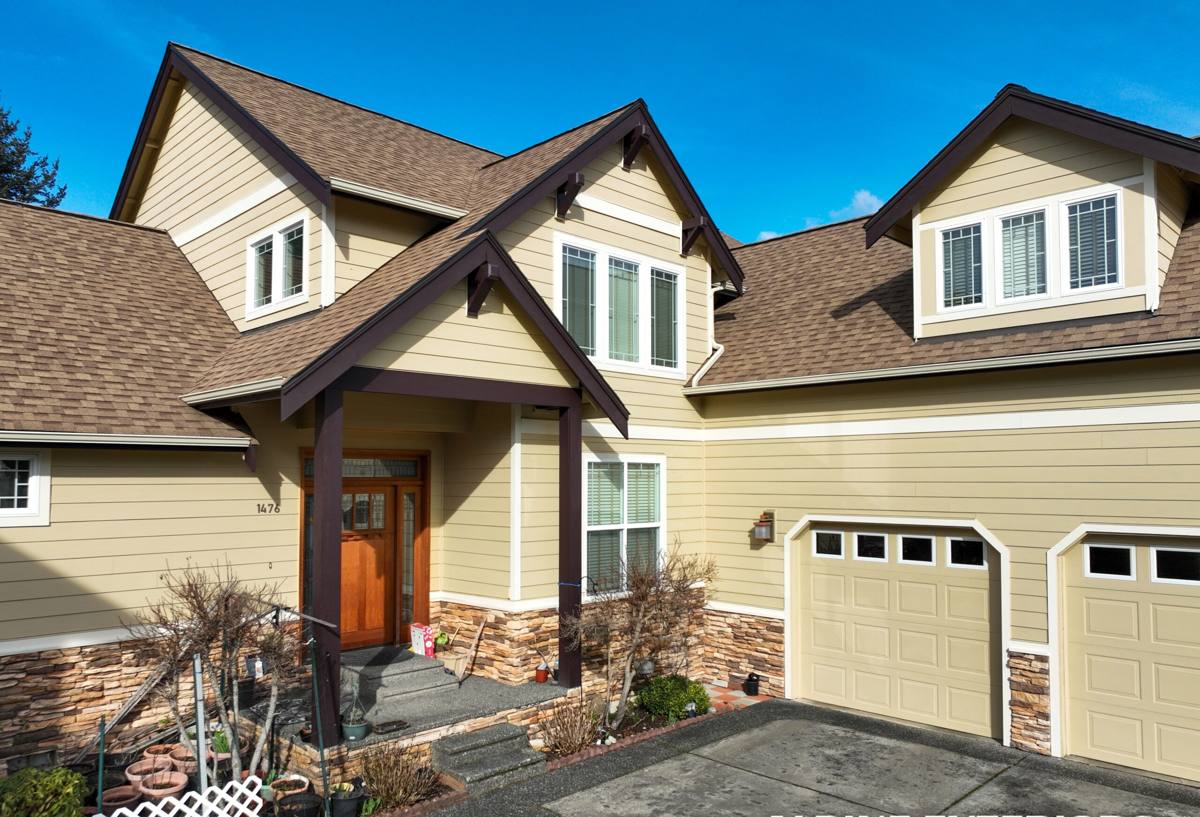
The Climate Sudden Valley Windows Actually Have to Survive
Bellingham and the rest of Whatcom County sit in a marine-influenced climate, and Sudden Valley's setting on Lake Whatcom adds its own wrinkle on top of that. The same weather systems that carry salt-laden air off Bellingham Bay and the Salish Sea also drive the rain and humidity that settle over the lake basin — and tree canopy around many Sudden Valley lots holds that moisture close to the house far longer than it would in an open subdivision.
A Long Moss Season
Shaded, north-facing walls and anything under a tree canopy stay damp for months at a time. Moss and algae don't just grow on roofs — they'll colonize window sills, trim, and any flashing detail that holds standing water instead of shedding it. A window installed with a flat sill or no back-dam will collect that moisture right at the one seam you can't afford to have fail.
Driving Rain, Not Just Rain
Wind off the lake pushes rain sideways into walls, especially on exposed or elevated lots. That means water pressure at the window opening isn't just falling from above — it's being driven horizontally and even upward under certain conditions, which is exactly the scenario proper flashing sequencing is designed to defeat and a lazy install is not.
Corrosion From Airborne Salts
Even away from open water, the marine air pattern that moves through this part of Whatcom County carries fine salt content that accelerates corrosion on exposed fasteners, hinges, and lesser-grade hardware over the life of a building. It's a slow effect, but it's cumulative, and it's one more reason hardware quality matters as much as glass quality.
What a Correct New-Construction Install Actually Involves
None of this is exotic. It's a sequence, and the sequence has to happen in order, every time, or the window becomes the weak point in an otherwise solid wall.
- Verify the rough opening against the actual window schedule — not the plan set, the window that showed up on the truck.
- Install a sloped sill pan with a back-dam, so any water that gets past the glass or frame drains outward instead of pooling.
- Set the window level, plumb, and square, then shim and fasten per the manufacturer's specified pattern — skipping fasteners to save time can void the manufacturer's warranty outright.
- Integrate the nailing fin with the WRB in proper shingle-lap order: sill first, then jambs, then head, so every layer sheds water onto the layer below it.
- Apply self-adhering flashing tape and, where called for, a fluid-applied flashing at corners and transitions.
- Seal and backer-rod both the exterior trim joint and the interior air-seal joint — these are two separate details with two separate jobs, not one bead of caulk doing double duty.
Sequencing With the Rest of the Shell
A window doesn't get installed in isolation. It has to be coordinated with the framer, the WRB installer, and whoever's doing siding and trim, because each of those trades laps their material over or under the window flange in a specific order. Get that lap order backward — a common mistake when different subs handle different parts of the shell without much coordination — and you've built a path for water to get behind the siding, where it won't show up as a problem until years later.
Choosing a Window Material for a Sudden Valley Build
Material choice affects moisture performance, maintenance, and long-term cost — all of which matter more here than in a drier inland climate.
| Material | Moisture/Rot Resistance | Maintenance | Typical Cost Tier |
|---|---|---|---|
| Vinyl | Very good — won't rot, but can distort under intense sun/heat cycling | Low | Entry to mid |
| Fiberglass | Excellent — dimensionally stable, handles wet/dry and hot/cold swings well | Low | Mid to upper-mid |
| Aluminum-clad wood | Good exterior protection, but any breach at a joint or fastener exposes wood beneath | Moderate | Upper-mid to high |
| Vinyl-clad wood | Similar profile to aluminum-clad — cladding does the protecting, interior wood needs the cladding to stay intact | Moderate | Mid to upper-mid |
We install all of these depending on the design and budget of the build, but we're honest about the trade-off with clad-wood products in a climate like this: the cladding has to be detailed perfectly at every joint and fastener penetration, because once moisture gets past the cladding into the wood substrate, it's much harder to catch early. That's not a knock on the product — it's a reason installation quality matters more with it, not less.
Performance Numbers Worth Asking About
Beyond material, the glass package and frame performance determine how the window actually behaves in this climate — energy loss, condensation, and comfort near the glass on a cold, wet night.
| Spec | What It Tells You | Why It Matters Here |
|---|---|---|
| U-factor | How much heat escapes through the window — lower is better | Keeps heating costs down through a long, damp Whatcom County winter |
| SHGC (Solar Heat Gain Coefficient) | How much solar heat passes through the glass | Matters more on south/west-facing lake-view glass than on shaded, tree-covered elevations |
| Condensation Resistance | How well the window resists interior condensation in cold, humid conditions | Chronic condensation on interior glass and sills is one of the most common moss/mold complaints we see in wooded, shaded lots |
| Gas Fill & Low-E Coating | Argon or krypton fill plus a low-emissivity coating on the glass | Standard on any window meeting current Washington State Energy Code glazing requirements |
Washington's energy code sets minimum performance targets for glazing, and your window schedule needs to hit those numbers on paper before the county will sign off — so this isn't just a comfort question, it's a permitting one.
Our Process on a Sudden Valley New Build
We walk every rough opening against the window schedule before a single unit gets set — measurements drift between the plan set and actual framing more often than people expect, and it's far cheaper to catch that before the window shows up than after. From there, we install sill pans, set and fasten each window to spec, integrate flashing with whatever WRB the builder is using, and seal both exterior and interior joints separately. Before siding closes any of it in, we do a walkthrough with the builder — and, where required, the inspector — because once the wall is closed up, a flashing mistake becomes a multi-year problem instead of a five-minute fix.
Permits, Code, and the Sudden Valley HOA
New construction in this area goes through Whatcom County's building permit process, with energy code documentation that has to show your glazing meets the required performance path. On top of that, many homes in Sudden Valley fall under an HOA with architectural review, which can weigh in on exterior details like grid patterns, frame color, and glass tint. Our advice: confirm those specs with your HOA or architectural committee before you place a window order, not after. Changing an ordered, custom-sized window because a color or grid pattern got rejected late is one of the more avoidable — and expensive — delays we see on builds out here.
Mistakes We See on New Builds Around the Lake
- No sill pan, or a flat sill pan with no back-dam to stop water from draining back toward the house
- Flashing tape and WRB layered in the wrong order, so a lap point channels water inward instead of out
- Spray foam used as the only air/water seal around the frame, with no backer rod and sealant joint doing the actual weather-sealing work
- Fasteners skipped or spaced wrong, which can void the manufacturer's warranty even if the window looks fine on install day
- Windows ordered off the plan set before the rough opening is actually framed, leading to field modifications that compromise the flange integration
- Poor handoff between the window sub and the siding sub, leaving gaps or reversed laps that only show up as a leak years later
Why Local New-Construction Experience Matters Here
Sudden Valley isn't a typical flat, open subdivision. Lots are often wooded, sloped, and lake-adjacent, with tree cover that keeps things damp longer and access that can be tighter than a standard cul-de-sac lot. A crew that's done new-construction window work in this specific setting already knows to plan for that shade and moisture, already has a working relationship with builders and framers active in the area, and already understands how the local HOA review process fits into the build timeline. That local familiarity translates into fewer surprises mid-build and a window installation that's still doing its job correctly a decade or two from now, long after the drywall and siding have covered it up.
If you're building, rebuilding, or adding on in Sudden Valley and want windows installed the right way the first time, we're glad to walk your plans and rough openings with you. Use the form below to request a free, no-pressure estimate.